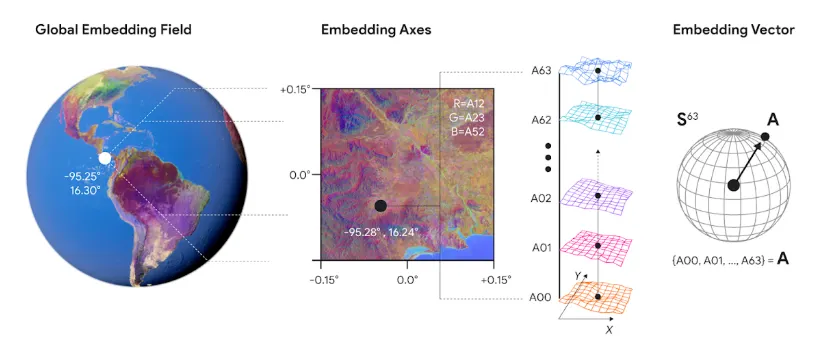
I’ve been thinking how to make a full-picture representation of these tiles by keeping the spatial details of pixels when conducting similarity search instead of having to average out the pixels… but maybe averaging is already good enough for the purpose of ‘representing this neighborhood for me’
Satellite embeddings are lowering the barrier to building with Earth observation data. Discover how to build scalable, native vector search applications using Google DeepMind's AlphaEarth Foundations, Google Earth Engine, and BigQuery.
Learn from our expert partners at Spatial Informatics Group and Earth Resources Technology, Inc as they walk you through seamless Extract, Load, Transform (ELT) workflows to bring powerful geospatial insights to any app. 🚀
Read the full guide here: https://t.co/z13gtwzVlF
@BiplovBhandari@sig_gis
Built a corn intelligence system and am releasing it publicly before moving to my next research phase.
What it is:
(1) County level vegetation indices, weather data, soil data, and drought data for monitoring corn growth conditions, updated every 8 days since 2001. All are proven impactors to corn yield. Plus county level yield forecasts for the top 12 US Corn Belt states. Uses peer reviewed machine learning methods. County level MAE: 12 bu/acre. Validated over the last 11 years.
Dashboard: https://t.co/lujRcU9DLG
Use case: time evolution of county-level corn yield forecast of 2024 https://t.co/szUi1GY8NG
(2) National corn yield forecasts since 2015. Consistently closer to final yield numbers than USDA's own July and August forecasts. Validated over the last 11 years.
Dashboard: https://t.co/14xYMgCl7x
Both are live now. 2026 forecasts begin in early May.
Why this exists:
Commodity traders have proprietary satellite forecast models. Farmers and regional co-ops have more limited access to this type of intelligence. This information asymmetry is expensive. I'm publishing these forecasts as a public good to narrow that gap.
Also: academic yield forecasting methods get published in journals and are rarely tested in operational settings. This is that test. Real data, real season, updated in real time.
How to use it:
Treat these as a second signal alongside USDA and other sources. Don't use forecasts in isolation. The county level monitoring data (vegetation indices, soil moisture, weather anomalies) is there to support you. Use it to understand what's driving the numbers.
What I need from you:
If you find this useful, tell me how to make it more useful. GitHub issues and discussions are open: https://t.co/iB4a5AJs9A
About me: https://t.co/NPtbT9Cecn
#AgTech #Agriculture #MachineLearning #RemoteSensing #OpenData #GeoSpatial #CornBelt #CommodityTrading #OpenScience #DataScience
This is Google being Google. Not vaporware, real infrastructure that saves lives.
This pairs beautifully with Akinboyewa et al. (2024) who used large multimodal model to estimate floodwater depth from on-site photos: https://t.co/xa6kePZnQ1.
Humanity poured hundreds of billions into foundation models, and now those models are auto-filling ground truth gaps that sensors rarely reached.
Flash flood prediction models need historical data and model training that often doesn't exist. Our solution: Groundsource, a new AI-powered methodology that uses Gemini to transform 5M+ global reports into a precise dataset of 2.6M+ flood events.
This provides a massive, open-source benchmark, scaling impact — especially in regions like Africa and Southeast Asia that lacked data. The same technique could be applied to other natural disasters.
Read the technical breakdown on the Research Blog: https://t.co/G6LPEN2sCh
I have a theory that AI chat is teaching us all the same vocabulary. Everyone online now says:
“Actionable insights” (how actionable?)
“Domain expertise” (is there actually an expert here?)
“Vertical” (just say industry)
“Game changer” (do you even know how the old game was played?)
Apologies for the sarcasm but these words create a weird hollowness. Now when I browse a startup website and see “actionable insights,” I feel intellectually insulted. Buzzwords, and especially the buzzwords that are AI centralized, makes everything feel less genuine, and harder to know what’s real.
I’m sure there are more I haven’t mentioned. Share your thoughts on what words got popular specifically because of AI. Are they worth the criticism? Curious if I’m onto something.