Understanding the economics of an oracle is a key part of risk analysis for lenders and borrowers.
At @credditxyz, we tried to come up with a standardized way to explain oracle configurations across every lending protocol.
For borrowers, the focus is on liquidation drivers: what can actually change your health factor?
btw shoutout to @EthanDeFi_ who's been relentlessly pushing lending protocols to surface more oracle transparency in their own UI.
Fluid does provide the relevant economic implications already in their UI.
Morpho also showed some initiative and introduced a methodology that classifies each feed using the oracle provider's own published categories or, for contracts such as vaults, how the contract calculates its price.
A feed can therefore be labelled NAV even when market prices enter the calculation underneath it.
Take the @protocol_fx fxSAVE market for example.
Morpho classifies it as NAV type because the oracle uses fxSAVE’s net asset value, so 'NAV' describes the calculation.
But that value depends on the fxUSD and USDC held in the underlying stability pool.
And fxUSD is valued using a moving average of its market price.
An fxUSD depeg can therefore lower your health factor and trigger liquidation, even though the oracle is labelled NAV.
The label is technically valid.
But "NAV"/"exchange price"/"redemption value" are often understood as being the valuation marked by the issuer, not any market price.
Hence this can be misleading in terms of economic implications for the borrower.
At creddit, the focus is on translating an oracle into economic meaning for the borrower and this consistently across every lending protocol.
We use various labels but the two main types are 'Market price" and "NAV".
For example we use "Market price" when the oracle reads the collateral’s own market price or a synthetic dollar's market price beneath it.
fxSAVE falls into the second category because fxUSD market price feeds the oracle.
We use "NAV" when the collateral is valued at its issuer’s redemption value, and the underlying stablecoin is fixed at par or is one of the major fiat backed stablecoins.
Taking fiat backed stablecoins at par for this classification is a choice, in theory stables like USDC / USDT / USDG can also show some market price fluctuations.
Where collateral and debt use the same price feed, that exposure can cancel.
For example, syrupUSDT/USDT on @aave uses the same USDT/USD feed on both sides.
Where it doesn't cancel, that residual risk is explained separately in the collateral/debt detailed section.
@pendle PTs have more specific labels to distinguish market pricing, fixed discounts and pricing limits.
Any feedback is welcome. @credditxyz is in beta, DM for access code
Love this lending APY for USDtb at 5% on @0xfluid
Exposure is only bluechip collateral: ETH, WBTC, cbBTC, wsETH, weETH
Reminder: USDtb is fully backed by Blackrock's BUIDL (short-term t-bills)
https://t.co/Yd4hDEXx6L
I've recently tested @credditxyz.
It's one of the most advanced DeFi analytics tools for yield farming I've come across so far.
One of its most interesting features is the PNL simulator.
On the "Carry Trades" page, you can find quite a few looping opportunities and simulate their PNL based on the average borrow rate, leverage, your estimated holding period, and entry/exit fees.
On the same page, you can also find a breakdown of the oracle used for each money market.
Another tab I find useful is called "Asset Profiles".
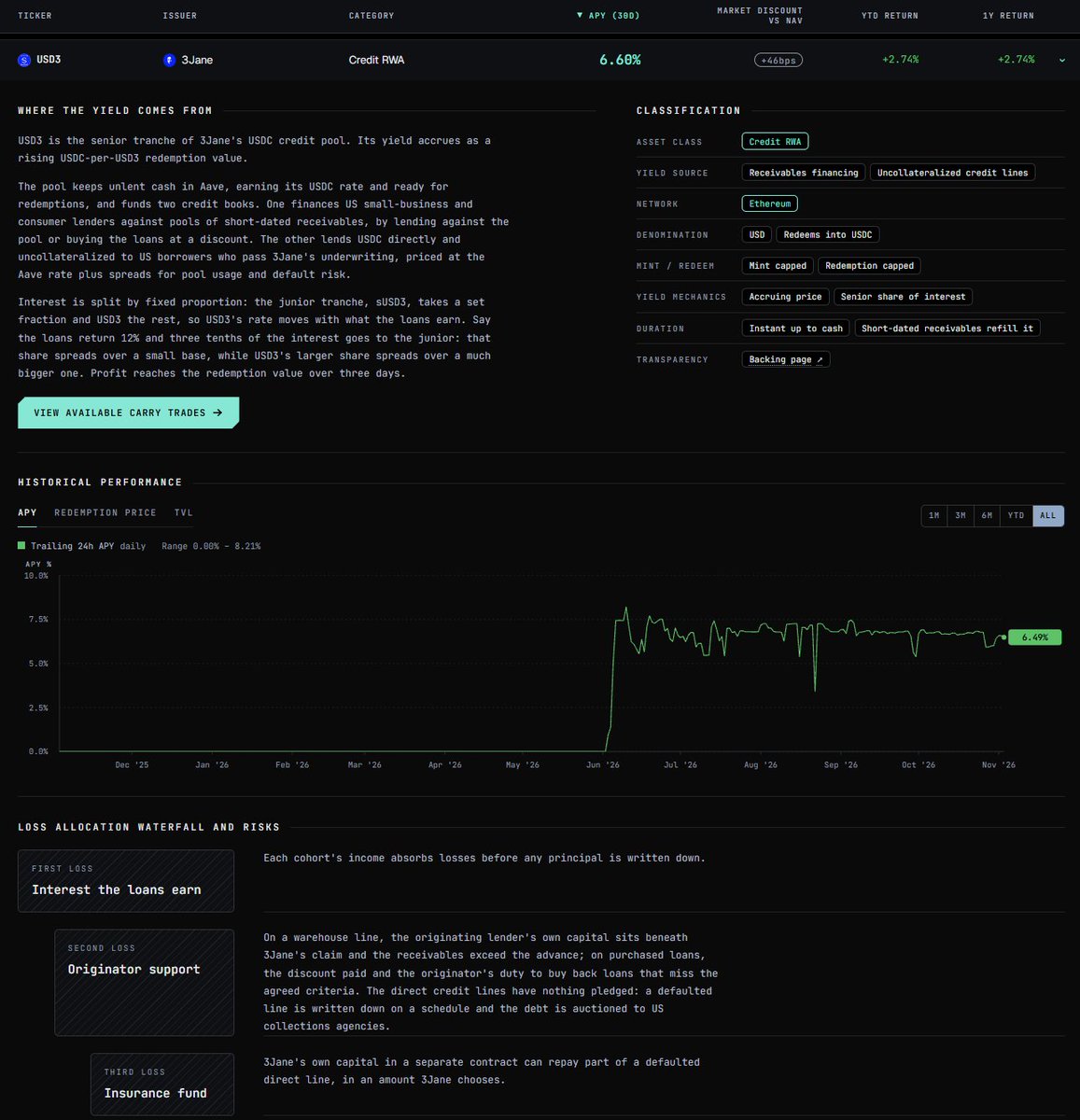
There you can find detailed breakdowns of several major yield-bearing assets. For each asset it tracks, it shows:
> Where the yield comes from
> How minting/redemptions work
> Whether it has a transparency page
> Loss allocation waterfall (what happens if the asset backing takes a loss)
> Whether it trades at a premium or discount to its peg
It also has plenty of other features, including a DeFi portfolio tracker where you can add your own wallets, a lending opportunities section, and more.
Creddit is currently in gated beta, but you can DM @credditxyz for an access code.
I believe it's worth giving it a try.
Also, to be clear, this isn't a paid promo. I think the tool is genuinely useful and that's why I am sharing it.
woke up to this little notification
For active LPs it's one of the most exciting things coming up imo
High level, Fluid DEX v2 offers you the following:
1) Cross margin your LP positions
Various collaterals contribute to one unified account health factor
Collateral
├ ETH / USDC LP
├ Gold
├reUSD
⇣
1 unified health factor
⇡
Debt
└ USDT / USDC LP
2) Earn money market rates on top of trading fees
ETH / USDC LP earns you:
+ trading fees based on liquidity provided
+ underlying money market rates (currently ~6% on USDC, ~1.6% on ETH)
This means even when out of range your capital works!
3) Leverage up your LPing, while the debt itself contributes to your LPing liquidity
Step 1 -> put 10k into ETH / USDC LP as collateral
Step 2 -> borrow 5k ETH / USDC debt *as an LP position*
Step 3 -> resupply that 5k as ETH / USDC LP collateral
Result:
10k collateral LP
+ 5k debt LP
+ 5k resupplied collateral LP
= 20k active DEX liquidity on 10k capital provided + 15K capital earning your money market lending yield - 5k costing you prevailing funding rates
Fluid DEX v2 unlocks a new frontier in terms of capital efficiency and AMMs
I like the prudent rollout described in the proposal
Looking forward to track the progress closely over the next 12 months
prediction f09702b7857167bd5a7687b0dfb26b138a6a932ee9ae716e5b1c5ca4fd4a707f
Excited to see @JupiterExchange ship one of my favourite DeFi primitives
Smart collateral and smart debt go into the category of 0 to 1 innovations expanding the frontier of capital efficiency
Built with the Fluid team, mechanics map 1:1 to Fluid DEX
Here is a deep dive I made a while back going through the underlying mechanics: 🔗https://t.co/Rc05GR4xwC
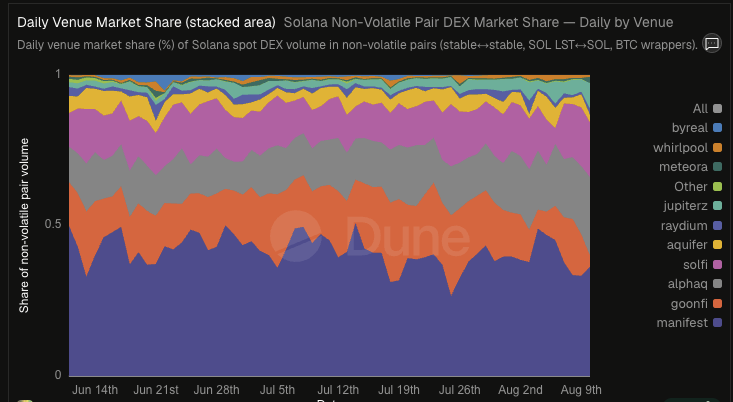
Will be interesting to see revisit this stablecoin volume market share on @solana in a couple of months
gave @Morpho Midnight a try today. quite exciting to see the beginning of fixed rate borrowing onchain.
@pendle_fi solved transforming variable rate into fixed rate for lenders.
But borrow demand is not where it should be given the attractive borrow rates we see across various repo markets
A major reason is that the borrower needs predictability, something utilization based rates don't offer
Its easy to illustrate this on a leveraged carry trade
the chart below shows the carry (delta between collateral APY and debt APY) of @re 's reUSD and the USDC borrow rate on that market.
Its extremely volatile.
it gives zero predictability in expected payoff and forces the looper to take a more conservative leverage, as negative carry at leverage quickly eats into your equity.
this is not attractive. when engaging into a leveraged carry trade the investor should only care about assessing the quality of the collateral asset.
not the volatility in carry determining his realized returns.
picture the chart below with a PT fixed rate asset and a fixed rate borrow.
Its a straight line!
you know exactly what you get. you know your reward.
your job is only to assess the risk of the collateral.
you enter the trade if the risk reward corresponds to your requirement.
Fixed rates is the next leg of growth for DeFi and imo will help stimulate the currently lacking demand for borrowing also mentioned here https://t.co/OdjIIw4Aw1
Chart below taken from @credditxyz
Is this the best risk adjusted return on BTC?
1y realized: >11%
30d trailing APY: 16%
How? DEX liquidity provision WBTC <-> cbBTC
Still some capacity left!
Let's have a look at how this works ⬇️
The best place to provide liquidity for ETH/USDC on Ethereum right now is @EkuboProtocol , with additional DAO incentives, it offers the highest APR vs others.
P/s: dashboard from @LpDexhq
One week into the Ethereum USDC incentive program and the early results are in:
3/4 incentivized pools have nearly doubled in TVL.
Across all four pools, LPs are earning more than 2x the APR of comparable pools on competing DEXes.
ETH/USDC - 81% APR
ETH/WBTC - 73% APR
WBTC/USDT - 135% APR
ETH/USDT - 80% APR
A key difference from most incentive programs: all rewards are distributed in USDC.
The incentives run for another 11 weeks and you can add liquidity in the comment below 👇
If you’re not sure what range to set, make sure to check out @LpDexhq
Providing liquidity on AMMs for yield has always been one of those things that looks simple until you actually try to manage it properly.
I came across this tool @LpDexhq from @letsgetonchain and it's basically treating LPing like what it actually is - market making.
- Proper analytics
- Clear view on returns vs IL
- Strategy testing + simulations
If you actively manage LP positions, you might wanna check it out. This tool is near perfect.
Can't wait to see more pairs this week :)
UX of providing liquidity on AMMs sucks!
Why not run it like a sophisticated market maker?
- Understand your PnL
- Track risk in realtime
- Test strategies and access all the right analytics
+ much more to come on @LpDexhq!
If you want early access, DM me!
Demo ⬇️