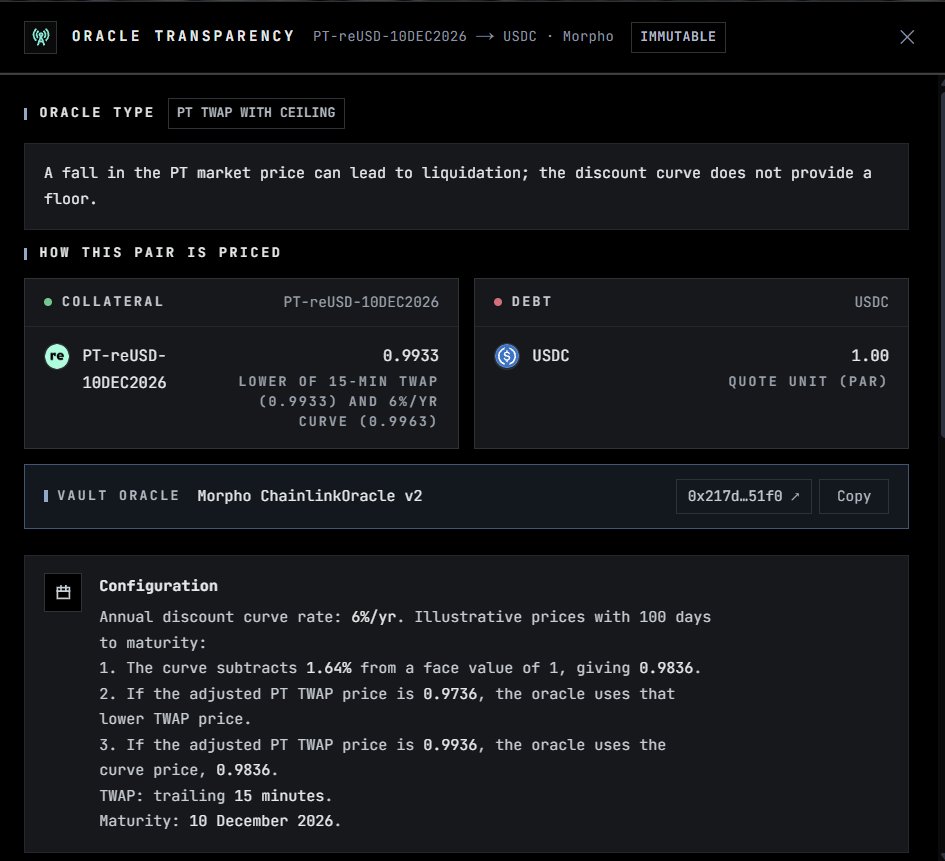
Understanding the economics of an oracle is a key part of risk analysis for lenders and borrowers.
At @credditxyz, we tried to come up with a standardized way to explain oracle configurations across every lending protocol.
For borrowers, the focus is on liquidation drivers: what can actually change your health factor?
btw shoutout to @EthanDeFi_ who's been relentlessly pushing lending protocols to surface more oracle transparency in their own UI.
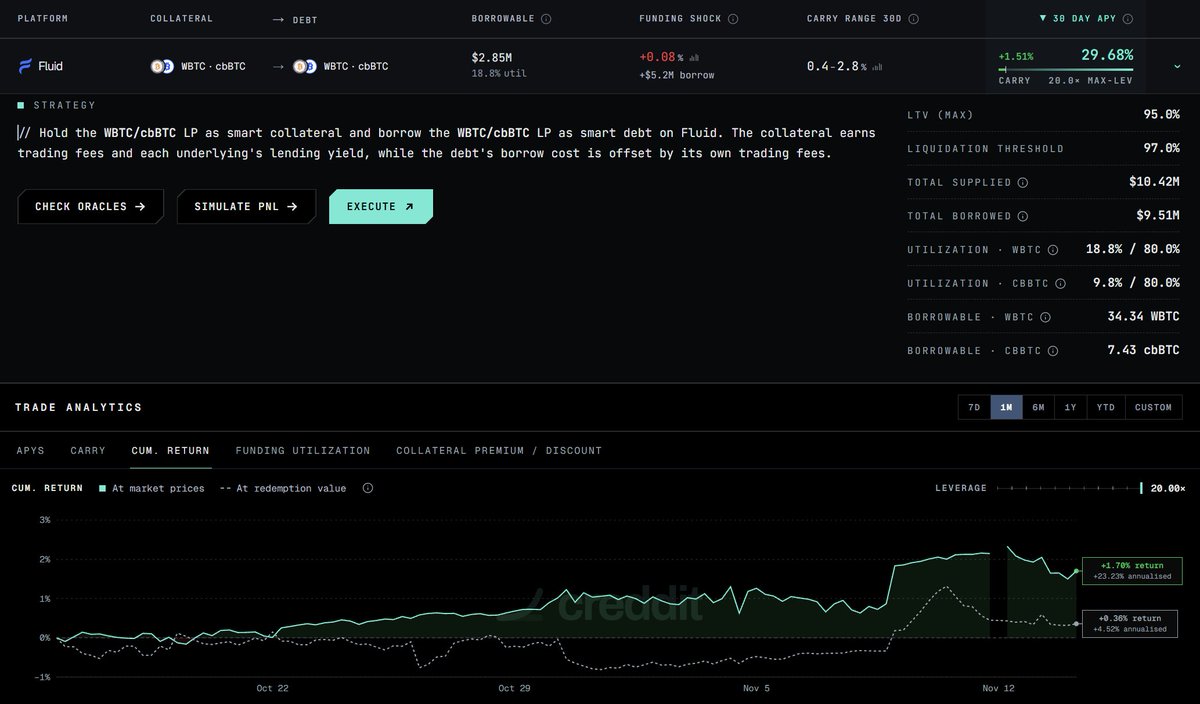
Fluid does provide the relevant economic implications already in their UI.
Morpho also showed some initiative and introduced a methodology that classifies each feed using the oracle provider's own published categories or, for contracts such as vaults, how the contract calculates its price.
A feed can therefore be labelled NAV even when market prices enter the calculation underneath it.
Take the @protocol_fx fxSAVE market for example.
Morpho classifies it as NAV type because the oracle uses fxSAVE’s net asset value, so 'NAV' describes the calculation.
But that value depends on the fxUSD and USDC held in the underlying stability pool.
And fxUSD is valued using a moving average of its market price.
An fxUSD depeg can therefore lower your health factor and trigger liquidation, even though the oracle is labelled NAV.
The label is technically valid.
But "NAV"/"exchange price"/"redemption value" are often understood as being the valuation marked by the issuer, not any market price.
Hence this can be misleading in terms of economic implications for the borrower.
At creddit, the focus is on translating an oracle into economic meaning for the borrower and this consistently across every lending protocol.
We use various labels but the two main types are 'Market price" and "NAV".
For example we use "Market price" when the oracle reads the collateral’s own market price or a synthetic dollar's market price beneath it.
fxSAVE falls into the second category because fxUSD market price feeds the oracle.
We use "NAV" when the collateral is valued at its issuer’s redemption value, and the underlying stablecoin is fixed at par or is one of the major fiat backed stablecoins.
Taking fiat backed stablecoins at par for this classification is a choice, in theory stables like USDC / USDT / USDG can also show some market price fluctuations.
Where collateral and debt use the same price feed, that exposure can cancel.
For example, syrupUSDT/USDT on @aave uses the same USDT/USD feed on both sides.
Where it doesn't cancel, that residual risk is explained separately in the collateral/debt detailed section.
@pendle PTs have more specific labels to distinguish market pricing, fixed discounts and pricing limits.
Any feedback is welcome. @credditxyz is in beta, DM for access code
been in many 15min twap PT markets so i think the criticism against @SteakhouseFi using a fundamentally unsafe oracle is unwarranted + loopers can avoid liquidation entirely by lowering health factors to unliquidatable levels based on pendle yield ranges
it also does not help that the market went from linear discount to twap from the last PT market to the current which probably caught a bunch of loopers offguard
i do think all lending platforms need to have MUCH richer oracle descriptions. seems trivial to add with a few prompts @aave@Morpho@eulerfinance@0xfluid
Creddit is a great yield farming tool
It has a detailed oracle transparency tab that explains very well how each market's oracle works and what the risks are for borrowers/lenders
It's in private beta but you can DM @letsgetonchain for access
I had a great experience with it
Understanding the economics of an oracle is a key part of risk analysis for lenders and borrowers.
At @credditxyz, we tried to come up with a standardized way to explain oracle configurations across every lending protocol.
For borrowers, the focus is on liquidation drivers: what can actually change your health factor?
btw shoutout to @EthanDeFi_ who's been relentlessly pushing lending protocols to surface more oracle transparency in their own UI.
Fluid does provide the relevant economic implications already in their UI.
Morpho also showed some initiative and introduced a methodology that classifies each feed using the oracle provider's own published categories or, for contracts such as vaults, how the contract calculates its price.
A feed can therefore be labelled NAV even when market prices enter the calculation underneath it.
Take the @protocol_fx fxSAVE market for example.
Morpho classifies it as NAV type because the oracle uses fxSAVE’s net asset value, so 'NAV' describes the calculation.
But that value depends on the fxUSD and USDC held in the underlying stability pool.
And fxUSD is valued using a moving average of its market price.
An fxUSD depeg can therefore lower your health factor and trigger liquidation, even though the oracle is labelled NAV.
The label is technically valid.
But "NAV"/"exchange price"/"redemption value" are often understood as being the valuation marked by the issuer, not any market price.
Hence this can be misleading in terms of economic implications for the borrower.
At creddit, the focus is on translating an oracle into economic meaning for the borrower and this consistently across every lending protocol.
We use various labels but the two main types are 'Market price" and "NAV".
For example we use "Market price" when the oracle reads the collateral’s own market price or a synthetic dollar's market price beneath it.
fxSAVE falls into the second category because fxUSD market price feeds the oracle.
We use "NAV" when the collateral is valued at its issuer’s redemption value, and the underlying stablecoin is fixed at par or is one of the major fiat backed stablecoins.
Taking fiat backed stablecoins at par for this classification is a choice, in theory stables like USDC / USDT / USDG can also show some market price fluctuations.
Where collateral and debt use the same price feed, that exposure can cancel.
For example, syrupUSDT/USDT on @aave uses the same USDT/USD feed on both sides.
Where it doesn't cancel, that residual risk is explained separately in the collateral/debt detailed section.
@pendle PTs have more specific labels to distinguish market pricing, fixed discounts and pricing limits.
Any feedback is welcome. @credditxyz is in beta, DM for access code
my brother is one of the most hardcore defi farmers i know
for the past 6 months he’s been building the perfect companion app for yield farmers to visualize positions, track pnl and risk
he used to be a bond trader and is now bringing wall street grade tooling to crypto
dm him for access
I think a bottleneck is a lack of lenders willing to underwrite these at rates that make it attractive to loop.
There is no way to liquidate these assets at scale if needed.
should liquidations occur collateral would have to be queued for redemptions.
So lenders are effectively exposed to the same underlying duration profile of those collateral assets.
Imo having a deep and competitive market that would make these assets liquid in periods of stress would help a lot
Love this lending APY for USDtb at 5% on @0xfluid
Exposure is only bluechip collateral: ETH, WBTC, cbBTC, wsETH, weETH
Reminder: USDtb is fully backed by Blackrock's BUIDL (short-term t-bills)
https://t.co/Yd4hDEXx6L
@DefiIgnas to be fair i'm even using it without the expectation of a TGE.
if i want to place a bet with little capital at risk but a potential big payout it just fits that need quite well.
its obviously gambling but its fair and reliable, no insider shenanigans
Cheap stablecoins borrows against WBTC and SOL on @JupiterExchange
Numerous nice lending opportunities (in the current liquidity crunch) to allocate those and cash in the carry
➡️ https://t.co/SmySbLTutK
@deltaausd@EthanDeFi_ its organic, you can simulate utilization sensivity and the effect it has on hte carry in the funding shock column
https://t.co/knqjGx7AAR