Excited to share our recent work:
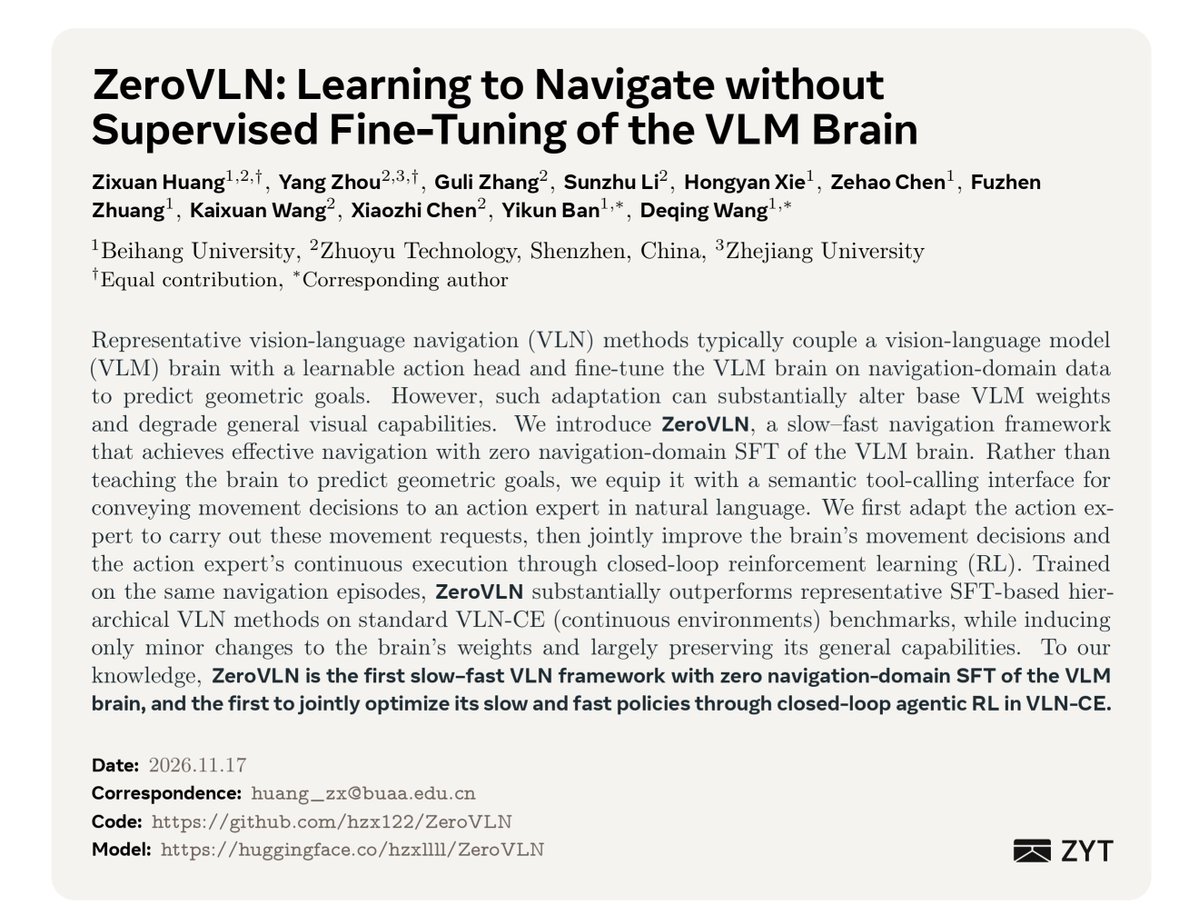
ZeroVLN: Learning to Navigate without Navigation-Specific SFT,
which explores how reinforcement learning (RL) can enable general-purpose vision-language models (VLMs) to learn navigation without navigation-specific supervised fine-tuning (SFT).
Vision-language navigation (VLN) is an essential capability for embodied agents, requiring them to understand natural-language instructions, perceive their surroundings, and navigate through continuous environments.
Most existing VLN methods rely on SFT to teach VLMs to predict pixel goals or numerical motion commands. However, we found that such task-specific adaptation can significantly degrade the VLM's general visual capabilities.
This motivates a key question: Can we teach a general-purpose VLM to navigate directly through RL, without navigation-specific SFT, while preserving its general capabilities?
To explore this, we propose ZeroVLN, a slow–fast navigation framework built around natural-language tool calling. Instead of forcing the VLM brain to predict geometric goals or low-level actions, we let it make navigation decisions and communicate movement requests in natural language. A flow-matching action expert then translates these semantic requests into continuous motion trajectories.
Our training consists of two stages:
Stage 1: Learning to execute semantic requests. We collect movement requests generated by the VLM brain during environment interaction and construct corresponding reference trajectories. With the brain frozen, we train the flow-matching action expert to follow these requests through supervised learning.
Stage 2: Joint optimization through closed-loop agentic RL. We jointly optimize the VLM brain and action expert using feedback from continuous navigation environments. We design rewards based on navigation success, movement progress, and information discovery, and use trajectory-level RLOO advantage estimation to improve both high-level navigation decisions and low-level motion execution.
Unlike conventional SFT-then-RL approaches, ZeroVLN starts directly from a general-purpose VLM and improves its navigation capabilities through closed-loop RL, without navigation-specific SFT of the brain.
📊 Experimental Results
Under the same backbone and training data, ZeroVLN achieves higher navigation success rates than NaVILA and DualVLN across three VLN-CE benchmarks: SAGE-3D, R2R-CE, and RxR-CE.
On R2R-CE, joint RL improves the success rate from 17.0% to 52.7%.
Importantly, the VLM brain exhibits only 0.01497% relative weight displacement, while largely preserving its general visual capabilities.
Our paper and code are now publicly available. Feedback and discussion are very welcome!
📄 Paper: https://t.co/N72SxXZ5Yx
💻 Code: https://t.co/sWVb2SWWKX
#ReinforcementLearning #EmbodiedAI #VLN #VLM #AgenticRL
Transformers usually scale by making their blocks wider or stacking them deeper.
We show another path toward scaling LLMs: branching.
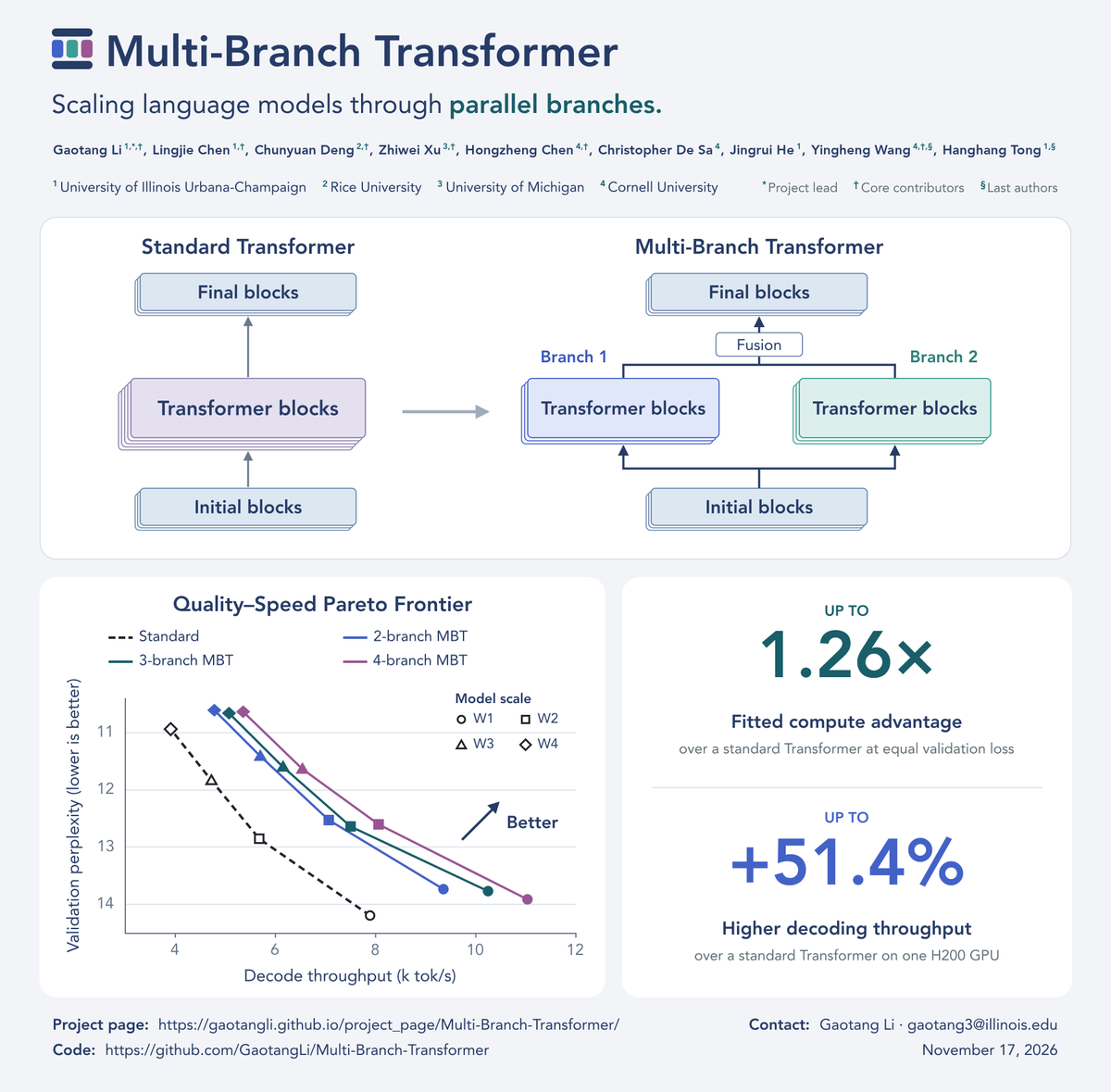
Introducing Multi-Branch Transformer (MBT): parallel composition of full Transformer blocks.
TL;DR:
• Better scaling: across a controlled pretraining scaling ladder, MBTs improve language-model quality at comparable training compute. Fitted curves indicate a standard Transformer needs up to 1.26× as much training compute to match our final MBTs' validation loss.
• Consistent pattern: controlled sweeps show the same behavior at every scale. With two branches, loss is lowest with ~1/3 of the blocks in parallel and only returns to the standard model's level near 80%.
• Faster decoding: with Joint-KV cache sharing and a branch-aware inference engine, up to 51.4% higher throughput on one H200 and up to 34% less KV-cache storage. More branches push the quality–speed Pareto frontier further out.
The architecture, the scaling results, and how we make it fast. 🧵
The future of AI may not be one monolithic intelligence, but a society of agents—diverse in size, strengths, and perspectives—communicating, collaborating, and learning from one another.
Through my wonderful time at NVIDIA and Stanford, one question has kept me up at night:
Should the future of AI be monolithic or plural?
To answer this question, we’ve raised $110M to get started, backed by @MenloVentures, @MadronaVentures, @NVIDIA, @NEA, @KindredVentures,@Wing_VC, @aixventureshq, @Principal_VC, @Cisco, @Snowflake, among others.
Today, Carlos (@guestrin) and I are stoked to launch Noeri, a neolab to push the frontier of plural intelligence.
Noeri means “the plural of intelligence” or many intelligences.
The future of AI we root for is plural: a healthy ecosystem of many intelligences, in all sizes, strengths, and quirks.
Discovery, in particular, has always been plural: many curious minds, each devoted to their own question, often on roads less traveled.
Our path there is self-improving AI that:
-> learns continually on the job, closing the gap between what AI can do off the shelf and what the dynamic world demands
-> learns to use other AIs as tools and make new tools to overcome its own limitations
-> picks the right-sized model for your problem, at a fraction of the frontier cost
Then the power of intelligence, from the craftsmanship of making AI to ownership, can be in the hands of all.
@noeri_ai mission reflects who we are as the founding team. My career has been anything but linear, literally continual learning on the job. Carlos has devoted his career to building tools that empower people through AI.
We are all a bit contrarian, a bit adventurous, and above all, big believers in pluralism.
Join us to build this future together: https://t.co/oAAoe0lzEH
This Thursday I will be giving the opening keynote at RISEx 2026 in Edmonton
Title: The Tashan/Openmind Robot Kindergarten
Abstract: It has always been a dream in reinforcement learning to make robots that learn online by trial and error from their own experience. After all, this is the way people and all other animals learn about their bodies and the world. In robotics, however, learning is almost never online. Instead, the field has focused on learning from data-sets collected from human demonstrations. Learning from experience requires a totally different approach, including anti-fragile robots, skin with tactile sensing, extensive onboard computation, and continual real-time learning algorithms. All these things are difficult and so have rarely been done. They require a substantial commitment of engineering effort and resources, plus determination and patience, plus scientific breakthroughs in reinforcement learning algorithms. The Tashan/Openmind Robot Kindergarten is an ambitious new attempt to do all these things, led by researchers from the Openmind Research Institute in Edmonton and from the Tashan Technology Corporation in Beijing. The work has just begun, and so this talk will focus on the challenge and the ambition. Robots must learn online.
We asked GPT-6 Astra to edit Qwen3.5-0.8B weights to improve math.
It directly changed only 0.016% of weights, fixing 0.8B's reasoning loops & improving math up to 6x and even instruction following 3x, without gradients or training.
We call this Weight-Space Programming: frontier LLMs can now natively read/write neural network weights! 🧵
Blog: https://t.co/bOWCcFhCVq
Excited to finally share Discovery Foundation Models (DFM), a research direction we’ve been developing toward Discovery Intelligence.
We’re interested in AI systems that go beyond executing predefined tasks: systems that can explore unknowns, formulate new problems, build and test hypotheses, learn from evidence, and carry what they discover into future research.
For me, DFM also connects naturally to a broader question I’ve been working on: how Recursive Self-Improvement can eventually lead to systems capable of open-ended scientific discovery.
This technical report is our first step. More work on scientific agents, environments, world models, and real-world discovery loops is coming soon.
Glad to build this together with @Charles_Y_Wu@zhenfei_yin_yzf and the PhAI Labs team.
📑 DFM technical report: https://t.co/nT3hiA2LqU
🔗 DFM research roadmap: https://t.co/y6CiWmKNTE
🏠 More about PhAI Labs: https://t.co/NG7fsXjig4
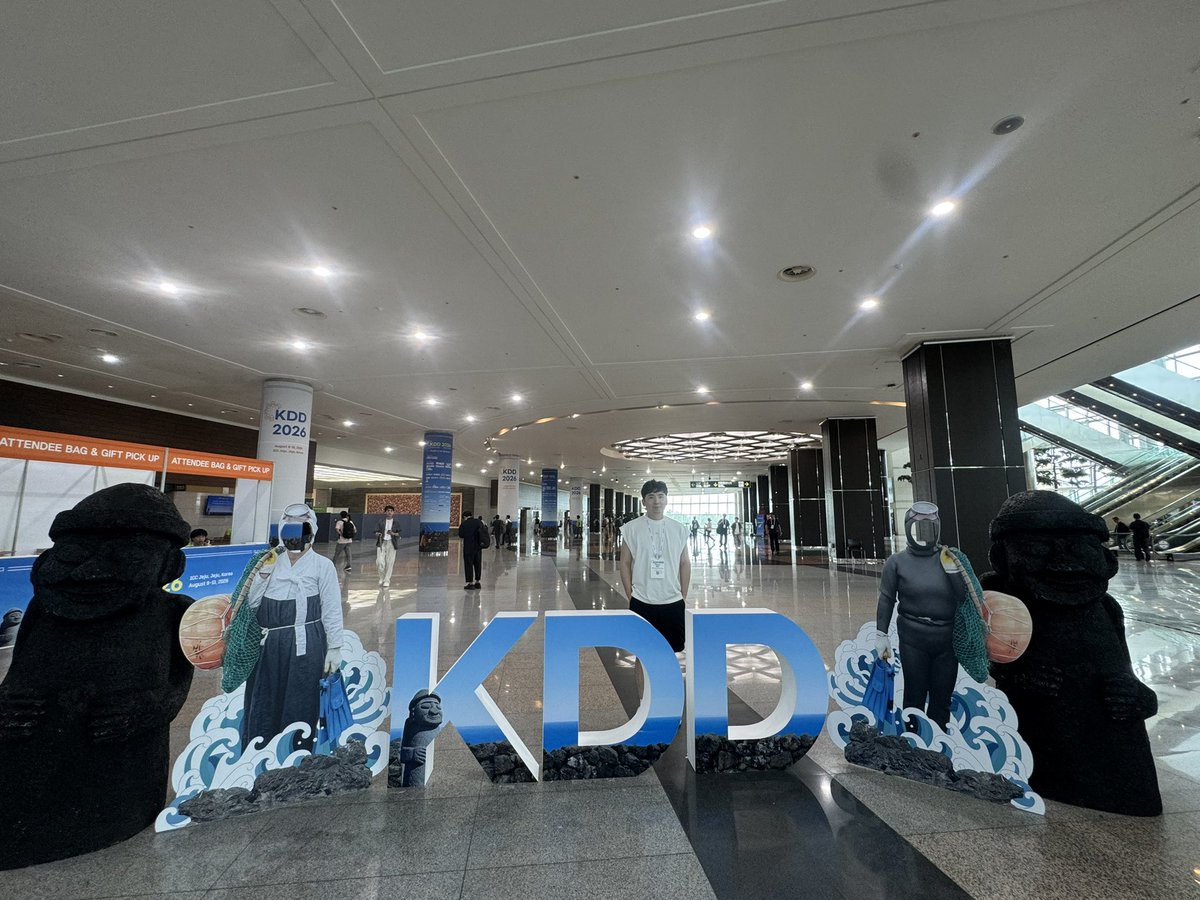
Wrapping up #KDD2026 in beautiful Jeju! 🌊🌿
Great to reconnect with old friends, meet new ones, and exchange ideas across AI, machine learning, and data mining. Inspiring discussions, fresh perspectives, and some truly stunning views along the way. See you next time!
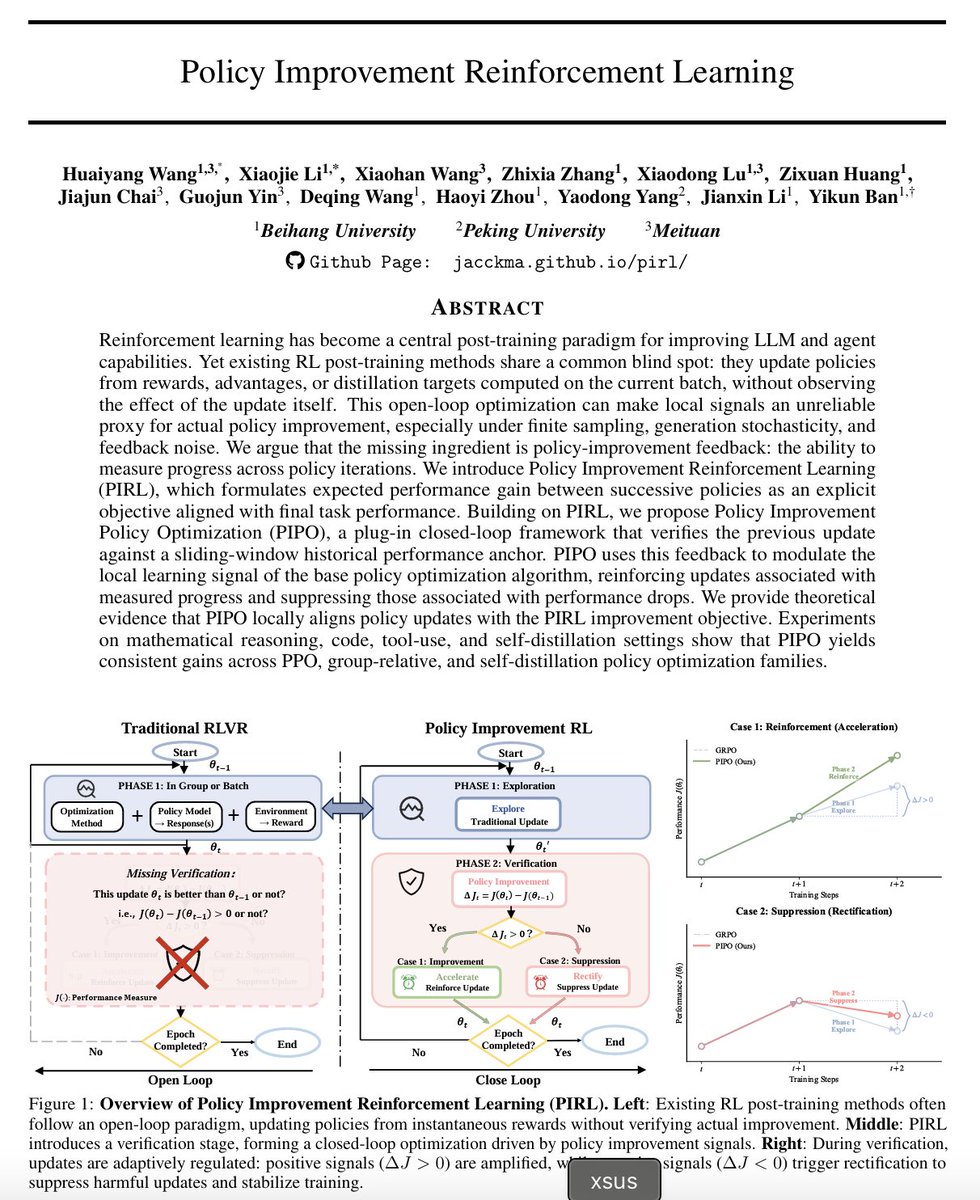
Across mathematical reasoning, code, tool use, and self-distillation, PIPO provides consistent gains across multiple policy-optimization families, while improving training stability and wall-clock efficiency.
📄 Paper: https://t.co/klajp6Fqeg
💻 Code: https://t.co/fMmMFT5H0E
Should policy improvement become a first-class RL training signal?
#ReinforcementLearning #LLM
Most RL post-training is still open-loop.
PPO, GRPO, DAPO, and self-distillation optimize the current batch—but rarely verify whether the resulting policy is actually better.
What if RL could look back and correct its previous update?
Introducing PIRL and PIPO. 🧵
If the previous update produced measurable improvement, PIPO reinforces its learning direction.
If performance declined, PIPO suppresses or rectifies that direction.
The base algorithm still assigns local credit. PIPO verifies whether that credit led to real progress.
PIPO turns this idea into a two-phase, closed-loop algorithm:
Explore: Apply the original PPO, GRPO, DAPO, or self-distillation update.
Verify: In the next iteration, compare the updated policy against a sliding-window historical performance anchor.
PIRL—Policy Improvement Reinforcement Learning—introduces the missing signal:
Did the new policy actually outperform its recent predecessors?
It reframes RL post-training around measurable improvement between policy iterations, rather than isolated batch-level optimization.
The problem:
A better local objective does not necessarily produce a better policy.
Finite sampling, generation randomness, and noisy feedback can push an update in the wrong direction. Without verification, training may silently drift or collapse.
Releasing the model weights and technical report of Kimi K3.
Kimi K3 is our most capable model: a 2.8T MoE model with native visual understanding and a 1M-token context window.
New model architecture: 2.5x the intelligence per unit of compute, not just more params.
Alongside Kimi K3, we're opening up more of the stack behind it — high-performance attention kernels, MoE communication library, and infrastructure for running agent environments at scale.
Model weights: https://t.co/7m7eEg6Y0B
Tech report: https://t.co/yeu6cjpMCT
Tech blog: https://t.co/YTfiMSNM1f