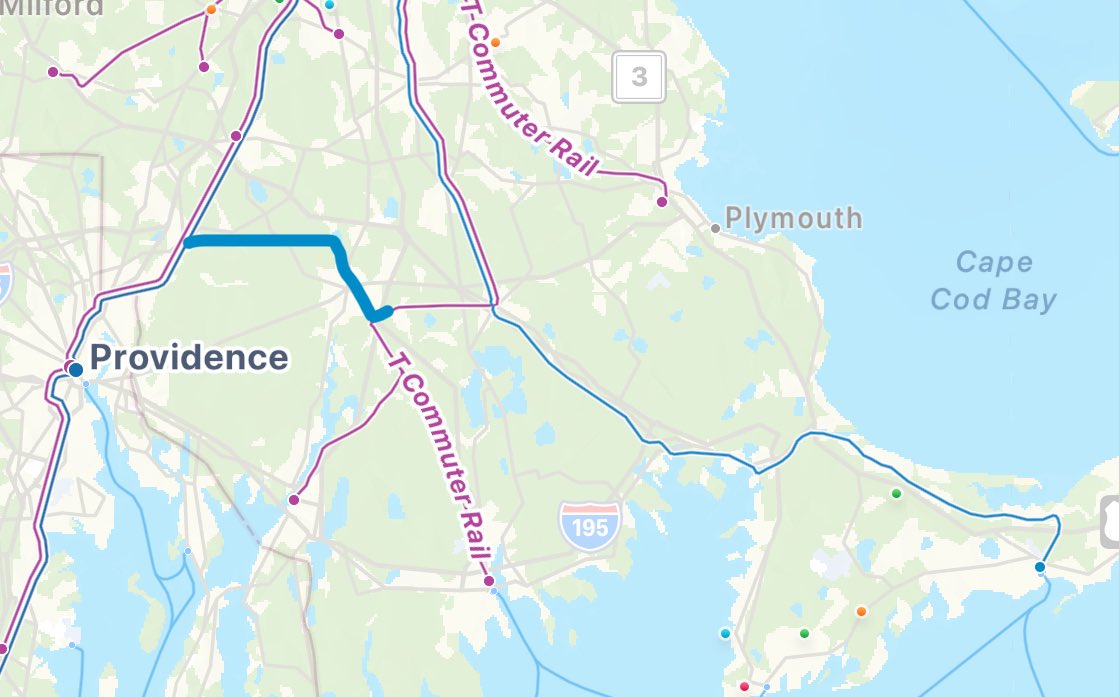
With the crushing amount of car traffic that Cape Cod sees, it begs the question why we haven’t revived Amtrak’s previous Cape Codder service? There are so many license plates from NY and NJ, so why not enable them to take the train instead?
The Cape and Islands are lovely, but at what point is the traffic hassle just not worth it? Today's Starting Point wrestles with the big question. https://t.co/sZFDGOLT1D
@trashisl4nd Our zoning drives developers to build bigger, more expensive housing in order to stay profitable. We should be streamlining and simplifying our rules to reduce costs and enable smaller developers to be successful.
Can someone help me understand why so many people in Massachusetts are allergic to developers and think the government can do no wrong?
Why does the public see developers as the cause of our housing problems instead of as partners we can work with to improve our quality of life?
Mayor Michelle Wu is proposing zoning changes to make it easier to build new homes, including temporarily exempting developments with fewer than 10 units from inclusionary zoning requirements and giving developers more time to pay affordable housing fees.
Real talk places like breweries and bars outside of a select few places will continue to shutter as Massachusetts housing remains unattainable for young adults
@mista_Z_ It’s a hilarious situation because, to your point, the current regulatory environment results in the situation that they don’t want: Only large developers are able to succeed
@Jtsbsaints15@OnlyInBOS Legalizing single-stair housing up to six stories would be huge for building larger, more affordably priced units. It would also help fill a gigantic gap in 3-4 bedroom units that large families need.
@VinceLennon@bdebone2 That’s exactly it. We need to realize that there are ways to make change without causing extensive service disruptions and cost overruns.
@onthembta1 I don’t know about you, but I wouldn’t be able to come up with a rendering myself. It’s very important to communicate intent, especially around infrastructure that requires public buy-in.
@BHartranft The state is expecting to eventually move forward with South Station expansion, even though they know the estimated cost is 4.7 billion (compared to the North-South Rail Link’s estimated cost of 8-9 billion).
https://t.co/bgRSrp56mU
The point of the North-South Rail Link is that it would completely transform the Massachusetts and broader New England economy.
Harvard’s study shows that it would only cost 8-9 billion in 2030, and we already have 4-5 from South Station expansion.
https://t.co/jhR4oCwFML
The most impactful project New England could build is the North-South Rail Link. Right now there’s a gap between North and South Stations in Boston, and connecting them with 2.8 miles of tunnel would drastically change how the MBTA and Amtrak would operate.
We could even build the connection more affordably by running from Boston to North Adams via Springfield and Greenfield, limiting most of the necessary track work to just Greenfield to North Adams
MassDOT released a study in November 2024 showing it could cost up to $1,590,465,076 to build passenger rail service between North Adams, Greenfield, and Boston.
Alternatively, it could cost up to $2,926,449,410 for electrified service.
LET’S BUILD THE BerkshireFLYER.
@GottheimerHater@yasinallahdev@friendchristoph I would also like to see full electrification and conversion to EMUs, but we need to start taking action that people can immediately benefit from
@GottheimerHater@yasinallahdev@friendchristoph The benefit of dual-mode trains (at least, for diesel-electric) is that they would enable immediate electrified service without excluding other lines from using the equipment. People need to see clear, cheaper improvements if we want them to get onboard with full electrification.
@lobefinned Also, I agree that Grand Junction service, faster service to Worcester (they’re triple tracking it now), North-South Rail Link, and electrification would result in a better near-term ROI, but we do need to enable western Massachusetts to grow.
MassDOT released a study in November 2024 showing it could cost up to $1,590,465,076 to build passenger rail service between North Adams, Greenfield, and Boston.
Alternatively, it could cost up to $2,926,449,410 for electrified service.
LET’S BUILD THE BerkshireFLYER.
@lobefinned Yeah it’s definitely not a high ROI. It’s likely something that would be seasonal like the CapeFLYER. That being said, build a link to North Adams via Springfield and Greenfield could work for a lot less money.
@GottheimerHater@yasinallahdev@friendchristoph They only ordered a handful of BEMUs and dual-mode push-pull locomotives, so they can still pivot. If they’re going to buy push-pull locomotives until the existing bi-level coaches reach EOL, then they should probably get a dual-mode diesel-electric version like Amtrak’s Airo.