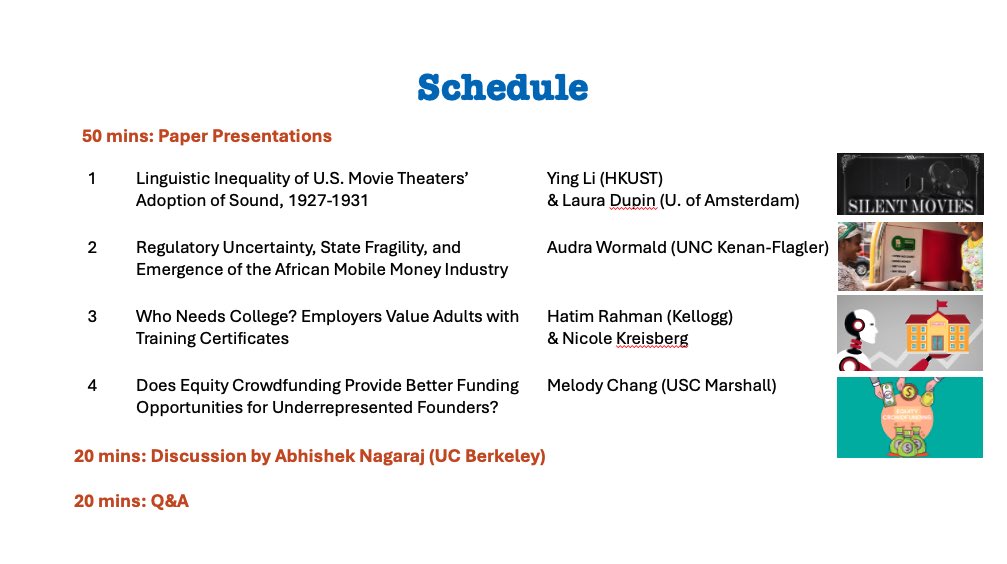
If you're coming to AOM (and are willing to wake up early on the last day 😄), you are cordially invited to join our symposium! Co-organized with @Manav_Raj_. The discussant is @abhishekn . Four unique papers by @laura_dupin1 , @AudraWormald,Hatim Rahman, and @MelodyHChang !
We will have a panel of six esteemed faculty mentors delivering speeches and dedicated to roundtable discussions of your research projects at any stage.
Happy New Year! I'm a little behind on everything but I am pleased to announce a new paper, "Does diversity influence innovation and economic growth? It depends on spatial scale" 1/n
https://t.co/8GbOcSCgqK
Are you planning on attending #Egos2024 in Milan, and are you interested in exploring the interplay btwn social cognition and physical space?🧠🗺️
If that's a yes, consider submitting to sub-theme 68 co-organized by Filippo Wezel, Martina Montauti and me:
https://t.co/XR90vMYWC2
Where does the first organization of a new kind come from? In this newly published AMJ article, my coauthor Olga Khessina and I use the context of the historical movie theaters to reveal the role of "provisional spaces". https://t.co/8ta8GWZdnf
Fun fact: Many people know 'nickelodeon' because of a TV channel. But before that, nickelodeon, as a form of a movie theater that emerged in 1905 in the U.S, meant "nickel" (the admission price was 5 cents) and "odeon" (meaning theater in Greek).
In different Chicago communities, the uneven distribution of the provisional spaces led to the different emergence timing of the first movie theater with different forms (nickelodeons, movie houses, and movie palaces).