AI Scientists are starting to actually do science. Not just answer questions. Not just run workflows.
Introducing AutoScientists: a decentralized team of AI agents that can generate hypotheses, design experiments, write code, test ideas, analyze failures, and revise strategy as evidence accumulates.
Because real research is not a to do list of tasks.
It is a living search process. Leads emerge, failures matter, teams form around what works, and priorities shift when evidence changes. Much like how a lab of scientists would work on cutting edge research together.
Across GPT training optimization, biomedical ML, and protein fitness prediction, this decentralized structure consistently does better research.
Learn more 👇
@GaoShanghua@marinkazitnik@KempnerInst@HarvardDBMI@Harvard
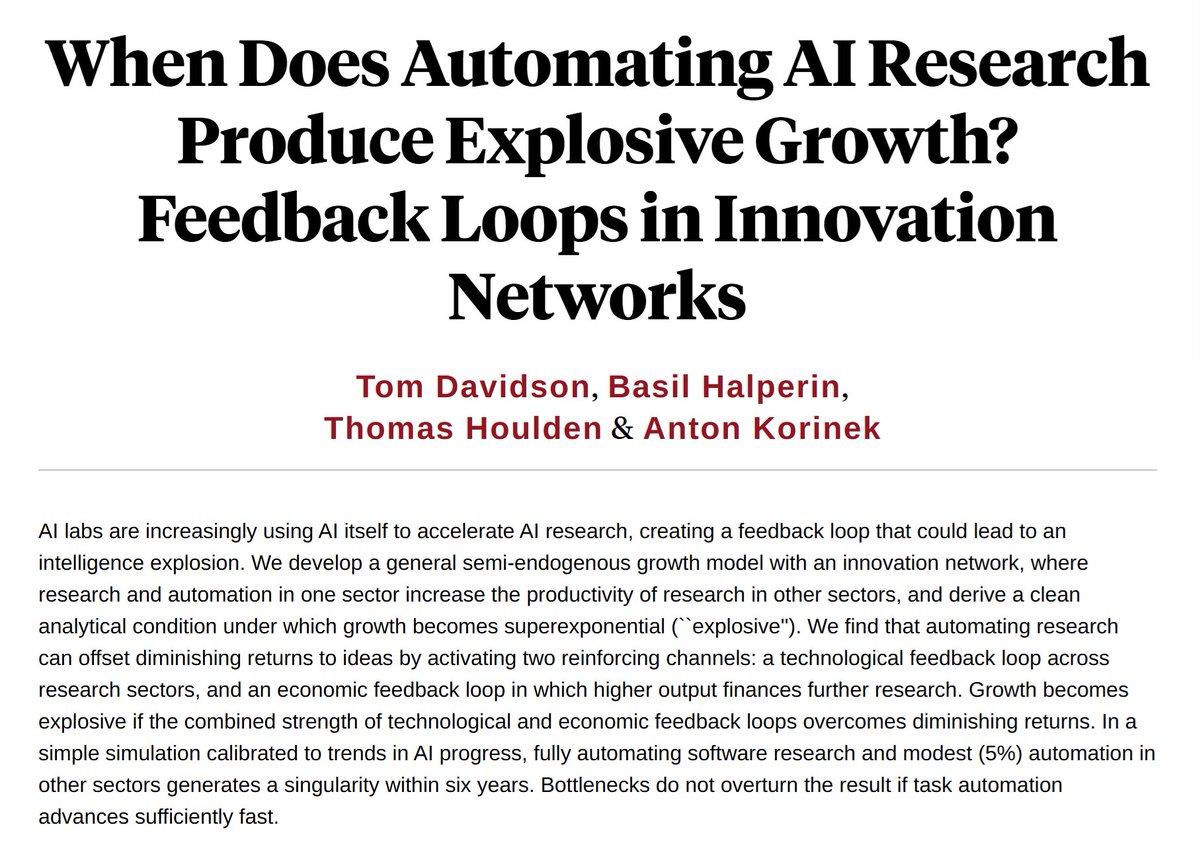
1/🆕 New NBER paper: 𝗪𝗵𝗲𝗻 𝗗𝗼𝗲𝘀 𝗔𝘂𝘁𝗼𝗺𝗮𝘁𝗶𝗻𝗴 𝗔𝗜 𝗥𝗲𝘀𝗲𝗮𝗿𝗰𝗵 𝗣𝗿𝗼𝗱𝘂𝗰𝗲 𝗘𝘅𝗽𝗹𝗼𝘀𝗶𝘃𝗲 𝗚𝗿𝗼𝘄𝘁𝗵?
Under empirically grounded calibrations, a singularity could arrive within just a few years of automating AI research. 🧵
📄 https://t.co/W7ca6Tml4N
My paper on peer effects has been accepted at the JPE @JPolEcon.
I formulate and empirically test a theory of why students influence each other's learning in school: by competing with each other.
I thank the editor, referees, and data editor.
Paper: https://t.co/7TwMwzdtZc
Congratulations to Yiyun Li, Robert F. Goheen Professor in the Humanities and Professor of Creative Writing at @PrincetonArts, who has won the #Pulitzer Prize for Memoir or Autobiography with "Things in Nature Merely Grow"! 👏
The Stata command lwdid is now available on SSC -- it implements Lee and Wooldridge (2025) rolling DiD estimators. The methods are described here: https://t.co/ubKnsajjmT
We provide methods similar to, and motivated by, Callaway and Sant'Anna (2021, Journal of Econometrics).
Submit your work using AI in the social sciences to the annual AI in Social Science conference at the University of Chicago! Submissions due May 1!
The conference will be held October 8-9 in Chicago, IL, USA.
@BeckerFriedman@CAAI_Booth@MiiELab
https://t.co/om2rdoepVR
PhD decision season. My inbox is more flooded than ever. Prospective PhD students asking some version of the question: "Should I keep going? Is an Econ PhD still worth it in the age of AI?"
I get it. The uncertainty is real. And, honestly no one knows the answer. My response begins with the caveat that I have no real certainty around my thoughts, I merely have a hunch. And, that intuition comes from combining my experiences in the academy with my recent field work alongside charities, governments, Walmart, and Anthropic itself.
My hunch is that AI will reveal expertise, not replace it, at least for the foreseeable future. Indeed, I wrote about this earlier with my justification.
As such, I do not view a PhD in economics as a credential. It's a forcing function for building that kind of deep, durable expertise. The expertise that AI amplifies rather than erodes.
So my advice? The uncertainty about AI may be the best reason yet to double down and go for an econ PhD. Why? Because the future belongs to people who know things deeply enough that AI becomes a multiplier, not a replacement.