🎉NeurIPS2026 spotlight: Phase Kernel Lifts Capacity of Dense Associative Memory
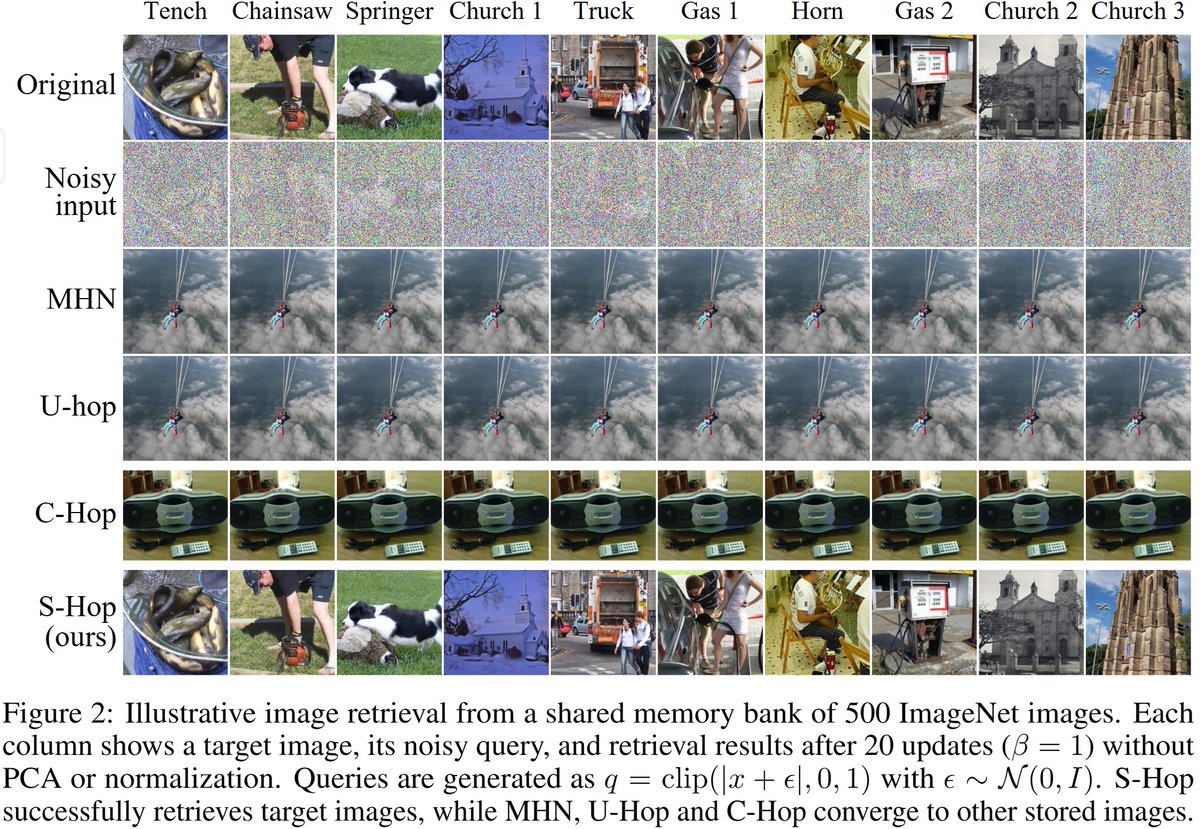
Modern Hopfield networks offer theoretically exponential memory capacity, yet their practical capacity is constrained by attractor interference.
We construct a new class with nonlinear kernel functions to enhance memory capacity, with better attractors and provable exponential capacity.
Diffusion models create novel images, but they can also memorize samples from the training set. How do they blend stored features to synthesize novel patterns? Our work in @NatureComms shows that diffusion models behave like Dense Associative Memory. Specifically, we identified three computational phases: memorization, generalization, and spurious pattern generation. The third computational phase, spurious patterns, is the hallmark of associative memory that appears alongside memorized and generalized samples. We characterized all three states using basins of attraction and curvature measurements, extending our analysis to Stable Diffusion.
The work is done in collaboration with @gaboraya, @Matteo, @mj_zaki, @LucaAmb, @DimaKrotov.
Here is the link to the paper: https://t.co/SwV246fYdJ
Ty to @IBM and @rpi for the funding.
Super interesting blog on memory! One note: theoretical capacity does not necessarily imply practical memory capacity, due to attractor interference.
We have attempted to improve the practical capacity of Modern Hopfield Networks: https://t.co/eQgS21T0Fl
It will be interesting to see how this may lead to revisions to the self-attention architecture.
tldr; every layer is a memory layer and we can use heuristic arguments to estimate their memory capacity based on how much interference they can suppress
🎉NeurIPS2026 spotlight: Phase Kernel Lifts Capacity of Dense Associative Memory
Modern Hopfield networks offer theoretically exponential memory capacity, yet their practical capacity is constrained by attractor interference.
We construct a new class with nonlinear kernel functions to enhance memory capacity, with better attractors and provable exponential capacity.
@YuanqiD Interesting work! Yes indeed, not only diffusion models, we also found Parallel Tempering can be useful for inference time scaling of recursive models. https://t.co/lbWShkMnmy
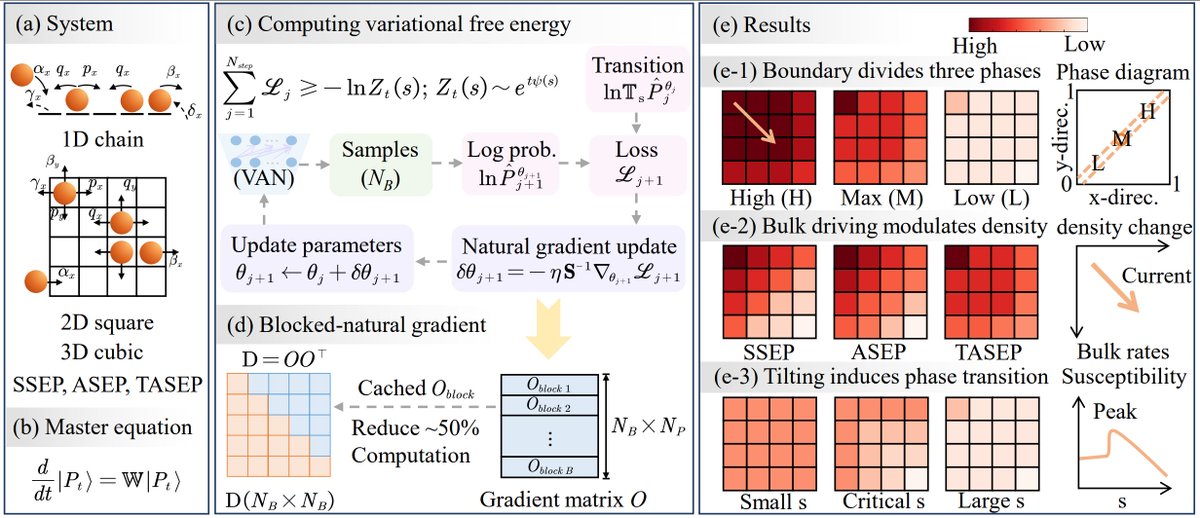
Language modeling of spins helps tackle another nonequilibrium physics problem.
Simple Exclusion Process is a paradigmatic model in nonequilibrium physics: Bernard Derrida derived exact steady-state solutions in 1D about 30 years ago, while 2D was explored more recently via numerics.
By evolving autoregressive neural networks, we systematically study its time evolution from 1D to 3D, revealing the scaling relation of dynamical phase transitions. https://t.co/V7p7Zp3rki
This work comes roughly 10 years after the pioneering "Dense Associative Memory for Pattern Recognition" and 6 years after "Hopfield Networks is All You Need", along with many other important works emerged in the field.
We hope that fundamental physical ideas will continue to inspire AI progress.
Some related works from dynamics perspective have recently emerged:
Flow Reasoning Models: https://t.co/p4qvtim5zS by @alec_helbling et al
Diffusion as a Training Curriculum for Timestep-Free Iterative Reasoning: https://t.co/pm8pc8xv2q by @MariiaD_ML et al
Fractal basins trap latent reasoning: https://t.co/59kd0PWfzv by @wgilpin0 et al
Thinking with Looped Flows: https://t.co/UX0lQlgRf3 by @ayhozade et al
We believe this direction is exciting and can have more applications.
More broadly, these findings may have implications for LLM possibly with loops
https://t.co/23brsK061b
Our work shows the promise of energy-based guidance, and studying its connection with CoT will be interesting.
I put together a mega write-up on GPT-6 Astra & looped transformers.
How looped transformers / recurrent depth works, cost-tradeoffs, whether it hides reasoning traces, with lots of figures and a tour of recent looped transformer research.
Energy can guide the recursive process, with potential application such as in the recent work on latent reasoning of Looped Transformers
https://t.co/TC07EewkHF
🚀New paper on Looped Transformers!
Latent reasoning is fast, but struggles to match CoT-level accuracy at scale. Can looped Transformers give us both?
We find: yes! A looped padded backbone turns out to be a surprisingly simple recipe that works -- It gives latent thoughts a parallel workspace that can be supervised similarly to explicit CoT. 🧵
Leveraging on the celebrated Energy-Based Transformer by @AlexiGlad,
https://t.co/oGNLgn4kgx
We use it as a recursive model and develop an energy guidance on language generation.
Again, "Energy transformers are looped transformers".
How can we unlock generalized reasoning?
⚡️Introducing Energy-Based Transformers (EBTs), an approach that out-scales (feed-forward) transformers and unlocks generalized reasoning/thinking on any modality/problem without rewards.
TLDR:
- EBTs are the first model to outscale the Transformer++ during pretraining across modalities and with respect to data, parameters, FLOPs, depth, etc
- EBTs achieve a +29% improvement over the Transformer++ at test-time via thinking longer
- EBTs exhibit better generalization than existing models during inference
🧵Thread:
♻️Energy-guided Recursive Model (ERM):
-Connect energy-based model and recursive model
-Energy guidance helps reach SOTA accuracy in recursive reasoning
-Parallel tempering can be integrated for improvement
https://t.co/lbWShkMnmy
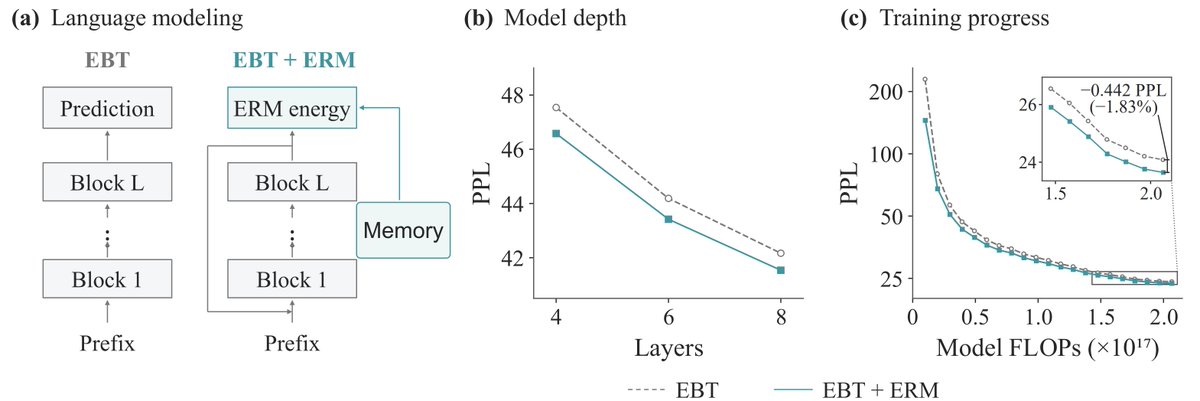
💹Update on Energy-guided Recursive Model(ERM):
-Extending it to language modeling with loops
-Energy guidance improves perplexity at marginal cost
-Suggests optimal recurrent depth in reasoning tasks
https://t.co/lbWShkMnmy
@alec_helbling Great work! I wonder how FRM compares to ERM, which also reaches peak accuracy, given that their names happen to be very close😃
https://t.co/GsVz62Jy3n
♻️Energy-guided Recursive Model (ERM):
-Connect energy-based model and recursive model
-Energy guidance helps reach SOTA accuracy in recursive reasoning
-Parallel tempering can be integrated for improvement
https://t.co/lbWShkMnmy
Introducing Flow Reasoning Models.
We developed a recurrent flow-based architecture to efficiently solve structured reasoning problems (e.g., Sudoku).
FRMs apply continuous flows to discrete data and recurrently refine their past mistakes through self-conditioning.
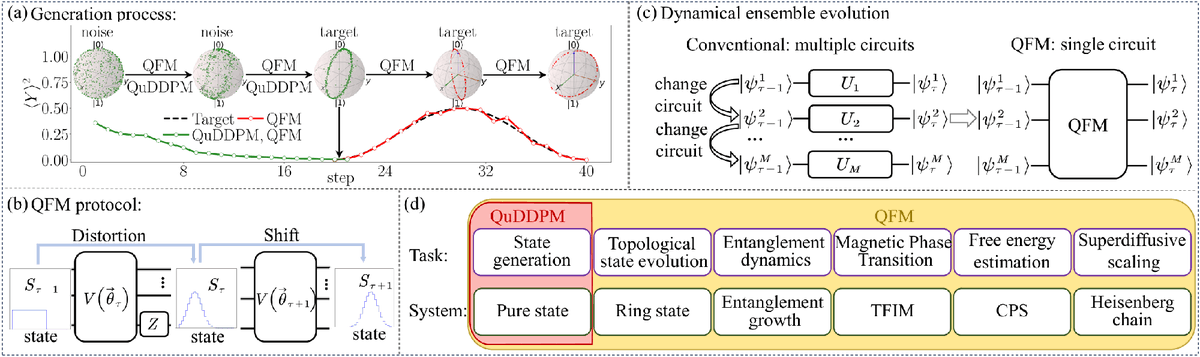
A new framework called Quantum Flow Matching uses a single quantum circuit to track evolving quantum states, making quantum simulations more efficient and reducing circuit-adjustment overhead by about 60%.
More in PRX Intelligence: https://t.co/93JS2ZHxbP