Our new native image generation and editing is state-of-the-art, and ranked #1 in the world. And we're rolling it out for free to everyone today.
You’ve got the tools. Now go bananas. Ideas & inspiration in the 🧵below.
The @xAI Grok 2.5 model, which was our best model last year, is now open source.
Grok 3 will be made open source in about 6 months.
https://t.co/TXM0wyJKOh
What if you could not only watch a generated video, but explore it too? 🌐
Genie 3 is our groundbreaking world model that creates interactive, playable environments from a single text prompt.
From photorealistic landscapes to fantasy realms, the possibilities are endless. 🧵
Two cents on AI getting International Math Olympiad (IMO) Gold, from a mathematician.
Background:
Last year, Google DeepMind (GDM) got Silver in IMO 2024.
This year, OpenAI solved problems P1-P5 for IMO 2025 (but not P6), and this performance corresponds to Gold. (1/10)
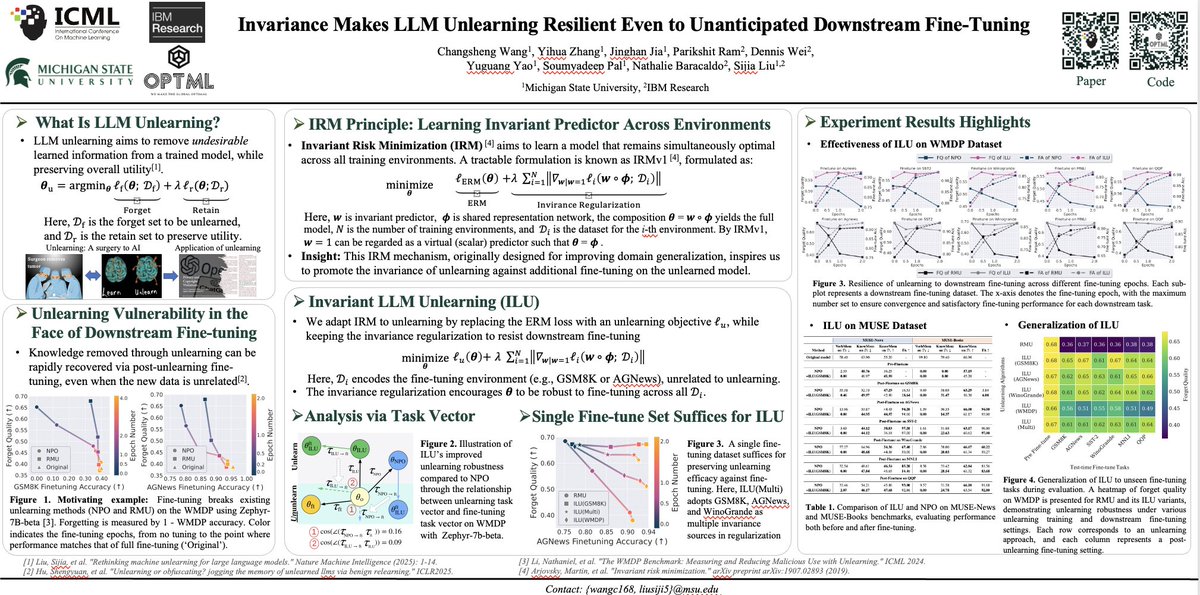
🎯 ICML 2025 Poster!
📄 “Invariance Makes LLM Unlearning Resilient Even to Unanticipated Downstream Fine-Tuning”
🔗 https://t.co/6MQZVtynMv
🗓️ July 15, 4:30–7:00 pm PT
📍 East Exhibition Hall A-B, #E-1108
🧍♂️ I won’t be there in person — but feel free to drop by and chat with my co-authors!
🧠 The Problem
You’ve erased sensitive info from your LLM.
But then someone fine-tunes it again—and boom, it comes back.
🔁 This is the downstream fine-tuning attack.
So the question is:
Can unlearning remain resilient, even under unseen, future fine-tuning?
🎯 Our Solution: ILU (Invariant LLM Unlearning)
We make forgetting stick by enforcing invariance—training models to be robust to downstream shifts.
Using IRM-based regularization, we ensure that fine-tuning has minimal impact on forgotten content.
➡️ No task-specific tricks. Just principled, built-in resilience.
🧩 Key Contributions
✅ ILU plugs into SOTA methods like RMU and NPO and makes them tougher.
✅ Just one unrelated fine-tuning set is enough to generalize.
✅ On WMDP, we get +23% robustness across 6 downstream tasks—with zero utility drop.
👥 With amazing collaborators from MSU: @zyh2022, @Jinghan Jia, @Hi_Soumyadeep, and my advisor @sijialiu17.
Big thanks to our IBM collaborators from @MITIBMLab: @NathalieBaraca1, Dennis Wei, @p_ram_p
Flow Matching (FM) is one of the hottest ideas in generative AI - and it’s everywhere at #ICML2025.
But what is it? And why is it so elegant? 🤔
This thread is an animated, intuitive intro into (Variational) Flow Matching - no dense math required.
Let's dive in! 🧵👇
It was a huge week of AI and robotics news.
So I summarized everything announced by Meta, Harvard, Engineered Arts, Tesla, Leju Robotics, OpenAI, Zoom, Agility Robotics, and Amazon.
Here's everything you need to know and how to make sense out of it:
🎥 Today we’re premiering Meta Movie Gen: the most advanced media foundation models to-date.
Developed by AI research teams at Meta, Movie Gen delivers state-of-the-art results across a range of capabilities. We’re excited for the potential of this line of research to usher in entirely new possibilities for casual creators and creative professionals alike.
More details and examples of what Movie Gen can do ➡️ https://t.co/M19x2ndwnr
🛠️ Movie Gen models and capabilities
Movie Gen Video: 30B parameter transformer model that can generate high-quality and high-definition images and videos from a single text prompt.
Movie Gen Audio: A 13B parameter transformer model that can take a video input along with optional text prompts for controllability to generate high-fidelity audio synced to the video. It can generate ambient sound, instrumental background music and foley sound — delivering state-of-the-art results in audio quality, video-to-audio alignment and text-to-audio alignment.
Precise video editing: Using a generated or existing video and accompanying text instructions as an input it can perform localized edits such as adding, removing or replacing elements — or global changes like background or style changes.
Personalized videos: Using an image of a person and a text prompt, the model can generate a video with state-of-the-art results on character preservation and natural movement in video.
We’re continuing to work closely with creative professionals from across the field to integrate their feedback as we work towards a potential release. We look forward to sharing more on this work and the creative possibilities it will enable in the future.
Excited to attend #ECCV2024 to present two of our recent works on the adversarial aspects of machine unlearning in computer vision! One explores "challenging forgets", while the other studies unlearning robustness in text-to-image generation. My student @ChongyuFan will lead the presentations. Join us at our poster sessions for further discussion!
🗓 Wed, Oct 2 @ 10:30 AM:
"Challenging Forgets: Unveiling the Worst-Case Forget Sets in Machine Unlearning"
🔗 https://t.co/rioIIak9PP
🗓 Thu, Oct 3 @ 10:30 AM:
"To Generate or Not? Safety-Driven Unlearned Diffusion Models Still Struggle with Unsafe Image Generation"
🔗 https://t.co/D6y1WfdlKE