Most existing cell-cell communication methods use the product of ligand and receptor expression to indicate the strength of L-R interactions between two cell groups. But can we leverage the gene regulatory network-level information to infer significant L-R pairs? A thread 🧵
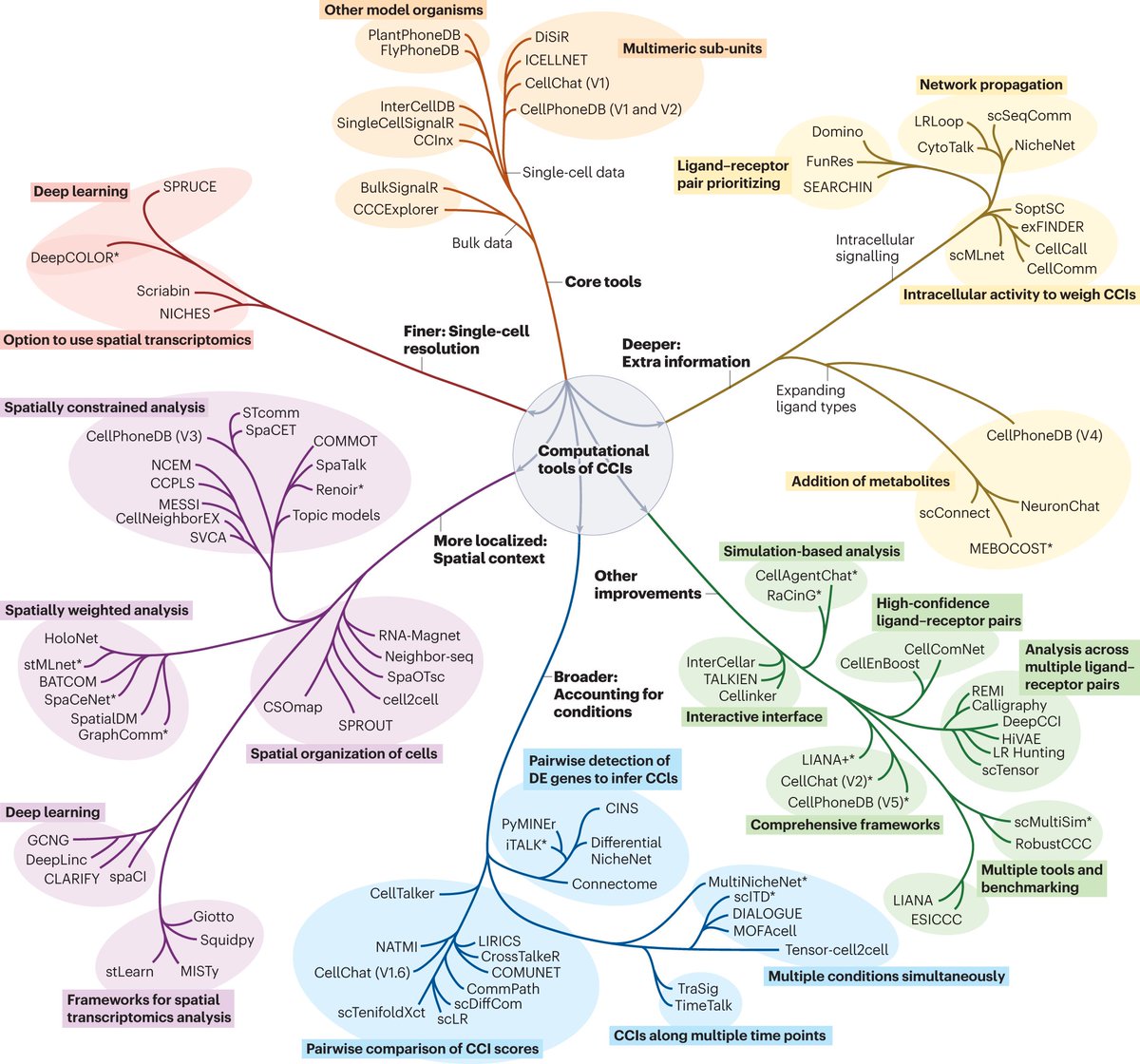
These past few years have seen a rapid expansion of cell-cell communication research. Check out @eagut's new @NatureRevGenet review of the diverse methods leveraging single-cell and spatial omics: https://t.co/0hEe8T3Ld2
How to decipher subcellular gene patterns in spatial transcriptomics data?
We're excited to share Bering, a graph neural network that harnesses subcellular gene colocalization graphs and transfer embeddings for joint cell segmentation and annotation (1/n)
https://t.co/qp2MvJVJ0g.
Can virtual KO experiments be carried out using only wild-type data? 🧬🧬🧬 Check out our new paper which was just published in Nucleic Acids Research @NAR_Open at https://t.co/nfmG0THL9m
A graph-based generative model like VGAE can then learn the similarity between the representations of genes in the two cases. Output is designed as a ranked list of perturbed genes for any downstream gene set analyses.
@jamescai@XShirleyLiu We have just uploaded a preprint on this topic where we predict surface protein profiles from scRNA-seq data with interpretability for temporal effects as well as gene-protein relationships. @XShirleyLiu
https://t.co/frdpWWLjgP
@jamescai@XShirleyLiu We have just uploaded a preprint on this topic where we predict surface protein profiles from scRNA-seq data with interpretability for temporal effects as well as gene-protein relationships. @XShirleyLiu
https://t.co/frdpWWLjgP
Videos from @recombccb2023 are now available in our @YouTube channel. We are waiting for permissions from a few more authors to release videos and we will update the list as we receive them. https://t.co/O9Yb7GxHMg
1/9 CPAis finally published. It can predict single-cell responses to combinatorial perturbation (drugs, CRISPR). This is a joint collab between @meta and @fabian_theis@HelmholtzMunich. Read the thread to understand the LEGO analogy! https://t.co/Ia87dfgdBF
Most existing cell-cell communication methods use the product of ligand and receptor expression to indicate the strength of L-R interactions between two cell groups. But can we leverage the gene regulatory network-level information to infer significant L-R pairs? A thread 🧵
More information can be found in our GitHub https://t.co/gDBQXZc8qc Thanks to my supervisor @jamescai and all collaborators for their invaluable support and contributions! :) @CellSystemsCP #SingleCell#scRNAseq#scTenifoldXct
Most existing cell-cell communication methods use the product of ligand and receptor expression to indicate the strength of L-R interactions between two cell groups. But can we leverage the gene regulatory network-level information to infer significant L-R pairs? A thread 🧵
Geneticists were often more interested in comparing two samples, such as healthy vs. diseased. So, how do we infer those differential L-R pairs? We proposed constructing a coupled joint similarity matrix (Fig. B) following the rule in the single-sample case.