#NeurIPS2022
What are ideal representations for self-sup. learning (SSL)?
🤓We give simple optimality conditions and use them to improve/understand/derive SSL methods!
🔥outperform baselines on ImageNet
https://t.co/SbFaePX2Z0
w. @tatsu_hashimoto@StefanoErmon@percyliang
🧵
#NeurIPS2022
What are ideal representations for self-sup. learning (SSL)?
🤓We give simple optimality conditions and use them to improve/understand/derive SSL methods!
🔥outperform baselines on ImageNet
https://t.co/SbFaePX2Z0
w. @tatsu_hashimoto@StefanoErmon@percyliang
🧵
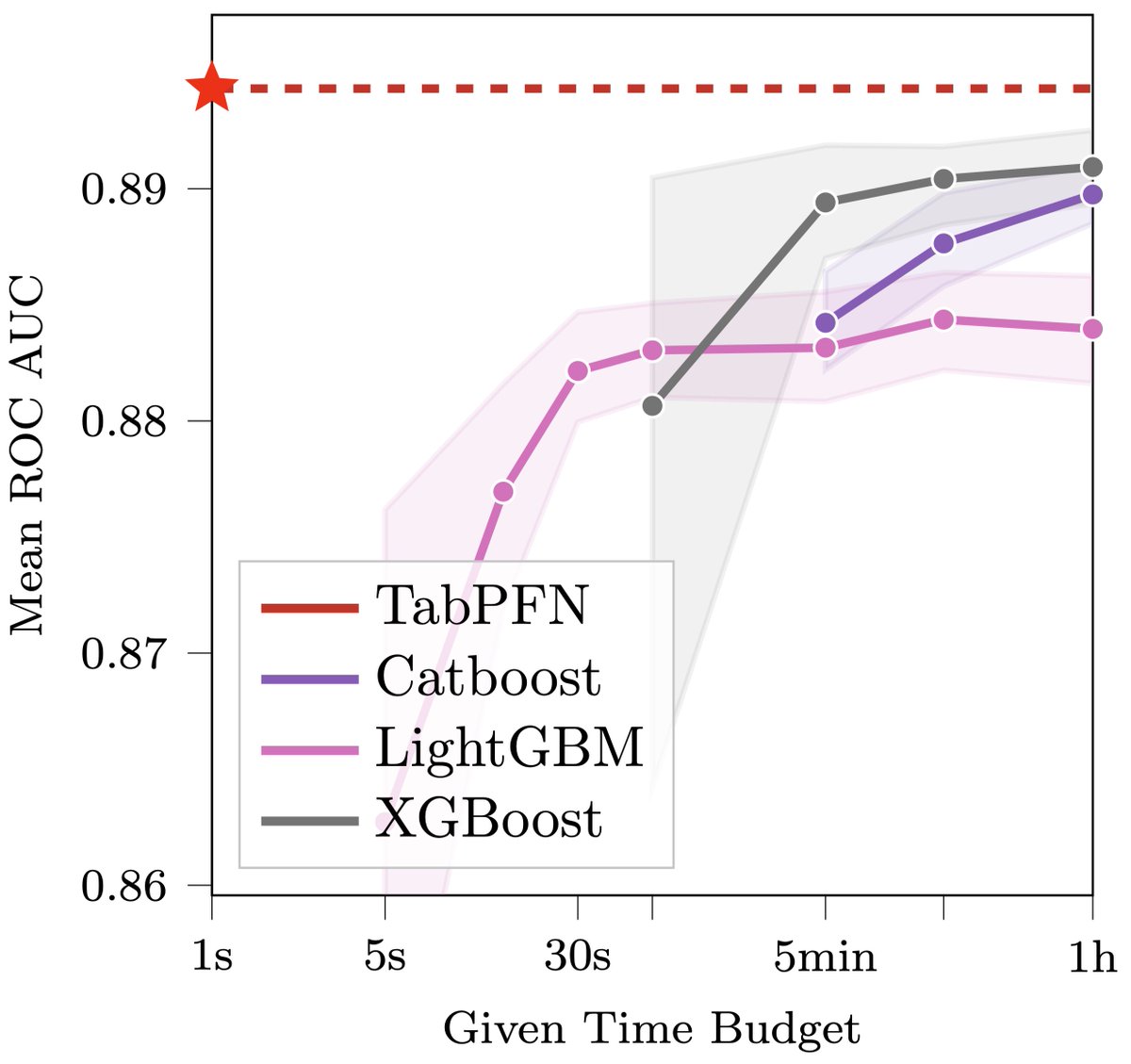
This may revolutionize data science: we introduce TabPFN, a new tabular data classification method that takes 1 second & yields SOTA performance (better than hyperparameter-optimized gradient boosting in 1h). Current limits: up to 1k data points, 100 features, 10 classes. 🧵1/6
New equilibria can be defined that are not subsets of Nash but instead generalize superrationality. They are at most unique and Pareto-optimal. A first analysis shows that social utility metrics are higher than those of Nash for the studied games.
As Machine Learning predictions become more accurate, the assumptions behind Nash game theory are pushed to the limits of their validity because of the prediction<->decision feedback loop. Game theory needs to be adapted with a shift of paradigm.
In addition, Common Knowledge of Rationality (I know they know I know... they are rational) is extended to the more stringent assumption of Necessary Rationality: we are all rational in all possible worlds, even if our decisions had been different.
Happy to finally share our work!
Joint collaboration with Louay Hazami and Ragavan Thurairatnam.
Efficient-VDVAE obtain SOTA log-likelihood on 7 commonly used image datasets. We make an argument against 5-bit benchmarks and lay some ground work for downstream tasks with HVAEs.
I’m excited to present our paper CM3: A Causal Masked Multimodal Model of the Internet where we train a model that can do zero-shot unconditional/conditional image generation (PixelCNN/DALL-E), image-infilling/captioning, entity linking/disambig, summarization all with prompting!
.@robintibor et al. propose a new method that "simplifies" images, allowing better dataset condensation and debugging and failures!
https://t.co/D0oborbBN0
Are all bits useful? How can we simplify images, and how do “simpler” images affect neural network training?🤔 with @sarahookr@savvyRL Tonio Ball
Paper: https://t.co/vUiljFOQ4j
Code: https://t.co/JjcsWvf4sX
🧵
.@BlancheMinerva evaluates how well GPT-J plagiarizes by investigating MOSS' "plagiarism score" and finds that it outperforms humans.
https://t.co/ixLw6fYpYI
Excited to share my newest paper, "Neural Language Models are Effective Plagiarists" with @EdwardRaffML. We took a dataset of CS 101 assignments and asked "can a language model do a good job solving these with minimal human intervention or knowledge?"
https://t.co/LcinStQ4ag
We had the privilege of presenting our Sim2Real Docs project at @NeurIPSConf 2021 DCAI.
TLDR: Python library for synthetic images of documents in natural scenes using @Blender.
It's open source:
https://t.co/47UQecCmfw
It's @nmaddikunta21's first paper:
https://t.co/tDI1eQ6WfG
We had the privilege of presenting our Sim2Real Docs project at @NeurIPSConf 2021 DCAI.
TLDR: Python library for synthetic images of documents in natural scenes using @Blender.
It's open source:
https://t.co/47UQecCmfw
It's @nmaddikunta21's first paper:
https://t.co/tDI1eQ6WfG
distribution of value at every time step, instead of attempting to solve everything by taking only the expectation, which gives a very narrow view of the environment. Related works to this are QR DQN and TQC.
When I discovered this paper and it's related papers, I thought it would have much higher reach than what I'm currently seeing, seeing that it's a more elegant way of thinking about the Bellman Equation. At it's core, DRL directly models the
Grokking: Generalization Beyond Overfitting on Small Algorithmic Datasets
abs: https://t.co/AjYuSpyzU3
NNs learn through a process of "grokking" a pattern in the data, improving generalization performance from random chance level to perfect generalization
.@jonLorraine9 et al conduct an in-depth analysis of optimizers and propose a new one that incorporates a "branching" mechanic.
https://t.co/7LZu0fXwgV
When minimizing objectives, randomly initializing + optimizing can fail to find different solutions. We give a branching optimization method for this using Lyapunov exponents..1/11
https://t.co/WjL7s3DT8X @AAMAS2022
With @PaulVicol@jparkerholder@TalKachman@Luke_Metz@j_foerst
When minimizing objectives, randomly initializing + optimizing can fail to find different solutions. We give a branching optimization method for this using Lyapunov exponents..1/11
https://t.co/WjL7s3DT8X @AAMAS2022
With @PaulVicol@jparkerholder@TalKachman@Luke_Metz@j_foerst