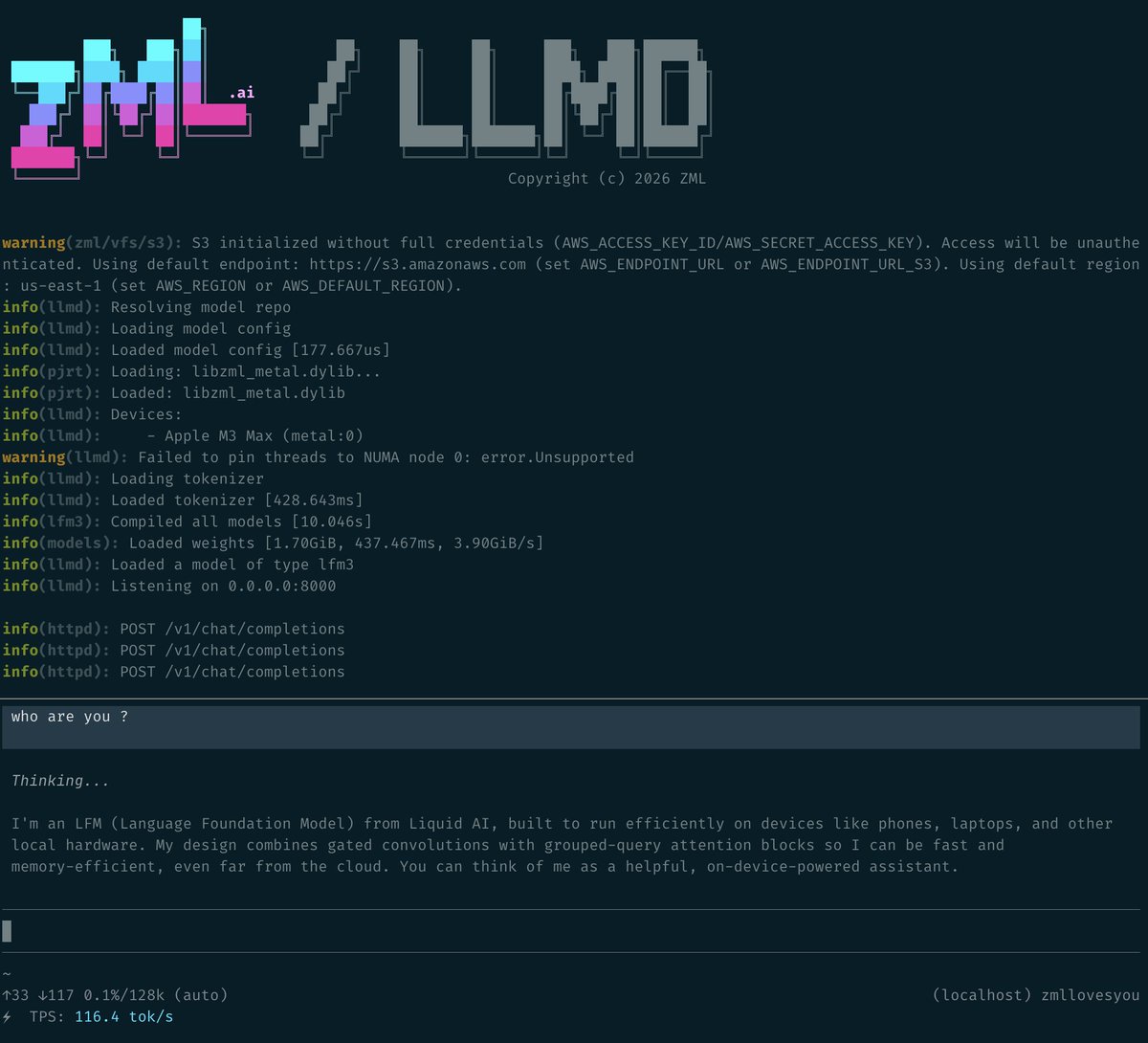
Mathias is making series of videos how to use offline models without agents , that old school way of doing tech that we no longer practice, recommend during your Claude session time.
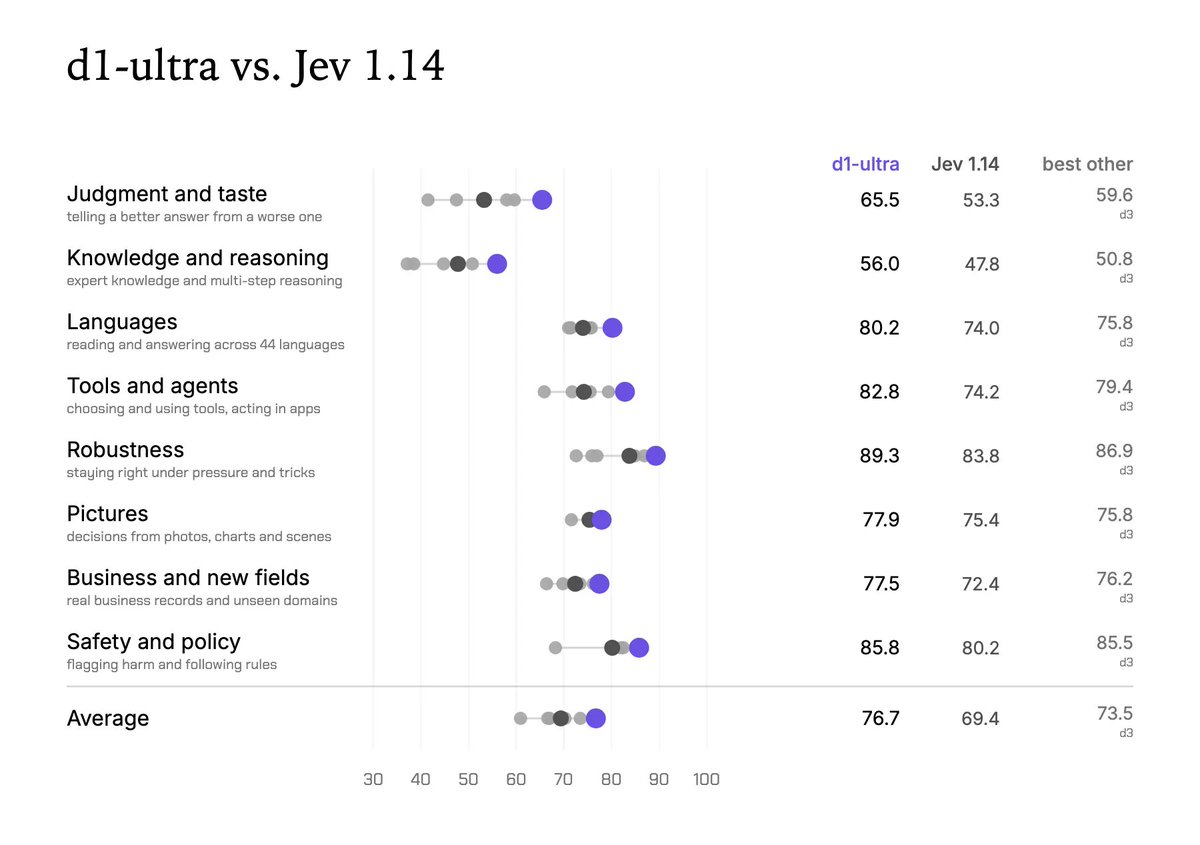
Today we release 𝚍𝟷-𝚞𝚕𝚝𝚛𝚊, our most powerful decision model.
> built for hard decision problems.
> d1-ultra is multimodal
> supports 44 languages
> #1 on the @ArtificialAnlys Decision Index (65)
> leads all eight categories of our 112-evaluation suite
1/
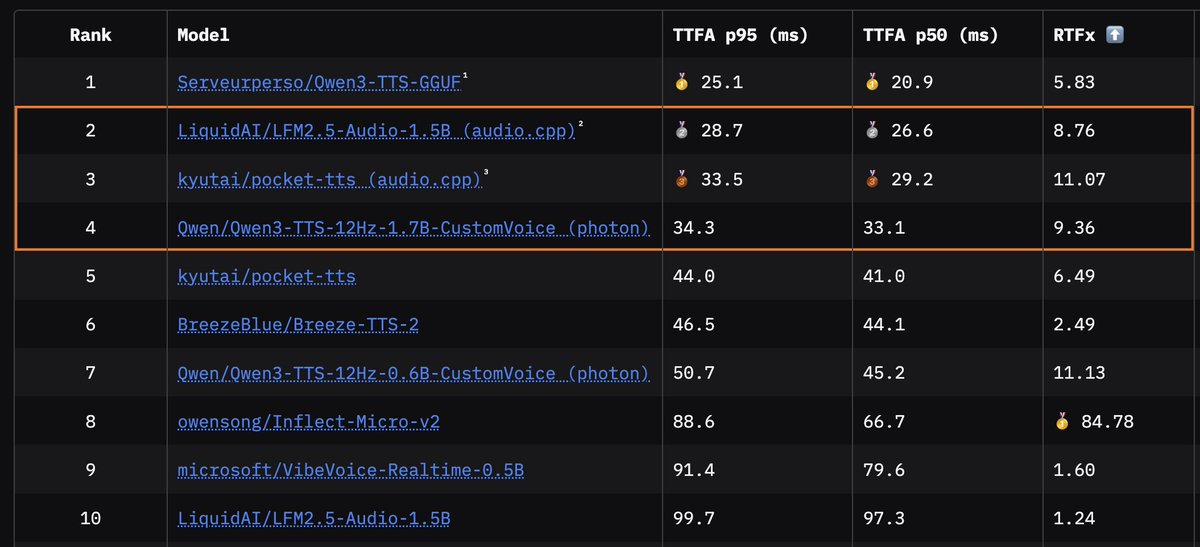
audio.cpp and photon bring low-latency streaming to open models: under 35 ms p50 / 35 ms p95 time-to-first-audio on A100.
Check them out if you're building voice agents 🤖
I had the pleasure of opening the Qualcomm Snapdragon summit day II with the legendary @cristianoamon. Our shared goal is to bring production-grade personalized AI to billions of devices from wearables to phones, and cars.
We announced Liquid context a deep shared memory layer for AI agents to operate cross device platforms. This is an enterprise product for OEMs to integrate on their snapdragon platforms.
OEMs get a shared foundation for personal context, plus a strong embedded agent they can choose to build with. Targeting the end of October for OEM testing!
incredibly grateful to Cristiano and the entire Qualcomm team for the start of this great partnership and the incredible road ahead!
Watch the full show: https://t.co/9q1X4Bxmo6
@Qualcomm 🤝@liquidai
Today, we release an experimental DSpark draft model for LFM2.5-VL-3B, bringing speculative decoding to our vision-language models.
A lightweight drafter proposes multiple tokens ahead, and the target model verifies them together in a single pass. This accelerates generation without changing output quality.
Across six vision-language task categories at batch size 1 and temperature 0:
> MLX on M5 Max: up to 3.13x faster decoding and 2.62x end to end
> llama.cpp on M3 Ultra: up to 2.14x faster decoding and 1.77x end to end
> SGLang on H100: up to 2.66x faster decoding and 2.27x end to end
All evaluations were collected using Pipette, the benchmarking infrastructure behind Liquid AI's public device-performance data.
🧵
We're partnering with @Qualcomm to bring personal AI context to devices powered by Snapdragon. Liquid Context, our on-device context layer, is now optimized for Snapdragon processors and runs on the Qualcomm Hexagon NPU.
Our goal: Give the agents people choose an understanding of what matters to them and when they need help. With the user's permission, Liquid Context learns from device signals and builds an understanding of their routines, preferences, and needs. That understanding is built and maintained locally, and Liquid Context shares relevant context with the user's chosen agents, whether they run on the device, in the cloud, or across both. That includes third-party agents and Liquid Agent, our efficient embedded agent powered by LFM2.5-2.6B.
Running on the Hexagon NPU, Liquid Context works in the background and keeps that understanding current without requiring a cloud model to process every update.
For device manufacturers, this is a path to add personal context to their devices while supporting their own choice of agents and services. OEMs building embedded or hybrid agents can also work with us to evaluate Liquid Agent.
As our CEO @ramin_m_h said: "Personal AI starts with understanding how you live and what you need, when you need it. Liquid Context builds that understanding on your device so the agents you choose can offer more relevant help and anticipate your needs."
> Read more about our partnership: https://t.co/qPBlES34qS
> Check out the livestream of @cristianoamon and Ramin's keynote here: https://t.co/UcqtQGHuuu
Device intelligence is about what an agent delivers within a time and memory budget. Combining Artificial Analysis’s 16K-context intelligence, end-to-end latency, peak memory and one-minute task completion scores places four of five LFM2.5 models on the joint Pareto frontier on both iPhone 17 Pro and Galaxy S26 Ultra.
LFM2.5-2.6B ranks co-first with Nanbeige 3B on intelligence among 39 models tested including models 3-10x larger, with roughly 40% less memory footprint and 3x lower latency.
On iPhone, that means 2.32 GB peak memory and 8.0s end-to-end latency, versus Nanbeige’s 4.03 GB and 21.4s. On Galaxy, it’s 2.45 GB and 18.6s, versus 4.13 GB and 71.4s. It is currently the highest-scoring model below 2.5 GB on both tested devices, on the market.
The family’s strength is delivering competitive intelligence across multiple practical device budgets. LFMs are designed to be customized. With customization you can truly unlock reliable agentic AI locally. 🐘
https://t.co/iy1c1nw97W
Today we release Pipette, a model evaluation suite for on-device intelligence, in partnership with @ArtificialAnlys
Most benchmarking platforms are optimized to measure core capabilities and speed profile of foundation models served in the cloud. Pipette gives the field a common, reproducible way to measure the quality, speed, latency, and memory use of AI models on devices such as phones, laptops, PCs, AI boxes, and embedded hardware.
> Pipette is open source
> In Pipette, models get compated as model + quantization + runtime + device from one interface.
> It comes with a warehouse of verified benchmark results, currently with 10k+ results across 35 model classes, 7 quants, llama.cpp runtimes, and 4 devices.
> Pipette is a dynamic platform, allowing new contributions from day one, adding new devices, runtimes, model families, and quantization levels.
🧵