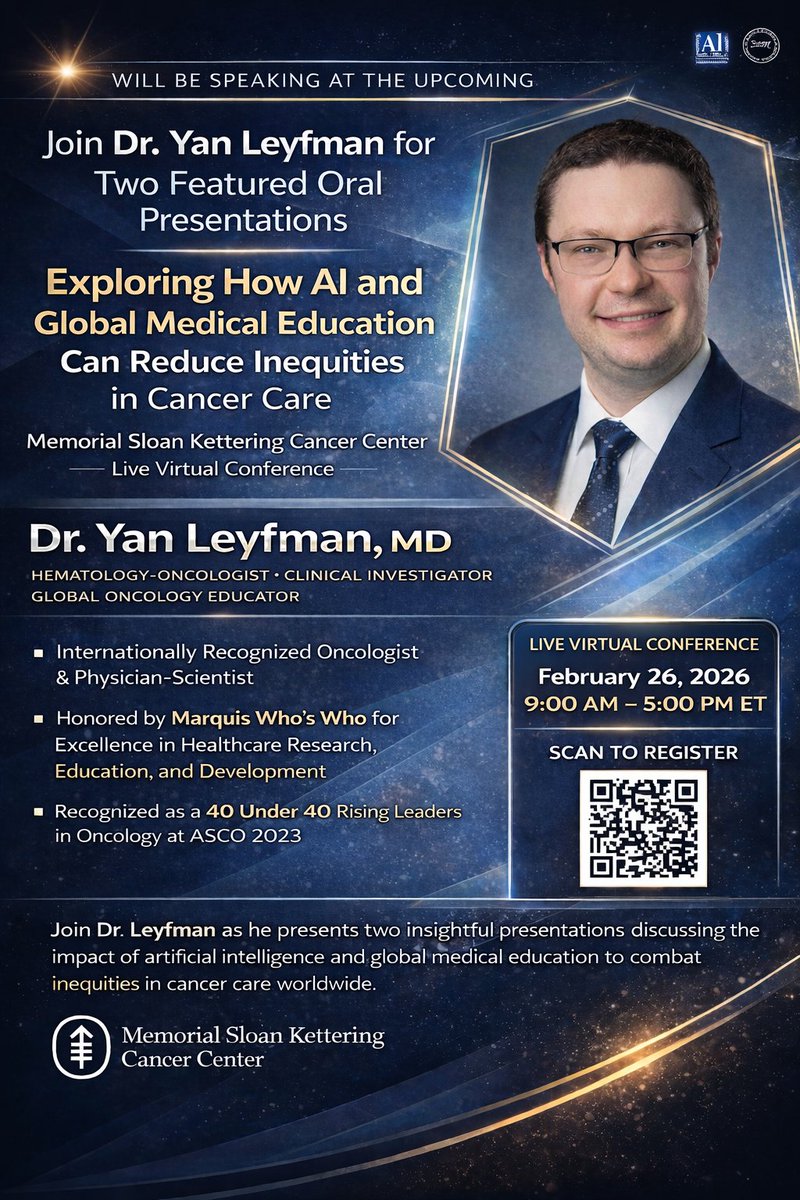
Honored and grateful to be invited to speak at this outstanding forum hosted by Memorial Sloan Kettering Cancer Center 🌍✨
I’m excited to share two oral presentations exploring how global oncology, AI, and evidence-based innovation can be translated into real-world action to reduce inequities in cancer care worldwide 📊🧬🤝
Immense gratitude to my mentors, Dr. Bonilla & Dr. Park, and collaborators whose guidance, support, and trust continue to shape this work — none of this is possible without you 🙏💙
Looking forward to engaging conversations, learning alongside leaders across disciplines, and advancing our shared mission to improve cancer care for patients everywhere 🌎🔬
@DrArturoAI@CParkMD
🧬 A new era in regenerative medicine begins.
The first patient has been treated in a first-in-human clinical trial evaluating partial cellular reprogramming for glaucoma—a milestone in the quest to restore function to aging tissues.
Researchers are activating three reprogramming genes (excluding the oncogenic c-MYC factor) to rejuvenate retinal ganglion cells and promote regeneration of the optic nerve, a tissue traditionally considered incapable of meaningful repair. Gene expression is controlled with doxycycline, providing an added layer of safety by allowing investigators to switch the therapy on and off.
The approach builds on compelling preclinical studies showing reversal of vision loss and optic nerve regeneration in aged animal models. However, important questions remain regarding long-term safety, durability, and the potential risk of tumor formation.
While this study targets glaucoma rather than aging itself, it represents one of the first clinical tests of partial cellular reprogramming in humans—and could mark an important step toward regenerative therapies for age-related diseases.
The future of medicine may involve not only slowing disease progression, but restoring the biology of aging tissues.
#GeneTherapy #RegenerativeMedicine #Longevity #Aging #Glaucoma #ClinicalTrials #CellReprogramming #Ophthalmology #Biotechnology #Medicine
https://t.co/u0jnlasmZ1
📹May’s ONCOLOGY Monthly Spotlight is on its way (just a tad late)! @YLeyfman breaks down why CAR-T is transforming expectations in multiple myeloma.
📖 Emerging T-Cell Engagers and Novel Immunotargets in Multiple Myeloma
https://t.co/ORg2aegQ6T
Read the latest from ONCOLOGY and join the discussion!
#mmsm #hematology #oncology | @Abdallah81MD
Can AI predict diabetes before it begins?
That's the question we explore in the latest episode of Translational Edge.
As medicine moves from treating disease to preventing it, predictive analytics may fundamentally change how we identify risk, intervene earlier, and improve outcomes.
A fascinating discussion on the future of AI-driven prevention, precision medicine, and digital health.
🎙️Predicting Diabetes Before It Begins
Watch here: https://t.co/zpmDl4zAXu
What healthcare challenge do you think AI is most likely to solve next?
#TranslationalEdge #ShufAI #ArtificialIntelligence #DigitalHealth #PrecisionMedicine #Diabetes #HealthTech #HealthcareInnovation #PredictiveAnalytics #FutureOfMedicine
🧬 Can a blood test reveal which cells in your body are aging fastest?
A landmark study analyzing 7,000+ plasma proteins from over 60,000 individuals used AI to estimate the biological age of 40+ different cell types—from neurons and astrocytes to immune cells and skeletal muscle.
Key findings:
🔹 Aging is highly cell-specific, not uniform across the body.
🔹 Accelerated aging signatures predicted future disease risk, including Alzheimer's disease, ALS, and lung cancer.
🔹 A new polycellular aging score stratified long-term mortality risk over 15 years.
This work moves beyond measuring "how old you are" biologically—it asks which tissues are aging the fastest, opening the door to more personalized disease prevention and precision medicine.
While these biomarkers remain investigational, they represent an exciting step toward earlier detection of age-related disease and individualized healthcare.
https://t.co/MWh5DYyYlT
#Aging #ArtificialIntelligence #Proteomics #PrecisionMedicine #Biomarkers #Longevity #MachineLearning #Medicine #Research
🚨 Watch @MedNewsWeek & @oncodaily 's Medical Spotlight Webinar!
🔬 Dr. Paolo Strati presents:
"Revolutionizing First-Line Care: AR² Therapy for Indolent B-Cell Lymphoma"
Link: https://t.co/hlJrJBFZJc
Highly recommended for clinicians, researchers, students & oncology experts!
A single infusion. Durable gene editing. Remarkable reduction in hereditary angioedema attacks.
The phase 3 HAELO trial demonstrated that lonvoguran ziclumeran (lonvo-z), an investigational in vivo CRISPR gene-editing therapy, significantly reduced hereditary angioedema (HAE) attacks after a single intravenous infusion.
Key findings:
🔹 87% reduction in monthly HAE attack rate versus placebo (P<0.001)
🔹 Monthly attack rate: 0.26 vs 2.10 attacks/month
🔹 Single 50-mg intravenous infusion
🔹 Median follow-up: 7.5 months
🔹 No serious or grade ≥3 treatment-related adverse events reported
Hereditary angioedema is a rare, inherited disorder characterized by recurrent episodes of potentially life-threatening swelling. Current preventive therapies often require lifelong repeated dosing. In contrast, lonvo-z is designed as a one-time in vivo CRISPR gene-editing treatment, targeting the underlying biology of the disease.
If these results are confirmed with longer-term follow-up, this approach could fundamentally change the treatment paradigm—from chronic disease management to durable genetic intervention.
This study also represents another important milestone for in vivo CRISPR therapeutics, demonstrating that precision gene editing can translate into meaningful clinical benefit in a randomized phase 3 trial.
#GeneEditing #CRISPR #HereditaryAngioedema #RareDisease #PrecisionMedicine #GenomicMedicine #ClinicalTrials #Innovation #Biotechnology
https://t.co/jP5hAalS5r
🚨 What if we could move beyond “watch and wait” and fundamentally rethink first-line therapy for indolent B-cell lymphomas?
Join us for the next episode of MedNews Week Medical Spotlight featuring Paolo Strati, one of the world's leading experts in lymphoma immunotherapy and cellular therapy.
Dr. Strati serves as:
• Deputy Section Chief for Indolent B-Cell Lymphomas
• CARTOX Program Leader
• Internationally recognized investigator in lymphoma therapeutics
In this masterclass, Dr. Strati will discuss the emerging role of AR² therapy and how novel treatment strategies are reshaping the frontline management of indolent B-cell lymphomas.
Topics include:
🔹 Evolution of first-line treatment paradigms
🔹 Clinical data supporting AR² therapy
🔹 Patient selection and practical implementation
🔹 Future directions in lymphoma care
Whether you're a hematologist, oncologist, trainee, advanced practitioner, researcher, or patient advocate, this is a discussion you won't want to miss.
📺 https://t.co/6XJO8y4DNN
#Lymphoma #Hematology #Oncology #Immunotherapy #CellTherapy #MedicalEducation #MedTwitter #HemOnc #CancerResearch #MDAnderson #BCellLymphoma @MedNewsWeek
One of the most rewarding parts of MedNews Week is watching talented individuals grow and find their voice.
It's been wonderful to see your development Adeena over the past several months and the impact you've already made through education, research, and community building. Thank you for your dedication to our mission and for everything you contribute to the team.
Excited to see what the future holds for you. The journey is just getting started!
🚨 What if we could move beyond “watch and wait” and fundamentally rethink first-line therapy for indolent B-cell lymphomas?
Join us for the next episode of MedNews Week Medical Spotlight featuring Paolo Strati, one of the world's leading experts in lymphoma immunotherapy and cellular therapy.
Dr. Strati serves as:
• Deputy Section Chief for Indolent B-Cell Lymphomas
• CARTOX Program Leader
• Internationally recognized investigator in lymphoma therapeutics
In this masterclass, Dr. Strati will discuss the emerging role of AR² therapy and how novel treatment strategies are reshaping the frontline management of indolent B-cell lymphomas.
Topics include:
🔹 Evolution of first-line treatment paradigms
🔹 Clinical data supporting AR² therapy
🔹 Patient selection and practical implementation
🔹 Future directions in lymphoma care
Whether you're a hematologist, oncologist, trainee, advanced practitioner, researcher, or patient advocate, this is a discussion you won't want to miss.
📺 https://t.co/6XJO8y4DNN
#Lymphoma #Hematology #Oncology #Immunotherapy #CellTherapy #MedicalEducation #MedTwitter #HemOnc #CancerResearch #MDAnderson #BCellLymphoma @MedNewsWeek