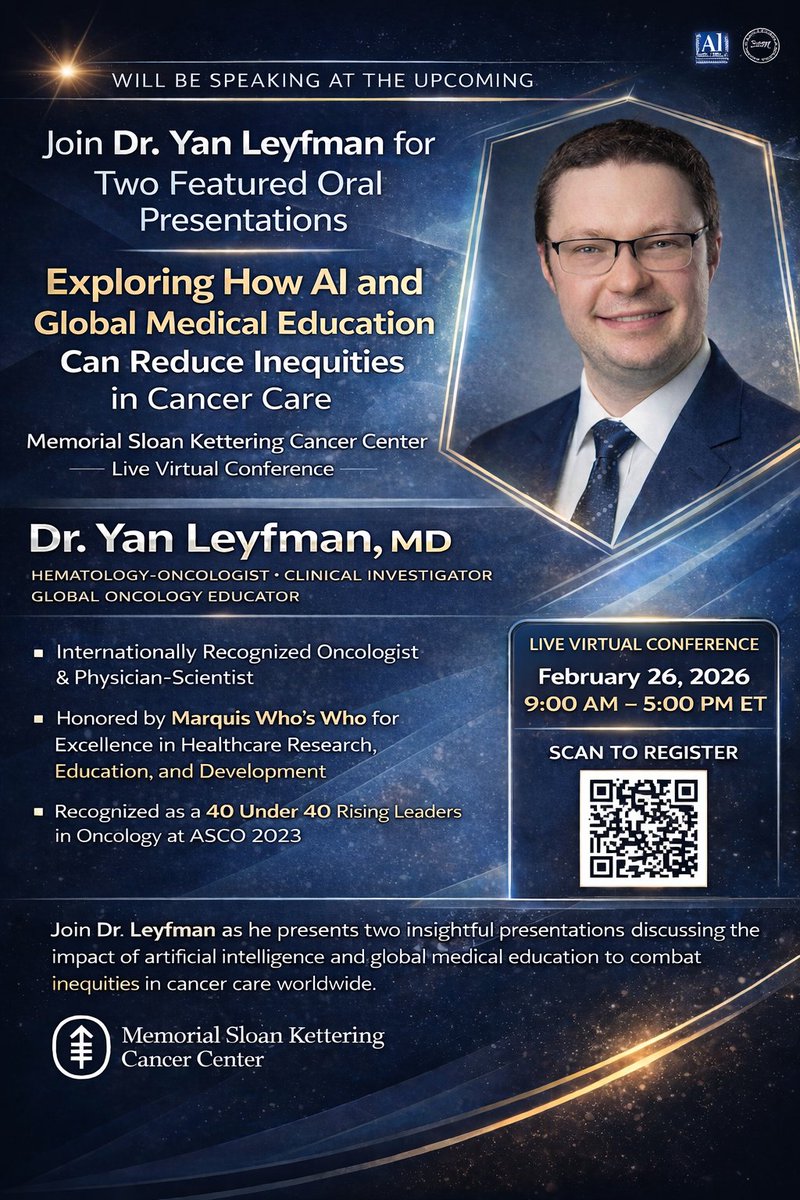
Honored and grateful to be invited to speak at this outstanding forum hosted by Memorial Sloan Kettering Cancer Center 🌍✨
I’m excited to share two oral presentations exploring how global oncology, AI, and evidence-based innovation can be translated into real-world action to reduce inequities in cancer care worldwide 📊🧬🤝
Immense gratitude to my mentors, Dr. Bonilla & Dr. Park, and collaborators whose guidance, support, and trust continue to shape this work — none of this is possible without you 🙏💙
Looking forward to engaging conversations, learning alongside leaders across disciplines, and advancing our shared mission to improve cancer care for patients everywhere 🌎🔬
@DrArturoAI@CParkMD
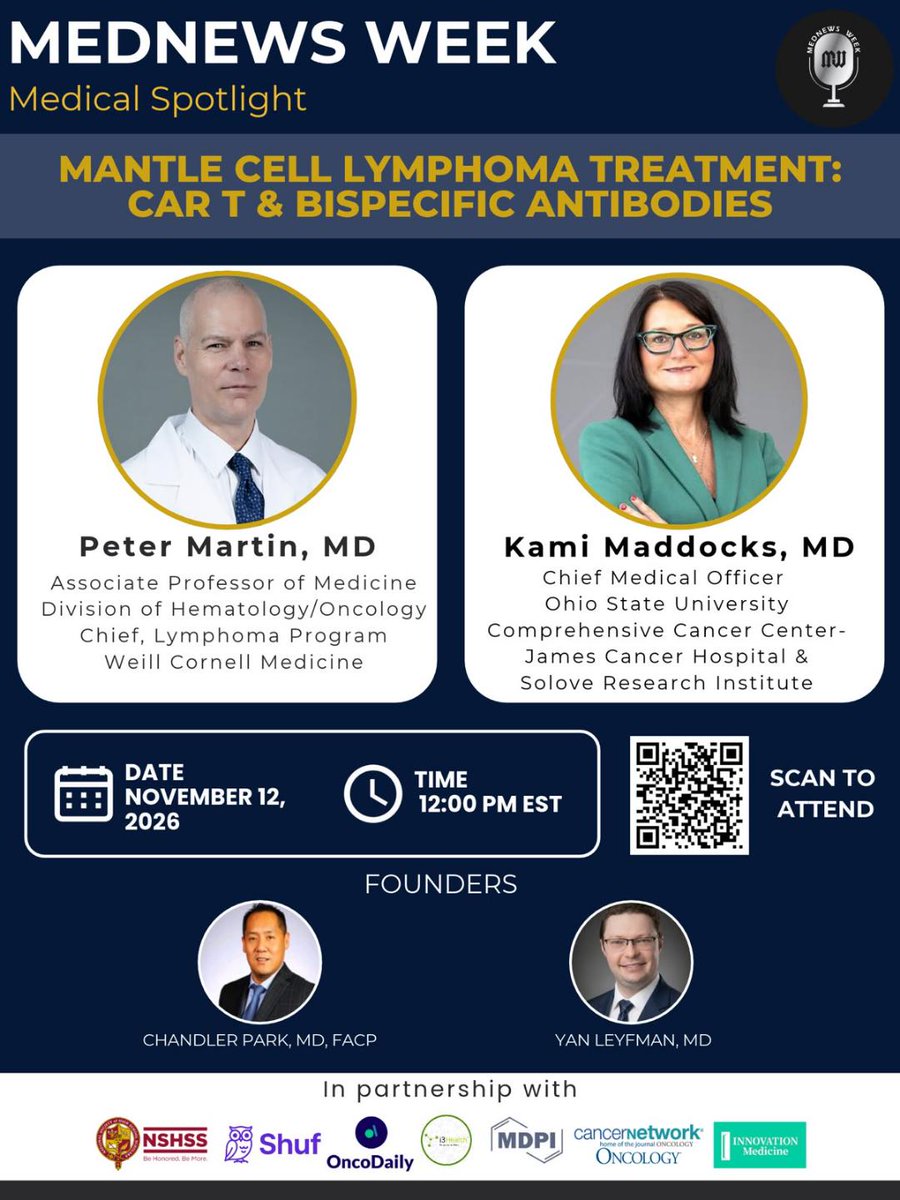
🔥 Mantle Cell Lymphoma from A to Z: A Masterclass with Two Pioneers of the Field
MedNews Week had the extraordinary privilege of bringing together two internationally renowned leaders whose contributions have helped redefine the mantle cell lymphoma treatment landscape:
🌟 Dr. Peter Martin — Chief of the Lymphoma Program at Weill Cornell Medicine, appointed Chair of the Lymphoma Research Foundation’s Mantle Cell Lymphoma Consortium Executive Committee, and LRF 2026 Career Laureate.
🌟 Dr. Kami Maddocks — Chief Medical Officer at The Ohio State University Comprehensive Cancer Center – James Cancer Hospital, a distinguished lymphoma expert and pioneering clinical investigator whose research has helped advance novel therapeutic strategies for patients with MCL.
From frontline management and treatment sequencing to BTK inhibitors, CAR T-cell therapy, bispecific antibodies, and emerging therapeutic strategies, this exceptional scientific exchange offers invaluable clinical perspectives from two leaders helping shape the future of lymphoma care.
More than a scientific discussion, this is an opportunity to learn directly from the minds behind the advances.
A must-watch for hematologists, oncologists, trainees, and researchers alike.
🎥 Watch the full episode:
https://t.co/0d9HclvqH8
Two pioneers. One extraordinary conversation. A can't-miss masterclass.
#MedNewsWeek #MantleCellLymphoma #Lymphoma #Hematology #Oncology #CART #BispecificAntibodies #MedicalEducation #OncoDaily
🔥 Mantle Cell Lymphoma from A to Z: A Masterclass with Two Pioneers of the Field
What happens when two of the world's foremost authorities on mantle cell lymphoma come together for an unfiltered scientific and clinical exchange?
An educational experience you simply cannot afford to miss.
At MedNews Week, in partnership with OncoDaily, we had the distinct privilege of bringing together two extraordinary physician-scientists whose contributions have helped reshape the mantle cell lymphoma treatment landscape:
🌟 Dr. Peter Martin — a pioneer in mantle cell lymphoma research, Chair of the Lymphoma Research Foundation's Mantle Cell Lymphoma Consortium, and recipient of the Foundation's prestigious 2026 Distinguished Leadership Award, recognizing his remarkable contributions to advancing lymphoma research and patient care.
🌟 Dr. Kami Maddocks — Chief Medical Officer at The Ohio State University Comprehensive Cancer Center – Arthur G. James Cancer Hospital and Richard J. Solove Research Institute, an internationally renowned lymphoma expert whose groundbreaking clinical research and leadership have been instrumental in advancing novel therapeutic strategies for patients with mantle cell lymphoma.
Together, these exceptional leaders take us on a comprehensive journey through the evolving landscape of mantle cell lymphoma, from foundational principles to the next frontier of precision medicine and cellular immunotherapy.
Topics include:
🔹 Frontline treatment and chemotherapy-free approaches
🔹 High-risk disease biology and individualized treatment strategies
🔹 The emerging role of measurable residual disease (MRD)
🔹 BTK inhibitors and the potential for fixed-duration therapy
🔹 Treatment sequencing in relapsed/refractory disease
🔹 CAR T-cell therapy and bispecific antibodies
🔹 The future of mantle cell lymphoma management
This is more than a review of the latest clinical evidence. It is a rare opportunity to learn how two individuals who have helped shape the field interpret the evidence, navigate clinical uncertainty, and envision the future of lymphoma care.
Whether you are a practicing hematologist, oncologist, fellow, researcher, or healthcare professional seeking to deepen your understanding of mantle cell lymphoma, this is an episode worth bookmarking and sharing with your colleagues.
On behalf of MedNews Week, we extend our deepest gratitude to Dr. Martin and Dr. Maddocks for their generosity, mentorship, and unwavering commitment to advancing science, medical education, and patient care.
🎥 Watch the full Clinical Exchange exclusively on @oncodaily:
https://t.co/0d9HclvqH8
Two pioneers. One extraordinary conversation. The past, present, and future of mantle cell lymphoma.
#MedNewsWeek #OncoDaily #MantleCellLymphoma #Lymphoma #Hematology #Oncology #CART #BispecificAntibodies #CellularTherapy #PrecisionMedicine #MedicalEducation #BloodCancer
👉👉 Current NCCN guidelines for firstline Rx of CLL
- Tried to capture all essential components in one slide. Hopefully this is easier to read/understand
(For an individual patient Rx decision, several other factors including patient preference are important considerations)
Could in vivo CAR-T make cellular therapy simpler, safer, and more accessible?
One of the major barriers to conventional CAR-T therapy is the complexity of manufacturing: collecting a patient's T cells, engineering them ex vivo, and reinfusing the final product. In vivo CAR-T aims to bypass that process by delivering the genetic instructions directly inside the patient.
CARsgen has reported preliminary clinical data for CT1182 (KJ-C2529), an investigational CD19/CD20-targeting in vivo CAR-T candidate developed using its CARvivo™ platform, in relapsed/refractory B-cell non-Hodgkin lymphoma.
Among six heavily pretreated patients with aggressive lymphoma, including five with DLBCL and one with blastoid mantle cell lymphoma, three achieved complete responses and two partial responses. All responses were ongoing at the October 31, 2026 data cutoff.
The initial safety findings were also notable: only Grade 1 CRS was reported, with no ICANS, dose-limiting toxicities, or treatment-related serious adverse events observed. B-cell aplasia was seen in all responding patients, providing evidence of biological activity.
The findings are encouraging, particularly given the high-risk population and the possibility of avoiding individualized ex vivo manufacturing. However, this remains a very early signal: only six patients were evaluated, with a median follow-up of approximately 3.2 months. Durability, dose optimization, and safety in larger cohorts remain to be established.
If these results hold up in further studies, in vivo CAR-T could represent an important shift in how cellular therapies are delivered — potentially moving CAR-T closer to an off-the-shelf, more accessible treatment model.
https://t.co/7cu2zShnBE
#InVivoCART #CARTherapy #DLBCL #Lymphoma #CellTherapy #Immunotherapy
Can we improve frontline outcomes for patients with high-risk large B-cell lymphoma by adding a bispecific antibody to standard R-CHOP?
Results from arm 1 of the phase 1b/2 EPCORE NHL-2 trial evaluate fixed-duration epcoritamab plus R-CHOP in patients with newly diagnosed LBCL and high-risk International Prognostic Index (IPI) scores of 3–5.
Despite a high-risk population—89% with stage IV disease and 53% with bulky disease—the combination demonstrated impressive activity:
Overall response rate: 98%
Complete response rate: 85%
MRD negativity: 100% of evaluable patients
Estimated 2-year PFS: 80%
Estimated 2-year OS: 87%
After a median follow-up of 44.2 months, median duration of complete response, PFS, and OS had not been reached.
The safety profile included neutropenia (74%), anemia (72%), and cytokine release syndrome (60%). CRS events were predominantly grade 1–2, and all resolved.
The most intriguing finding may be the depth of response: all MRD-evaluable patients achieved MRD negativity, alongside high complete response rates and encouraging long-term disease control.
These results suggest that engaging T cells through CD20×CD3 bispecific therapy may strengthen frontline chemoimmunotherapy for patients with high-risk LBCL.
However, this remains a 47-patient, single-arm phase 1b/2 cohort. The ongoing phase 3 evaluation will be essential to determine whether these results translate into improved outcomes over standard frontline therapy.
The question is no longer simply whether bispecific antibodies can work in aggressive lymphoma, but how best to integrate them into frontline treatment.
https://t.co/GZfxrO4KBO
#DLBCL #LBCL #Lymphoma #Epcoritamab #BispecificAntibodies #Immunotherapy #Hematology
More options. More possibilities. More difficult decisions.
As CAR T-cell therapy and bispecific antibodies reshape the conversation around mantle cell lymphoma, how do we navigate this expanding therapeutic landscape?
Dr. Kami Maddocks & Dr. Peter Martin discuss on @MedNewsWeek
Our @NatureMedicine study of IEC-EC after cilta-cel. This was a true team effort, motivated by our patients, who came to clinic with intractable diarrhea and needed answers. Grateful to be part of this multidisciplinary working group/tumor board.
https://t.co/WUGDcPkXrY
NYU Langone’s Perlmutter Cancer Center is growing its breast medical oncology team in NYC. New trials, new science, new faculty. Come help build what comes next! Apply: https://t.co/1q1s015VDc #BCSM#SABCS26@ASCO@AACR@SusanGKomen@BCRFcure
What if a bispecific antibody could maintain clinical activity in relapsed/refractory multiple myeloma while requiring dosing only once every four weeks?
Etentamig is an investigational BCMA×CD3 bispecific T-cell engager with a distinct molecular design: a low-affinity CD3-binding domain, a high-avidity bivalent BCMA-binding domain, and retained FcRn binding intended to support extended dosing intervals.
Updated results from ongoing phase 1 and phase 1b studies offer an encouraging look at its clinical profile.
Among 146 heavily pretreated patients, with a median of four prior lines of therapy and a median follow-up of 13 months:
Overall response rate: 66%
Very good partial response or better: 54%
Median duration of response: Not reached
Median progression-free survival: Not reached
Grade 3/4 neutropenia: 38%
Grade 3/4 infections: 23%
In the phase 1b cohort receiving a single step-up dose followed by monthly dosing, CRS occurred in 30% of patients—26% grade 1 and 4% grade 2—with no grade 3 or higher events reported in this cohort.
The molecular design is particularly interesting. Lower-affinity CD3 binding may help limit excessive T-cell activation, while bivalent BCMA binding and retained FcRn interaction may support target engagement and prolonged drug exposure.
The potential advantage extends beyond efficacy: less frequent dosing could reduce treatment burden for patients who often require continuous therapy.
These are early-phase, nonrandomized results, and the contribution of each molecular feature to clinical outcomes remains to be established. Nevertheless, etentamig represents an interesting approach to engineering the next generation of BCMA-directed bispecific antibodies.
#MultipleMyeloma #BispecificAntibodies #BCMA #Immunotherapy #TCellEngagers #Hematology #DrugDevelopment
https://t.co/7pgt9FWGfL
Not all patients with relapsed/refractory multiple myeloma respond to T-cell–redirecting bispecific antibodies in the same way. Can we identify who is most likely to benefit—and who faces a particularly high risk of early progression?
A multicenter study involving 15 US centers developed and externally validated a prognostic model for patients receiving BCMA-directed bispecific antibodies or talquetamab, a GPRC5D-directed T-cell engager.
The analysis included 943 treatment courses, with 92% of patients classified as triple-class refractory. Median progression-free survival (PFS) was 6.4 months.
Six factors independently associated with inferior PFS were incorporated into the CHARGE index:
Cytogenetic risk: del(17p) or ≥2 high-risk cytogenetic abnormalities
Hyperferritinemia: ferritin ≥600 ng/mL
Anemia: hemoglobin <9 g/dL
Relapse: within 18 months of frontline therapy
General performance status: ECOG ≥2
Exposure to prior BCMA-directed therapy
The score separated patients into three clinically distinct risk groups:
Low risk: median PFS 21.8 months
Intermediate risk: 7.1 months
High risk: 1.6 months
Importantly, this discrimination was reproduced in an independent International Myeloma Foundation cohort of 173 patients, where median PFS was not reached, 7.0 months, and 3.0 months, respectively.
The CHARGE index offers a practical framework for integrating disease biology, inflammatory status, functional reserve, and treatment history into prognostic assessment.
As bispecific antibodies become increasingly integrated into the myeloma treatment landscape, identifying patients at risk for early progression may help inform treatment sequencing, clinical trial selection, and expectations of benefit.
The next question is whether risk-adapted strategies can improve outcomes for patients in the highest-risk group.
#MultipleMyeloma #BispecificAntibodies #Immunotherapy #Hematology #PrecisionOncology #BCMA #GPRC5D
https://t.co/RWOcAhByLZ
What does no one in oncology say out loud? 🌙
We asked nine oncologists in #NYC. Their honest answers are in this next on-the-road clip from The Moonlight Shift at #CFS2026 & #NYL2026!
What would you add?
Also watch on YouTube: https://t.co/rXz3kaBGwI #Oncology#MoonlightShift