🌏 World models need to capture a scene’s hidden physics properties, e.g., mass or friction, to generate predictions consistent with physical reality.
🚀 Excited to introduce PhysiCalWorld: In-Context Physics Calibration for World Models! We calibrate world models through an interaction clip, grounding future predictions in scene-specific dynamics.
🏷️ Supervision: trained without physics labels
⚡ Efficiency: minimal additional inference cost
⚛️ Generalization: extrapolation beyond the physics ranges seen during training
https://t.co/k9PRgg7qmR
More below 🧵
I’ll be at #CoRL2026 in Austin next week! Excited to catch up with friends, meet new people, and talk robot learning 😊
I’ll be presenting a poster and organizing a workshop:
🤖 HuRo — Robotizing human videos into robot-aligned observations and actions for scalable VLA pretraining.
📍 Nov 10, 5:00–6:30 PM · Poster Session 2, #59
JW Marriott, Lone Star Ballroom (3rd floor)
🎤 Scaling H2R — Exploring how scaling and diversifying human data can improve robot learning, with an amazing speaker lineup: Ruijie Zheng, Shuran Song, Homanga Bharadhwaj, and Chelsea Finn!
📍 Nov 12, 8:30 AM–12:30 PM
If you’re around, let’s chat!
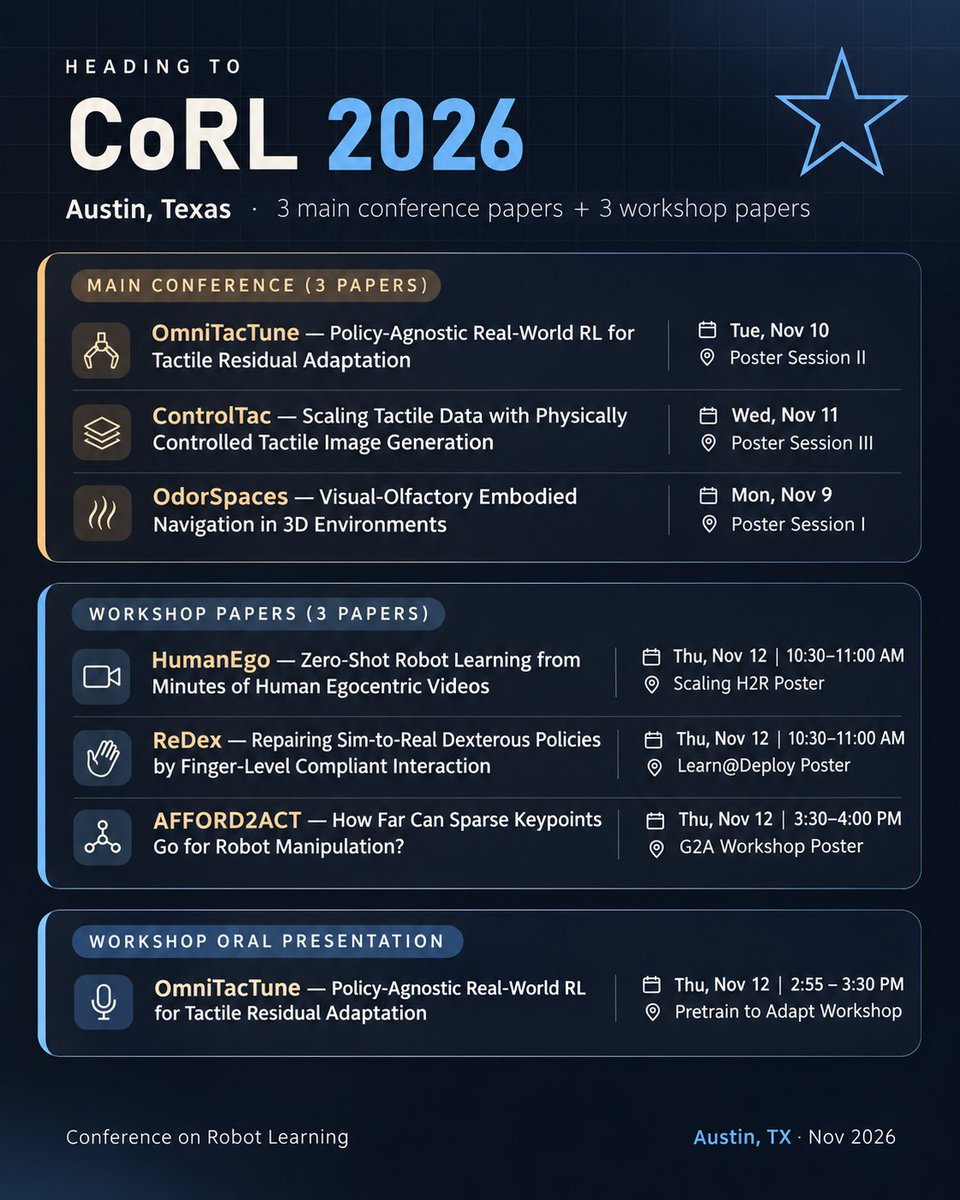
Heading to Austin next week! #CoRL2026! 🚀
Excited to share 3 main conference papers + 3 workshop papers spanning tactile learning, human-to-robot transfer, dexterous manipulation, and olfactory navigation!
📚 Main: OmniTacTune, ControlTac, OdorSpaces
🤖 Workshops: HumanEgo, ReDex, AFFORD2ACT
🌟 OmniTacTune will also be presented as an oral presentation at the Pretrain to Adapt Workshop
See the schedule below 👇
Would love to connect and chat in Austin!
The era of System One Vision Model is here! Introducing VFlash: parsing the visual world in parallel at unmatched speeds for Physical AI.
Most embodied prediction tasks like object localization, robot trajectory planning, and dense 3D motion are fixed-length float vectors. For example, a bounding box is always 6 tokens, a 10-waypoint robot arm trajectory is 54: we know these beforehand. Instead of decoding one token at a time, we can output the entire geometric shape in one go.
VFlash enables up to 12x faster action decoding and a 5.1x overall robot inference speedup on edge GPUs like the Jetson Thor and DGX Spark. What’s surprising is that it ends up even more accurate than the VLM backbone, with up to 61% lower 3D trajectory error. The intuition is that VFlash avoids the cascading errors of autoregressive decoding, where every coordinate is written in ink and every later point loses the chance to backspace.
Everything that moves will be autonomous, and everything autonomous will need to think on its own chip. The next inference revolution is physical reasoning at the speed of reflex.
And as always, it’s open paper, open source! Link in thread:
@Elish_alice21 Interesting point. The calibration should also work for soft or deformable objects since they also follow some physical properties and we can use our in-context calibration method to align the world model with those properties.
🌏 World models need to capture a scene’s hidden physics properties, e.g., mass or friction, to generate predictions consistent with physical reality.
🚀 Excited to introduce PhysiCalWorld: In-Context Physics Calibration for World Models! We calibrate world models through an interaction clip, grounding future predictions in scene-specific dynamics.
🏷️ Supervision: trained without physics labels
⚡ Efficiency: minimal additional inference cost
⚛️ Generalization: extrapolation beyond the physics ranges seen during training
https://t.co/k9PRgg7qmR
More below 🧵
If the physics changes, the old descriptor describes the previous physics, so it probably won't fit. Potential ways to tackle dynamic cases are that to re-encode a new descriptor or do some streaming updates to the descriptor according to the actions. We have also discussed that in our paper.
How to effectively leverage simulation data for robot learning? The key to sim-to-real robot learning is not generating more simulation data, but learning which data to generate. MetaGenSim is an effective meta learning method for this strategy. Led by @LiqianMa4 meet us @CoRL
Coding agents that call robot tools directly mostly work on fully observable tabletops. Can an agent solve long-horizon mobile manipulation under partial observability, with the target inside a fridge or blocked by other objects, zero-shot and without rehearsal in simulation?
We present TAMPAgent, an agentic planning framework that endows a coding agent with a belief-space task and motion planning (TAMP) model. We evaluate it in simulation and on a real RB-Y1 mobile manipulator and a Unitree G1 humanoid. More details: https://t.co/H8TV2AMIrX
To appear at the Late-Breaking Results session and the LEAP workshop at #CoRL2026.
🧵 below
🙏 Huge thanks to my collaborators @wthe2004, @YinpeiD, @namhyelin99, and @HongzeF14218, and to our advisors Joyce Chai, @NimaFazeli7, and @jjpark3D!
We will also present this work at the CoRL PhysWM and UncertainWM workshop. If you're at CoRL, come say hi!
(10/10)
✨ Our goal: world models whose predictions adhere to the actual physics of the scenes they are deployed in.
Explore the paper and interactive comparisons:
📄 Paper: https://t.co/tNyrQVOxpj
🎬 Project: https://t.co/Sz8nbobWMs
(9/10)