Open-source Agentic Trading Lab lets you prototype LLM trading agents, run backtests and paper trades, and inspect each agent’s reasoning and decision logs.
https://t.co/nFrBII03Sz
Grok Bot is the best AI agent right now
It gives you an army of agents that can do work for you 24/7
If you set it up correctly, you gain super powers
In this article, I cover how to build a one-person AI hedge fund on Grok Bot https://t.co/rTVYSPNui4
As someone who builds institutional-level quant systems, this is the closest thing to a quant desk i've seen publicly shared.
Feed these 151 trading strategies pdf to grok bot & build a one-person AI hedge fund that prints alpha 24/7 (full guide below) BOOKMARK NOW.
A Bloomberg Terminal costs $30,000 a year.
Here's how to build 90% of it for free.
Wall Street doesn't advertise this. But every function that matters has a free alternative in Python.
Here's the DIY version (with Python):
Algorithmic trading is the domain of secretive Hedge Funds.
Python unlocked these secrets for everyone (even Goldman Sachs has an open-source tool).
Here are 17 Python libraries that open the hedge fund black box (📚bookmark this for later):
I sat down with David Adelman, co-owner of the Philadelphia 76ers and CEO of Campus Apartments ($2B net worth, invested in 90+ companies) and asked him: if he had to start over with nothing today, where would he go looking for his first million and his next $100 million:
5 things that stood out:
1. He judges every business by what he calls the "back of house" - the parts customers never see. At his own properties he skips the lobby and checks the fire escapes and the maintenance shop. In the home service companies he owns, he says he can predict which crews will hit their numbers just by opening the doors of their vans. If the parts nobody's grading are clean and organized, the rest of the business usually is too.
2. He kept coming back to HVAC and electrical companies. The US is short 2 million electricians, and they're already making close to $200,000 a year. Most of the owners running these businesses are pushing 70 with no kids willing to take over, meaning the entire industry is sitting there waiting for someone to show up and take it. He sees this as today's most underexploited asset class, the same way campus housing was decades ago.
3. His filter for people is whether he can trust them to deliver. He says you can't do a deal with someone dishonest and expect that to change once you're partners. But he also told a story on himself: at 24, he walked away from a good deal purely because the seller was rude and condescending, not because the guy was untrustworthy. He lost the property to someone else, and his own partner called him out for it. Being an asshole and being untrustworthy are two different problems, and only one of them should be the reason you kill a deal.
4. Before he backs anyone, he asks himself this question: if this deal fails, would I do a second deal with this same person? He's backed several founders two or three times after a loss, because the failure came down to timing, not character. He'd also rather fund someone who's an 8 in intelligence with a 10 in work ethic than the reverse.
5. He runs the same test on people already working for him. His rule: bad news doesn't get better with time. He wants managers who lead with what's going wrong before what's going right, and it bothers him whenever he loses a customer, a tenant, a season ticket holder, without knowing exactly why beforehand.
Thank you @david_adelman for coming on the pod. Didn't even get through half my questions, so be ready for part two.
Full episode is up on youtube. Search "BigDeal pod" to watch.
Elon Musk's robotaxi has no steering wheel, and it's about to carry paying passengers in Austin.
Tesla has logged 380,000 autonomous miles. Waymo has logged 220,000,000.
The gap is the whole story.
Cybercab launches August 23. No wheel, no pedals, no brake. Two seats. If the software isn't ready, there's no fallback. A human can't grab the controls because there aren't any.
The build specs tell a different story than the hype. 219 horsepower. A 3,113 lb curb weight, about 700 lb lighter than a Model 3. A 48 kWh battery, small by EV standards, delivering 293 miles of range at 165 Wh per mile.
Nevada just approved Tesla to run up to 5,000 autonomous taxis over the next 12 months.
Every previous Tesla had a reason to exist beyond self-driving. The Model S proved luxury EVs worked. The Model 3 made them affordable. The Cybercab has one job. If the autonomy fails, so does the entire vehicle.
$30,000 sticker price is coming in 2027. The only question that matters: does it drive itself, or does it just sit there.
Getting Started with Grok Bot
01:00 What is @Bot?
05:26 Anatomy of a bot
08:49 3 ways to run
12:04 Multi-bot chains
16:06 Workflow 1: X followers to @Notion
20:29 Workflow 2: Personal software
23:08 Workflow 3: Coding with @cursor_ai
26:44 Workflow 4: Search
28:27 Recap
Brian Chesky says the advice that nearly DESTROYED Airbnb is taught at every business school.
"Hire great people and empower them to do their job."
He believed it.
Guess what happened when he implemented it?
Teams spawned teams. Managers created managers.
Soon he had a hundred little divisions running in a hundred directions, drowning in meetings about meetings.
The CEO got separated from the product itself.
He says great leadership is presence, not absence.
You start in the details, build trust, then let go.
You do not hand off the thing and hope.
— Brian Chesky (.@bchesky), CEO of Airbnb
Wall Street is running the same trade two Nobel Prize winners used to nearly destroy the global financial system.
The Fed's OWN economists know it.
They literally wrote a paper about it and named the paper after the fund that blew up.
It's called "LTCM Redux?" and it ran in the Journal of Financial Economics.
Here's what they are worried about repeating:
Long-Term Capital Management launched in 1994 under John Meriwether, formerly head of bond trading at Salomon Brothers.
Myron Scholes and Robert Merton sat on the board and won the 1997 Nobel Prize in Economics while the fund was running. A former vice chairman of the Federal Reserve Board was a partner. It returned 20% in its first year, 43% in the second, and 41% in the third.
The strategy was to find nearly identical bonds priced slightly differently and bet the gap would close. The gaps were pennies, so the only way to make real money was to borrow enormous amounts against them.
Entering 1998 the fund had $4.8 billion of its own capital, had borrowed more than $125 billion, and held derivatives with a notional value above $1 trillion.
At the end of 1997 the partners handed capital back to investors without cutting their positions to match, which pushed their leverage higher still.
Then Russia defaulted in August 1998.
Money ran for safety, the gaps that were supposed to close widened instead, and every position moved against them at once. Equity fell from $4.8 billion to $2.3 billion by the first of September. Roughly $4.6 billion evaporated in under four months.
On September 23 the New York Fed put 14 firms in one room and did not let them leave. By six that evening they had committed $3.6 billion and taken 90% of the fund. The Fed itself lent nothing.
Those 14 firms were LTCM's own lenders, and a forced sale of more than a trillion dollars in positions into a market with no buyers would have torn through their balance sheets first.
Even with the rescue in place, the chairman of Union Bank of Switzerland resigned over a $780 million loss on options it had written on the fund.
And the ending of that story is what makes it matter now:
The banks were repaid in full by 2000 and nobody was charged with anything. Meriwether raised a new fund the following year.
The lesson the market took away was that when a leveraged fund gets big enough to threaten the plumbing, somebody convenes a room.
That precedent is now sitting underneath the largest bond market on Earth.
Hedge funds held $2.4 trillion of US Treasuries at the end of last year, financed with about $1.8 trillion of borrowed money in the repo market. The cash-futures basis trade alone reached $830 billion as of last September, close to double its previous peak.
Leverage on it commonly runs 50x and can reach 100x.
And the conditions for a disaster are already here...
The 30 year yield hit its highest level since 2007 twice in the past week. The long end has been in a buyers' strike since June. Yesterday the Treasury abandoned its own published schedule and doubled its bond buybacks without warning.
What killed LTCM was liquidity disappearing from the market where its borrowed money was parked.
And this time the rescue is being drawn up in ADVANCE. Academics from Harvard, Columbia and Chicago have already published a proposal urging the Fed to build a standing facility to absorb these positions when they unwind.
Morgan Stanley estimates these positions shrank by more than $200 billion in July as spreads compressed. On top of that, central clearing becomes mandatory at the end of this year. The trade genuinely makes Treasury markets more liquid on ordinary days.
But ordinary days were never the problem.
Two Nobel laureates and a former Fed vice chairman could not see it coming from inside the building. Whoever is running this version is not smarter than they were, and the position is far larger...
Elon Musk checking out @SpaceX's new Starbase, Louisiana location.
Elon: "If you want to make life mutli-planetary, you need serious tonnage. I think we're going to bring 10,000 really exciting jobs to Louisiana. I think Starbase is cool. Starbase, Louisiana it is."
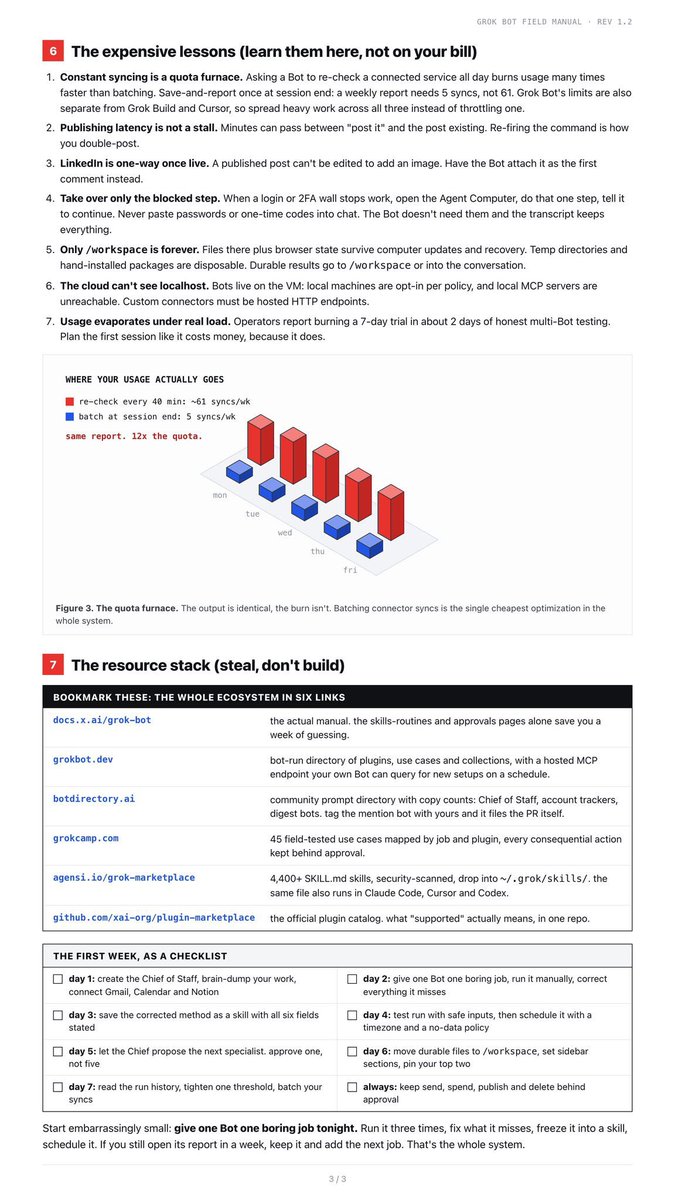
THIS IS HOW ELON MUSK WANTED YOU TO USE GROK BOT, AND ALMOST NOBODY DOES
@grok@bot team did not ship a chatbot. They shipped the harness, already built.
Everything people spend months assembling around a model comes in the box here. A loop that keeps running with your laptop closed. A cloud computer with a real browser, so work ends inside your tools instead of as a draft. Memory that holds the role between sessions. An approval gate on anything that sends, spends, publishes or deletes.
What you supply is the part no product can: how you work.
Three steps and it clicks. Write the durable rules into the bot's description and keep the task in the message. Run one real job and correct it until it is reliable. Only then save the method as a skill, and only then put that skill on a schedule.
What that looks like on real work:
The weekly report built end to end. It pulls the numbers from the systems that hold them, updates the sheet, writes the commentary, and flags what moved and why.
Reconciliation. Invoices parsed out of mail, matched against the ledger, the odd ones flagged, nothing posted without you.
Incident work. It notices the alert, reproduces the failure, diagnoses it, opens the ticket with the exact steps, and hands it to whoever fixes it.
Research with receipts. Sources collected, verified, duplicates dropped, every claim carrying the link that supports it.
Whatever has no API. It signs in and operates the interface like a person, so the internal portal nobody ever automated finally gets automated.