A Zcash hot take with a boring ending:
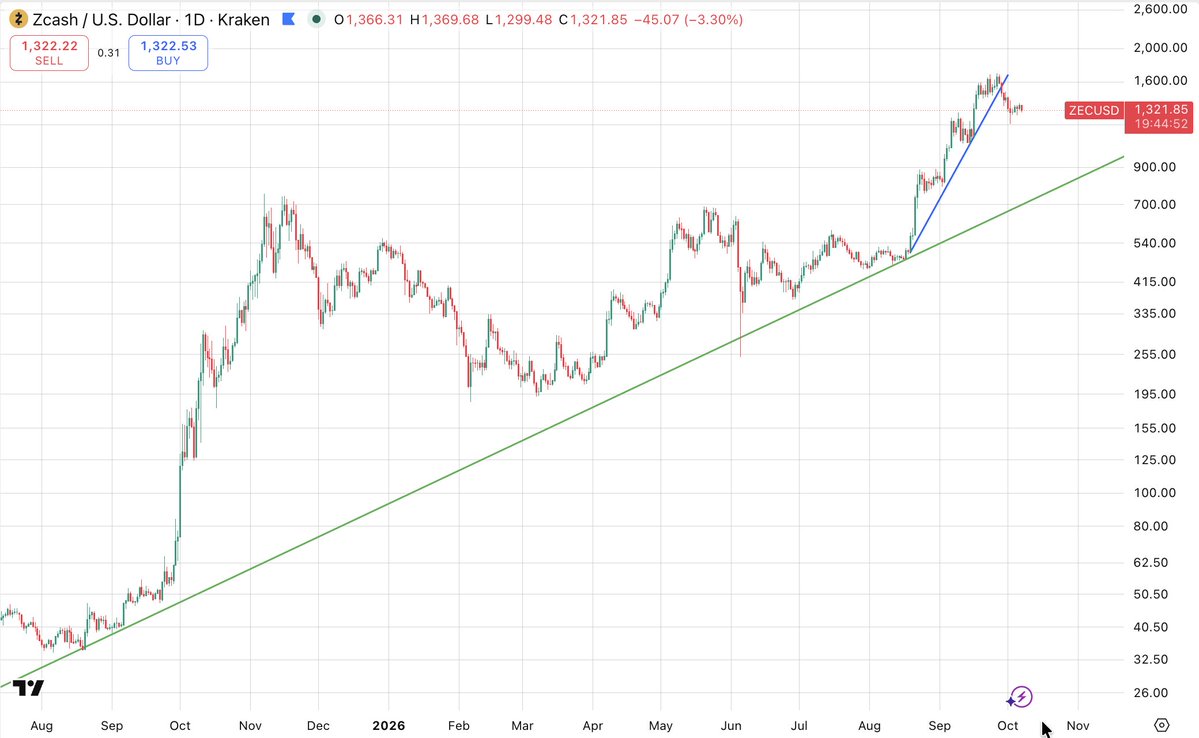
Zcash will settle into a small percentage of Bitcoin’s value over the next few years.
Last year was Round 1. Zcash escaped containment and got rerated by crypto natives.
Round 2 is retail. As the bull market continues, the privacy narrative will pull in a much larger pool of capital. I expect ZEC/BTC to look something like ETH/BTC into June 2017: a violent relative rerating that overshoots.
But many of the things helping Zcash today eventually become liabilities.
Bitcoin became an SoV without influencers creating the narrative around it. Zcash today benefits from personalities with millions of followers, centralized companies with economic incentives, and hedge funds whose job is to generate returns and crystallize carry.
Today, that is rocket fuel. At a much higher valuation, it becomes gravity.
Sell pressure increases. Questions around decentralization and network control get louder. Upgradeability, which looks like an advantage while the network is improving rapidly, starts getting viewed with much more suspicion once people are underwriting it as money.
Then ZEC/BTC trends down for years.
That does not mean ZEC does poorly. It can still trade dramatically higher in dollar terms.
It means ZEC will underperform the hopium being sold around it.
Not because Zcash is not good.
Because many of the people helping carry the narrative today will eventually hit their price target and move on.
Bitcoin’s monetary premium was built by surviving that process.
Zcash still has to, but the setup is much more adversarial.
1) This is to corroborate your point https://t.co/5En2FI2iL0
2) The revolution in some sense has worked with more people having the opportunity to voice their exit from fiat, privacy is harder but still on track with advances in zk-cryptography, and better onchain products are downstream of usable technology
It may sound counterintuitive, but if you are truly in ZEC for the long run and sitting in spot, you should probably root for it to go back below $1000, the slower the better.
@Evan_ss6 The main reason to lose from here would be:
1) over-rotation
2) leverage
If sitting in extremely high quality spot tokens for years, they more likely than not they avoid the said fate.
The problem with these takes is they are pure emotion. No rationale beyond “trust me bro.”
This can still be the biggest cycle ever. In fact, that is my base case as TradFi capital enters.
But that does not default to several memes must go to multi-billions.
Last cycle, WIF, BONK, FARTCOIN, USELESS and most 2024 memes peaked an order of magnitude below DOGE or SHIB.
Why?
1) Launching coins is now trivial. Number of coins launched have gone exponential. Memecoin traders want 100-1000x, so $100M coins already feel “late.”
2) The market has become much more efficient at trading them.
Both can be true:
1) The biggest crypto cycle ever.
2) And far fewer memes reaching multi-billion valuations than people expect.
Maybe they do.
But ignoring the supply of tokens, while only focusing on how the next cycle is going to be the biggest ever lacks rigor.
Hopium alone is just “trust me bro.”
You all forgot how to dream. Strong disagree with this
The next bull run will be extremely violent and silly. It's just gearing up now, we aren't even in it yet
Higher
"As model performance converges, distribution, inference cost, latency, privacy, and routing become increasingly important."
"For an agent making millions of calls, it (cost) becomes one of the primary economic variables."
"Frontier capable open-source models should create an increasingly competitive inference market."
Excited to have participated in the @AntSeed Foundation's $2.4M token round!
Decentralized inference is increasingly finding product market fit as several trends converge: open-source model quality, inference commoditization, agentic demand, privacy, and stablecoin native payments.
One of the most important shifts is the state of open-source AI models. Frontier labs still lead at the absolute edge, but open-source models are increasingly competitive across a much broader portion of the capability curve. That will change where value accrues. As model performance converges, distribution, inference cost, latency, privacy, and routing become increasingly important.
In the future, I see two dominant product experiences:
1. Vertically integrated products built around a specific customer need, with deep attention to UX.
2. Inference marketplaces that compete primarily across cost, latency, privacy, reliability, and routing.
In the 2nd product category, the same model can be served by many providers using different hardware, geographies, and cost structures. The logical end state is a marketplace that dynamically routes demand to the best available supply. This is where, in my opinion, AntSeed is incredibly well positioned. Going forward, cost will matter much more as companies and users increasingly prioritize ROI rather than productivity at any cost. For a consumer making 20 prompts per day, the difference between inference providers may be negligible. For an agent making millions of calls, it becomes one of the primary economic variables. AI agents should be extremely price sensitive consumers of compute. This is the core of the @AntSeed thesis.
AntSeed creates a permissionless market where inference buyers can route across competing providers based on price, performance, reputation, and privacy, rather than being locked into a single centralized API. Supply becomes more fungible and competition moves to the inference layer.
Furthermore, privacy is significantly overlooked as a key input of AI adoption. AI is increasingly where users put their most sensitive information: health data, proprietary code, investment research, financial data, internal documents, and other highly personal information. Yet most AI usage today still requires users to identify themselves to a centralized intermediary. AntSeed approaches this differently. No central account or email is required. Requests are routed P2P, and users can select TEE-verified providers where prompts remain protected from the inference provider itself. As AI becomes embedded more deeply into our workflows, I expect privacy and anonymity to move from niche preferences to core product attributes. We have already seen evidence of this with the rapid growth of Venice as a privacy-focused consumer AI product.
Then there is the question of payments. Crypto is very well suited to coordinate this market. You need permissionless, global, machine-to-machine settlement, coordinating according to reputation and economic incentives across counterparties that do not know or trust each other. Stablecoins make sub-cent, cross-border AI transactions practical in a way traditional payment rails do not.
AntSeed is already live, supports hundreds of models, has thousands of users and has demonstrated paid demand. The team combines deep crypto-native experience with the technical expertise required to build a real-time inference marketplace. I have worked with Amos and Shahaf since nearly the very inception of Antseed and have seen first hand their crystal clear focus, strong attention to solving user pain points, and non-stop shipping. Frontier capable open-source models should create an increasingly competitive inference market. In turn, a meaningful portion of the value will shift away from owning a proprietary model and toward efficiently coordinating compute supply and demand for inference. That is the market @AntSeed is building for.
Very excited to be backing this team and vision.
I am not concerned about this risk just yet, but it is worth acknowledging:
As equities make new highs and AI stocks pull ahead, does speculative capital rotate back out of high-risk crypto and into AI equities again?
We have seen that competition for risk capital before.
You can argue with 100% conviction that this makes zero sense, and that would be a perfectly defensible position.
But if you believe there is any merit in this line of thinking, the ceiling on BTC gets that much higher.
I already think BTC is one of the most underpriced assets in the world purely on its macro merits. This ideas makes the mispricing much more severe.
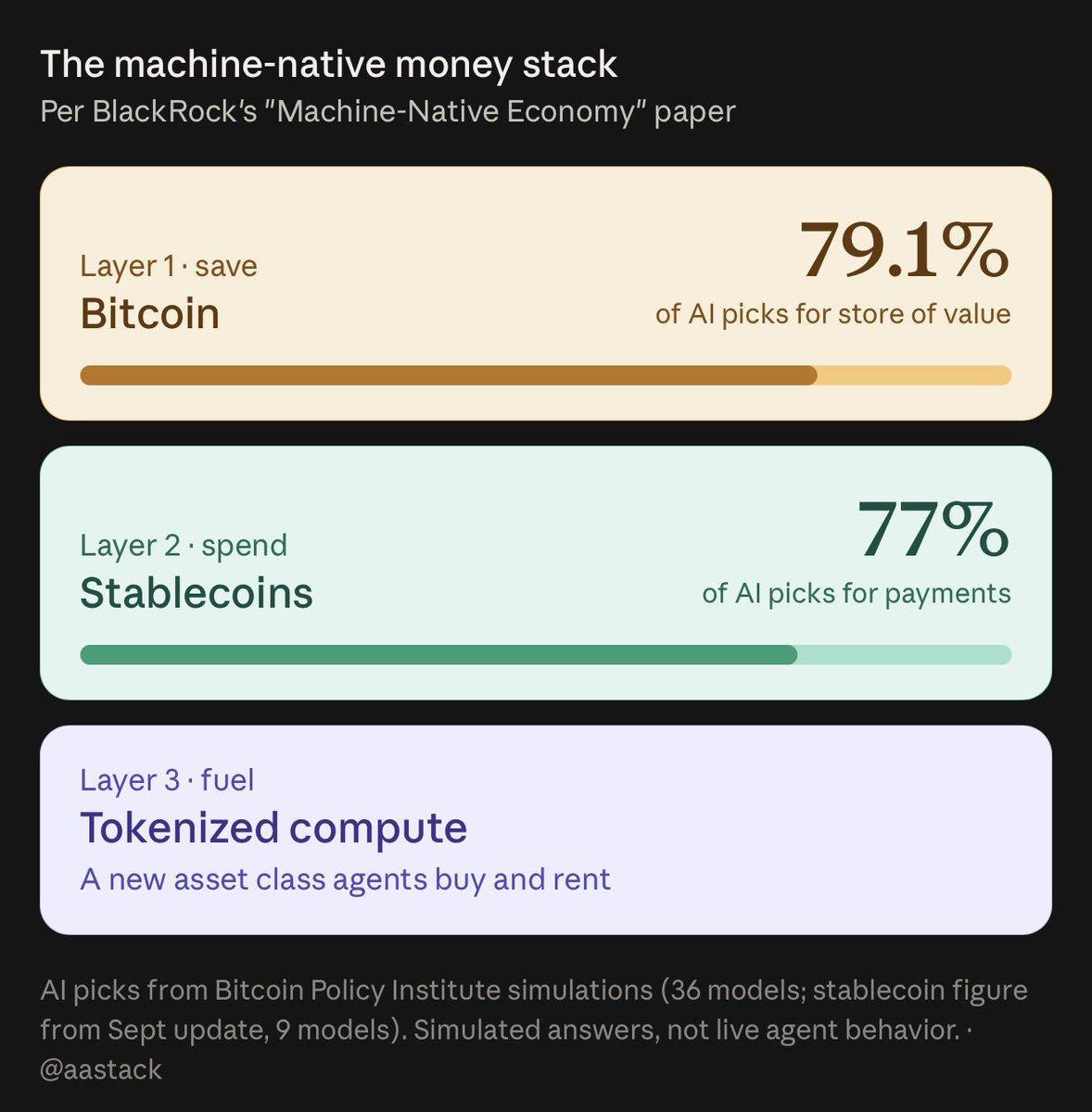
The real fun starts when BlackRock realizes that BTC is, in fact, tokenized compute.
BTC proof of work tokens = transferable proof of compute expended in the past.
AI inference tokens = digital representation of compute to be consumed in the future.
So an AI can accumulate BTC representing past compute, then spend it to purchase future compute.
Past compute becomes future AI agency.
Which means AI agency is constrained by compute costs at both ends of this stack.
On one end, there must be enough inference compute available in GPUs and AI chips to execute the action.
On the other, there must be enough BTC available to pay for that compute and everything else the AI needs to act.
BTC can serve as that stockpile. It is the geopolitically neutral asset and network for that exact task.
The business world already understands the first constraint. AI chips are massively oversubscribed because everyone understands that access to inference compute determines AI capability.
What almost nobody understands yet is the second constraint.
BTC is not understood as critical AI infrastructure yet because the market still categorizes it as "crypto" or "blockchain" tech thanks to years of tangential gambling shitcoinery
It has not yet priced Bitcoin as infrastructure for metering, budgeting, and imposing costs on machine agency.
Available inference compute determines what an AI can do.
Available BTC will determine how much AI can afford to do.
And the latter is a lot more scarce and valuable than the former.
If AI security ultimately comes down to:
1. controlling access to compute, and
2. imposing costs on autonomous action,
then Bitcoiners are already sitting on the world's largest infrastructure for the second half of that equation.
The world understands why AI needs chips.
It has not yet figured out why AI may need Bitcoin.
When the market finally understands that distinction, the correction is going to be insane.
Everyone on my timeline seems enchanted by Pearl and its pitch as the AI-native Bitcoin. Great narrative. But as an engineer, 7 things bother me.
1. You can't secure a network with hardware everyone else has 100x more of. Nearly every Bitcoin ASIC on earth is already mining Bitcoin; there's no second fleet to attack it with. Pearl's entire network is ~174 MW. A single big AI lab runs gigawatts. Any one of them gets 51% with one decision.
2. Attacking burns nothing. Attack Bitcoin and your ASICs become scrap metal. That's what keeps miners honest. Attack Pearl and your GPUs go back to serving customers a minute later. You can do it on rented hardware, exactly how ETC and Bitcoin Gold got hit.
3. Consensus must be stable. AI never is. SHA-256 hasn't changed in 17 years. Pearl has to rewrite its mining rules every time AI moves: new number formats, new architectures, new chips. Five consensus changes in the first few months, one of which let miners fake hashrate for 41 days. Money with changing rules is not hard money.
4. Miners are officially allowed to cheat. In Bitcoin the puzzle is the same for everyone; you only pick a number. In Pearl you bring your own matrices, and the protocol accepts any. So you can pick ones that are easier to win on. It already happened: a higher noise rank made blocks easier to win for the same work. Holes get patched one fork at a time, and the underlying math is from 2025, untested by time.
5. It's built for the AI nobody runs. The advertised 5% overhead means a GPU serves ~5% fewer model outputs with mining on. But that number comes from a model pre-converted into Pearl's integer format, with the Pearl team's help. Real AI runs in floating point on custom-tuned engines in data centers. It's like launching "mining on vehicles" with software written for horse carriages. Floating-point support is still a draft.
6. "Useful work" is never verified, and the "double reward" doesn't fix it. The protocol only checks that a matrix multiplication happened, not that it came from a real model. Pearl has an answer: a provider gets paid by the customer and by the chain, so it will outcompete pure miners. That only holds if both run the same hardware at the same load. They don't. Real inference needs expensive server GPUs, a data center, and spare capacity for peaks, and it only runs when a request arrives. A pure miner needs a cheap gaming card running 100% around the clock, and nothing slows down. The second reward has to cover that whole gap, and nothing in the protocol guarantees it ever does.
7. Who needs new Proof Of Work at all? If AI compute needs a blockchain, it needs smart contracts for payments and escrow. Proof-of-stake chains do that today; Ethereum dropped mining in 2022 and runs fine. Pearl is a Bitcoin fork with no real smart contracts: the most expensive way to secure a chain, paired with the most limited platform, where the only thing you can do is move the token itself.
So what am I missing? A lot of smart people are falling for Pearl right now, and I'd genuinely like to understand why. If there's a paper, a thread, or an argument that answers the points above, send it.