How are you still bearish on Ripple and $XRP when THIS is the Swell 2026 lineup?
I’m not saying that because there are a few famous names on a conference page.
I’m saying it because when I went through what these companies are actually doing, the lineup started looking like an entire financial system sitting in one room.
BNY. DBS. Aviva Investors. ICE. Tradeweb. State Street. Robinhood. Bullish. Canary Capital. Zero Hash. Fiserv.
Then add Raghuram Rajan, Hugo Philion, Alex Pruden, Michael Higgins, Matt Damon and Gary White.
And several of them are already tied directly to Ripple’s infrastructure.
BNY is the primary custodian of RLUSD reserves.
This is a company with $62.6T in assets under custody and/or administration.
Then you have Evy Theunis of DBS.
DBS is already working with Ripple and Franklin Templeton around sgBENJI, RLUSD, trading and potential collateral use on XRP Ledger.
Aviva Investors went even further.
In July, it launched a tokenized share class of its U.S. Dollar Liquidity Fund on XRPL.
So when Alastair Sewell appears at Swell, he isn’t coming in to ask what tokenization could look like.
Aviva already did it.
Then you have Tom Farley of Bullish.
Bullish is integrated with Ripple Prime, including institutional spot, futures and options infrastructure.
Ripple Prime itself clears $3T+ annually for 300+ institutional customers.
That is serious market plumbing.
Then Steven McClurg of Canary Capital.
Canary’s XRP ETF had around $348.1M in net assets as of September 4.
That is direct regulated exposure to $XRP.
Now zoom out again.
Michael Blaugrund of ICE, parent of the NYSE, is coming while ICE is building a 24/7 tokenized securities platform settled against stablecoins.
Billy Hult of Tradeweb is coming from a market that handled about $2.8T in average daily trading volume in August.
Sam ten Cate of State Street represents another giant moving into tokenized funds, tokenized deposits, stablecoins and digital custody.
Johann Kerbrat of Robinhood comes from a platform with 28.5M funded customers and more than 190 tokenized stocks and ETFs.
Look at the shape of this.
Asset managers.
Custodians.
Banks.
Exchanges.
Fixed income.
Retail distribution.
Stablecoins.
Prime brokerage.
Tokenized funds.
DeFi.
Security.
Payments.
And Ripple now has:
RLUSD
Ripple Prime
Ripple Custody
Ripple Treasury
Ripple Payments
XRP Ledger
$XRP
All sitting around that same institutional buildout.
That is why Swell 2026 has my full attention.
I’m not looking at it as another crypto conference anymore.
I’m looking at it as Ripple bringing different pieces of the financial stack into the same room after many of them have already started using parts of its infrastructure.
And the $XRP opportunity gets bigger as more of those assets become digital.
More funds.
More stablecoins.
More currencies.
More securities.
More collateral.
More markets.
That creates more places where liquidity has to move.
And XRP already sits inside XRPL as the native asset capable of bridging between fragmented pools when the routing makes economic sense.
Swell starts October 27. With this lineup.
What exactly do you think they’re going to be talking about behind those doors?
What makes solving Navier-Stokes important?
Fluid dynamics affects more than you realize in your everyday life. This breakthrough — if it is true — gives you:
Cheaper, safer flying and driving. Air over a wing or around a car is a Navier-Stokes problem. Better control of that flow means less drag, so planes and trucks burn less fuel, stay quieter, and stall less often.
Weather you can actually plan around. Storms, jet streams, and ocean currents are giant fluid problems. Sharper turbulence physics is one of the remaining limits on hurricane tracks, heat waves, and flood forecasts. That is the difference between “maybe evacuate” and a clear warning.
Hearts, stents, and artificial valves. Blood is a fluid. Doctors already simulate flow through arteries and implants from CT/MRI scans. A more reliable theory of swirling, high-speed blood flow would help design stents, heart valves, and aneurysm treatments that work better.
Cleaner power from wind and turbines. Wind hitting a turbine blade, steam inside a power plant, and fuel mixing in an engine are all the same equations. Better models mean more electricity from the same wind farm and engines that waste less fuel
Ships, pipes, and dirty air. Oil in a pipeline, water in city mains, smoke over a city, and waves slamming a hull all follow Navier-Stokes. Better predictions cut leaks, pump energy, and help track pollution after a spill or wildfire.
Many other everyday effects: buildings, sports, and rain. The same math decides whether a skyscraper sways in a gale, why a dimpled golf ball flies farther, how air moves through a house’s vents, and even how raindrops form in clouds. Those are not abstract puzzles; they are why planes fly, forecasts exist, and a stadium roof doesn’t peel off.
None of this happens instantly because of a math problem solution by AI. But everything that does happen is going to help engineer a better life for all of us. This is big.
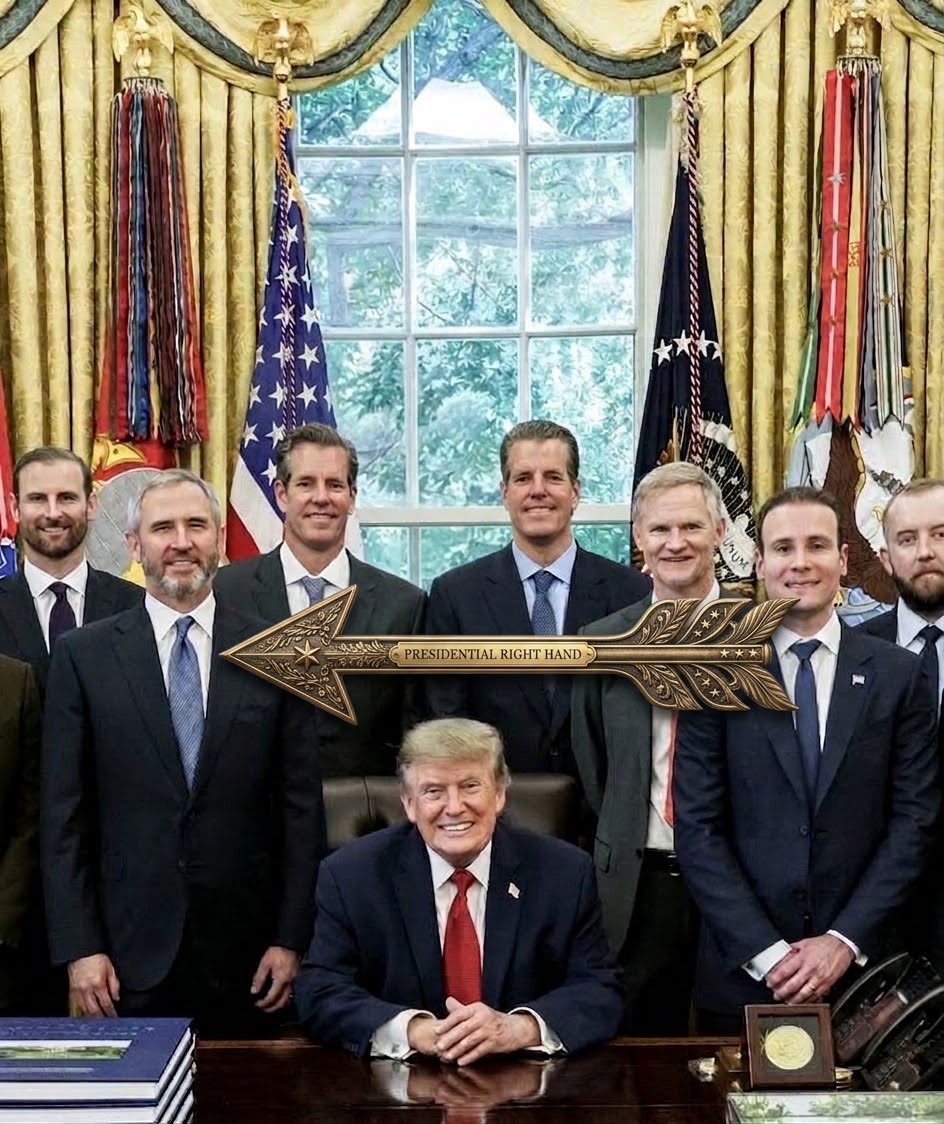
🇺🇸 @Ripple CEO Brad Garlinghouse is standing on 🇺🇸 President Trump’s right.
That’s not a coincidence.
The CEO the SEC spent years trying to take down is now in the Oval Office while the United States writes the rules for digital assets.
#XRP isn’t on the outside looking in anymore.
What’s the first thing this photo tells you?
Drop it below. I want the real takes not the hopium.
At the end of the month, Swift will launch 24/7 cross-border payments with a group of 50 banks (more than 30 of which are Ripple partners).
In July, the DTCC will begin tokenizing securities. The Clarity Act will also be approved and signed.
And this is so that everything is ready for the DTCC to give the green light in October to start settling in XRP.
The next 6 months are going to be incredible.