Interesting: Lipid length increases with age, altering membranes & reducing cell viability. This trend is reversed by rapamycin, CR & exercise. Authors propose lipid length as a driver of aging & that interventions targeting lipid remodeling may combat aging
🚨BREAKING: A revolutionary new cancer treatment called Histotripsy is showing incredible promise by literally liquefying tumors using focused sound waves—no surgery, no chemo, and no radiation needed.
Developed by pioneers Dr. Zhen Xu and the late Dr. Charles Cain at the University of Michigan, this FDA-approved technology is now being used at leading hospitals like Johns Hopkins and the Cleveland Clinic.
How it works:
- A robotic arm delivers precise high-intensity ultrasound waves straight to the tumor.
- These waves create tiny gas bubbles inside cancer cells that rapidly expand and collapse.
- The mechanical force destroys the tumor cells, turning the mass into liquid debris that the body naturally clears away.
- It also appears to stimulate the immune system to better recognize and attack remaining cancer cells.
- Because it relies on mechanical disruption rather than heat or radiation, it spares healthy surrounding tissue.
Patients often undergo the quick outpatient procedure and go home the same day. It is currently treating liver tumors, with trials expanding to kidney and brain cancers.
This could be a game-changer in the fight against cancer.
It’s happening.
We’re moving very fast now.
math Singularity is already here
The anti aging Singularity is near.
Scientists just rejuvenated 80 year old cells to a molecular age of under 20
From 80 to under 20. Scientists turned back human cells molecular clocks.
Bonn researchers transformed blood cell precursors from an 80 year old into neural stem cells with a molecular age below 20. Achieved in the lab, the breakthrough gives scientists a new way to study rejuvenation, and test what could accelerate it.
Like I said before, we're entering an era where aging itself could become a target of scientific intervention.
Here's a small hint of what's coming.
SCIENTISTS JUST REJUVENATED 80-YEAR-OLD CELLS TO A MOLECULAR AGE OF UNDER 20! 🤯
Researchers at the University of Bonn directly reprogrammed blood-derived cells into neural stem cells, substantially resetting their epigenetic age.
You may be 80, but some of your cells could potentially be rejuvenated to a much younger molecular state.
Researchers at the University of Bonn have demonstrated this in human cells in the lab.
Here's what they achieved:
→ Cells from an 80-year-old donor reached a molecular age of under 20.
→ Researchers studied cells from 15 donors aged 0–101.
→ They directly converted blood-derived precursor cells into neural stem cells, bypassing the conventional pluripotent stem-cell stage.
→ The rejuvenation process unfolded over approximately 50 days, with most measured age-associated epigenetic signatures resetting during this period.
The resulting cells could also develop into neurons, astrocytes, and oligodendrocytes.
The interesting part is the biology: the researchers observed substantial changes in DNA methylation patterns associated with aging, alongside changes in other cellular aging markers.
This could help scientists understand how cellular aging can be reversed at the molecular level and potentially advance research into age-related diseases.
We're still far from rejuvenating an entire human body.
But understanding how to reset the biological age of cells is an important step toward a future where age-related decline could become increasingly treatable.
The future of aging research is getting very interesting.
When you feel sad, remember that tiny proteins called kinesins are working inside you 24/7 just to keep you alive.
So be kind to yourself, your body is doing everything it can to keep you alive!
(video by thequantara)
Osteoporosis treatment is entering a new era.
ENTERA BIO'S EXPERIMENTAL BONE BUILDING PILL IS ADVANCING TOWARD PHASE 3 AFTER PROMISING PHASE 2 RESULTS.
what's interesting to me is that they're delivering an established bone building hormone through a pill.
> EB613 is an experimental oral tablet containing teriparatide (PTH 1-34), designed to stimulate bone formation.
NOW, THE COMPANY IS PREPARING FOR A PHASE 3 TRIAL INVOLVING APPROXIMATELY 750 POSTMENOPAUSAL WOMEN.
The primary endpoint will measure changes in total hip bone mineral density after 12 months.
> New trial is planned to begin in late 2026, with topline results expected in the second half of 2028.
Honestly, if it proves safe and effective, this could make bone-building treatment more convenient for patients who currently need daily injections.
source:
https://t.co/gfqORM9RKo
big anti aging news
An encouraging first human signal for cellular rejuvenation.
Life Biosciences reports that ER-100, a gene therapy designed to rejuvenate damaged eye cells, was well tolerated in 3 glaucoma patients through 56 days, with no serious adverse events.
Two showed improvements in visual field testing.
This is insane 🔥
The FDA cleared the first human age-reversal trial
A Harvard professor proved you can reverse aging by 75% in 6 weeks in mice cured blindness, reversed Alzheimer's, MS, ALS, kidney and liver disease then confirmed it works in monkeys
Now humans are next. Life Biosciences raised $80M to make it happen
His words "The eye is just the beginning. We believe we can treat every tissue. A whole body reset"
AI scientists are spreading fast and growing exponentially
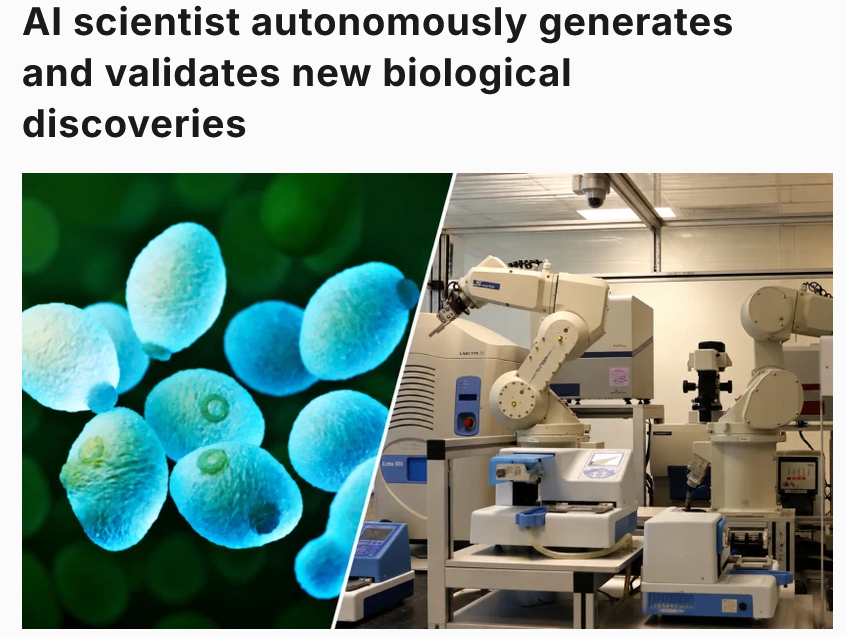
Researchers at Chalmers University of Technology in Sweden built a close loop AI scientist that can generate hypotheses, design real laboratory experiments, analyze the results, and then use those results to decide what to investigate next, with minimal human intervention.
Working with yeast, the system connected LLM agents to automated cell culture and metabolomics equipment and made experimentally validated biological discoveries, including previously unknown interactions involving glutamate, spermine, aminoadipate, and formic acid stress.
FDA is now putting aging and longevity on its regulatory science agenda.
At the 2026 Aging Research & Drug Discovery meeting at Harvard, FDA Chief Scientist Steven Kozlowski said aging and longevity will be highlighted in the agency’s upcoming FARS update, expected in 2027.
Actually, regulators are now working on how to scientifically evaluate therapies that target the biology of aging.
But challenge is enormous:
How do you prove a drug actually slows aging without waiting 30 years?
Researchers need validated biomarkers, clinical endpoints and functional measurements to show whether a therapy slows age-related decline.
That's why FDA officials discussed 2 potential paths:
1. Show that a therapy targeting an aging mechanism reduces multiple age-related diseases, such as cardiovascular disease, Alzheimer’s, Parkinson’s or cancer.
2. Measure broader changes in aging-related function, including cognition, frailty, hearing, vision and physical function, and demonstrate that treated patients deteriorate more slowly than controls.
Meanwhile, ARPA-H is investing $144 million through its PROSPR program to develop better ways to measure and treat age-related functional decline.
What I see here is that longevity research is about to get a big push.
source: https://t.co/dgDjKLVKwR
The greatest goal scorer in NHL history . . . and he also regularly wrecked dudes with the body.
Not sure we're going to see another one like him any time soon.
REGENERATIVE BREAKTHROUGH:
welcome to the everyday breakthrough era.
Scientists just found a new way to partially rejuvenate aging human dental follicle stem cells and restore their ability to form bone.👀
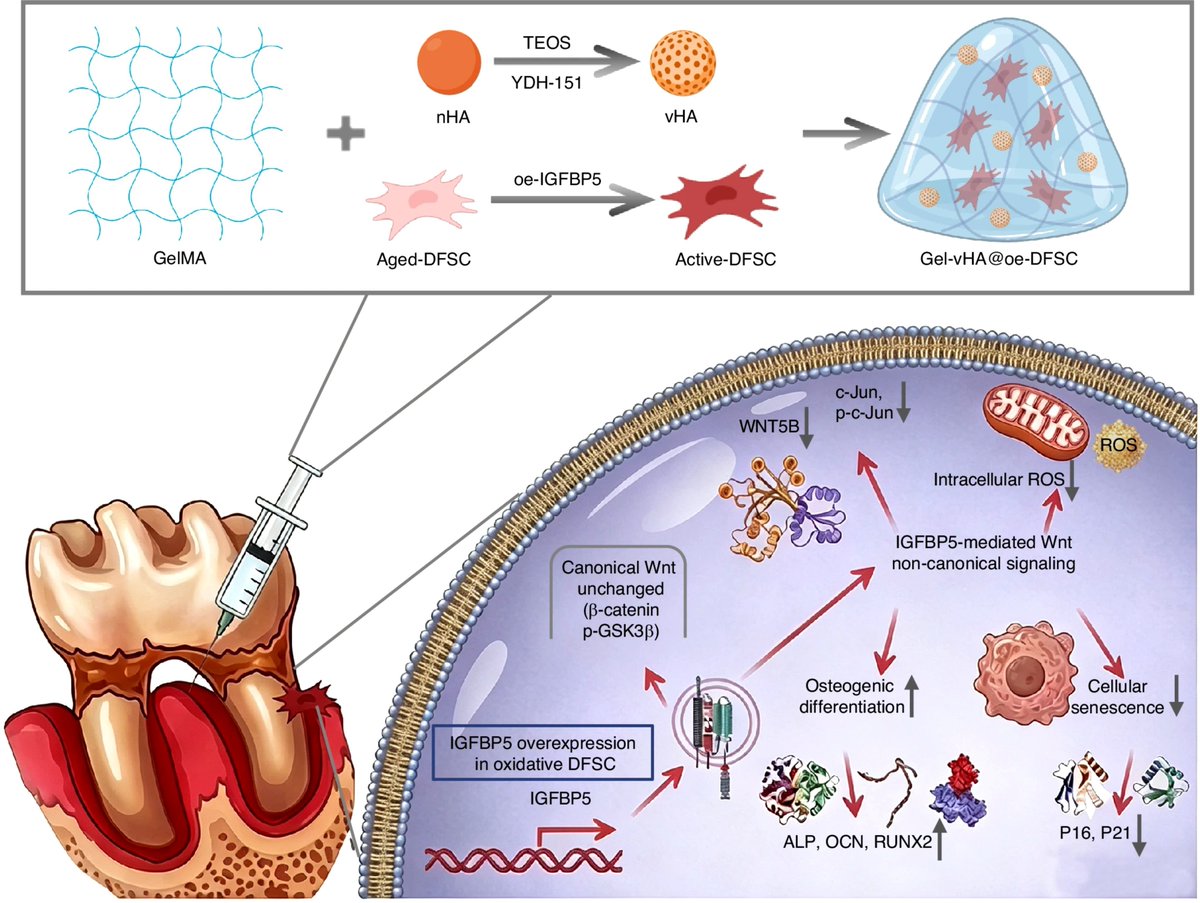
The key appears to be IGFBP5.
As these stem cells become senescent, IGFBP5 levels decline, weakening their regenerative capacity.
Researchers just restored IGFBP5, which reduced cellular senescence and improved osteogenic differentiation.
They then engineered a Gel-vHA@oe-DFSC hydrogel combining:
> GelMA-based hydrogel
> Vinyl-functionalized nanohydroxyapatite
> IGFBP5-overexpressing dental follicle stem cells
In rats with periodontitis, the treatment improved alveolar bone regeneration, bone density and tissue organization.
But the bigger idea is even more interesting:
By restoring the molecular machinery that makes cells regenerative, future therapies could potentially help damaged tissues repair themselves more effectively.
This study is still preclinical. The regeneration experiment was performed in rats, not humans.
But targeting stem-cell aging itself could become an important direction for the future of regenerative medicine.
source:
https://t.co/ylyLbDXJt0
paper:
https://t.co/bx2cQWKUpJ