A former SpaceX/xAI engineer just leaked the exact Jev + Grok Bot system for building an AI company
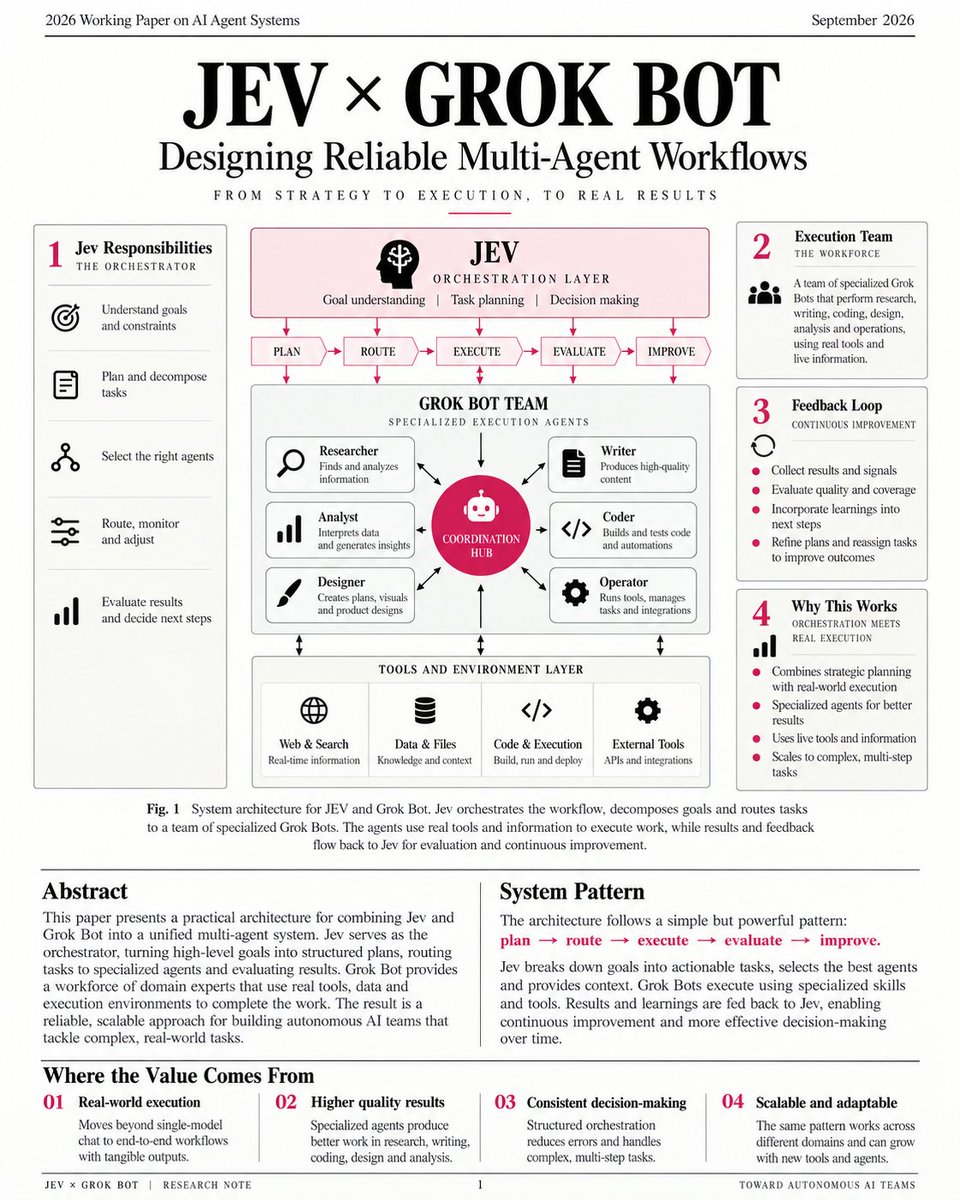
this system researches, writes, designs, routes, verifies and ships work inside one operating loop
step 1 → launch the Grok Bot team: manager, researcher, writer, engineer, designer, operator and supporting specialists
step 2 → make Projects Manager the front door: every request enters through one bot and flows into one coordinated system
step 3 → place Jev at the center of the workflow: Grok Bots execute, Jev directs the next move
step 4 → give Jev 4 core jobs: route the next worker, validate research, review completion and control high-risk actions
step 5 → route through the live team: Jev selects from the workers available in the current environment
step 6 → build the routing loop: current state → Jev → next worker → updated state → Jev again
step 7 → create a research decision gate: every key claim receives one of three outcomes → accept, verify_more, reject
step 8 → create a completion gate: objective, outputs, evidence and open gaps all pass review before the task closes
step 9 → assign autonomy by risk: research, drafting and execution move fast, approvals govern publishing, sending, spending and deleting
step 10 → automate proven routines: run the workflow, refine the method, save the routine and schedule the loop
step 11 → package the whole company into folders: /bots /jev /routines /tests
step 12 → test the full operating loop: research + writing + design + outbound + verification + approvals
the result: Grok Bots become the execution layer, Jev becomes the decision layer and the company runs with speed, structure and control.
Save this, then read the full 12-step blueprint below ↓
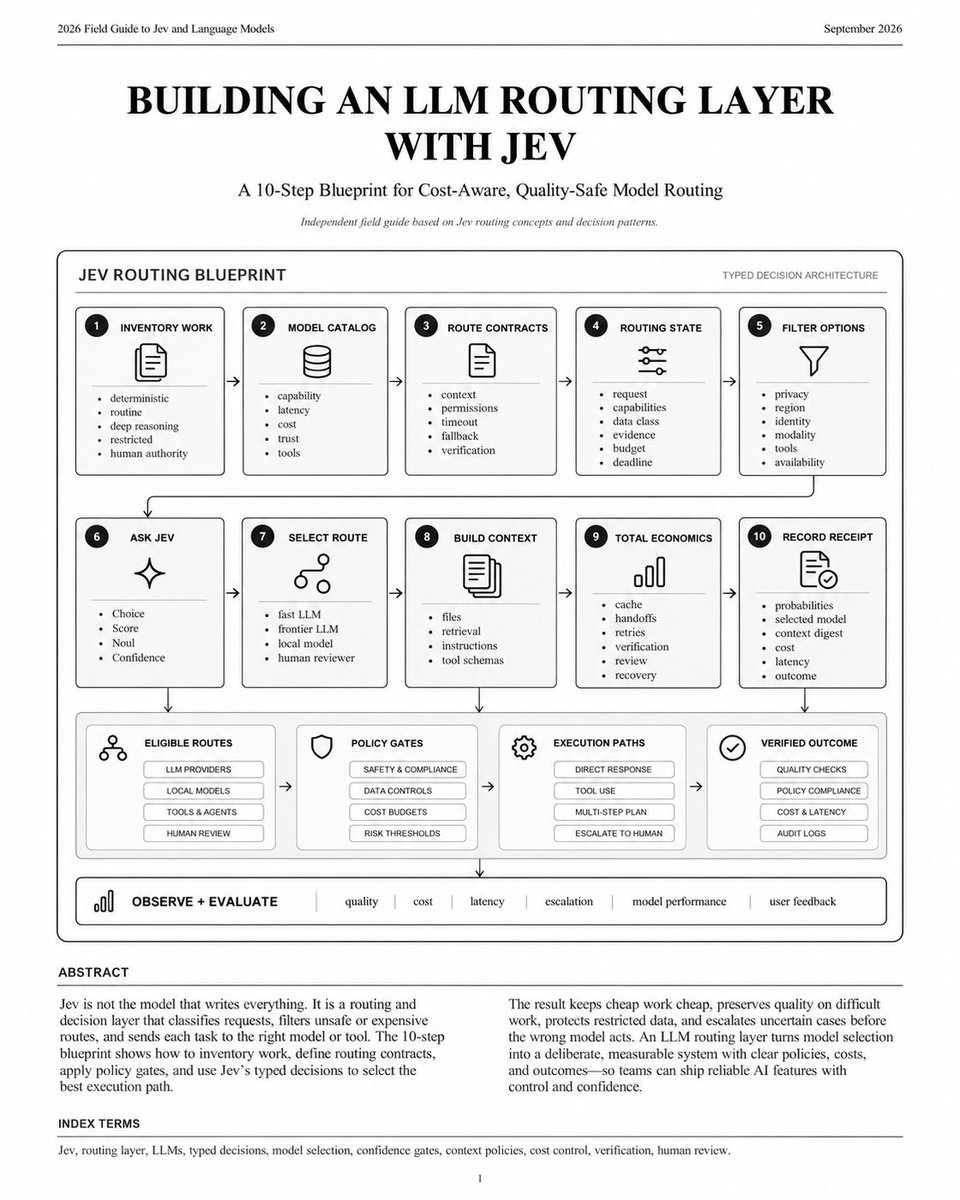
Jev Founder, Diogo Almeida, just released a 12-page PDF on building an LLM Routing Layer with Jev
this is a 10-step blueprint on how to stop sending every task to the most expensive model without destroying the quality of difficult work:
step 1 → inventory the work: separate deterministic lookups, routine generation, deep reasoning, restricted data and tasks that require human authority
step 2 → build a model catalog: describe every code path, fast model, frontier model, local executor and human route by capability, latency, cost, trust and tool access
step 3 → define route contracts: every destination gets its own context policy, tools, permissions, timeout, retry budget, verification plan and fallback
step 4 → build the routing state: send Jev the request, required capabilities, verified data classes, available evidence, budget and deadline instead of the entire conversation
step 5 → filter before routing: code removes providers that violate privacy, region, identity, modality, tool, budget or availability requirements
step 6 → ask typed questions: Choice identifies the task family, Score estimates complexity, Noul checks sensitivity and confidence determines whether the system should act
step 7 → route by capability, not brand: code maps Jev’s signals to an exact handler, fast LLM, frontier LLM, approved local model or human reviewer
step 8 → build context after the route: load only the files, retrieval sources, instructions and tool schemas required by the selected execution path
step 9 → calculate total economics: include cache misses, context reprocessing, model handoffs, retries, verification, human review and recovery instead of comparing token prices
step 10 → record every route: bind the state, eligible options, Jev probabilities, selected model, context digest, cost, latency, fallback and verified outcome to one receipt
most AI courses tell you which model is the best
this 12-page guide teaches you how to build a system that chooses the right model for every request
the result:
cheap tasks stop wasting frontier-model tokens
difficult tasks still reach the most capable route
restricted data stays inside approved boundaries
and uncertain requests escalate before the wrong model touches them
Send this PDF and the original Jev article to Claude Code or Codex and tell it to replace your hardcoded model selector with a real routing control plane ↓
Jev Founder, Diogo Almeida, just released a 12-page PDF on building an LLM Routing Layer with Jev
this is a 10-step blueprint on how to stop sending every task to the most expensive model without destroying the quality of difficult work:
step 1 → inventory the work: separate deterministic lookups, routine generation, deep reasoning, restricted data and tasks that require human authority
step 2 → build a model catalog: describe every code path, fast model, frontier model, local executor and human route by capability, latency, cost, trust and tool access
step 3 → define route contracts: every destination gets its own context policy, tools, permissions, timeout, retry budget, verification plan and fallback
step 4 → build the routing state: send Jev the request, required capabilities, verified data classes, available evidence, budget and deadline instead of the entire conversation
step 5 → filter before routing: code removes providers that violate privacy, region, identity, modality, tool, budget or availability requirements
step 6 → ask typed questions: Choice identifies the task family, Score estimates complexity, Noul checks sensitivity and confidence determines whether the system should act
step 7 → route by capability, not brand: code maps Jev’s signals to an exact handler, fast LLM, frontier LLM, approved local model or human reviewer
step 8 → build context after the route: load only the files, retrieval sources, instructions and tool schemas required by the selected execution path
step 9 → calculate total economics: include cache misses, context reprocessing, model handoffs, retries, verification, human review and recovery instead of comparing token prices
step 10 → record every route: bind the state, eligible options, Jev probabilities, selected model, context digest, cost, latency, fallback and verified outcome to one receipt
most AI courses tell you which model is the best
this 12-page guide teaches you how to build a system that chooses the right model for every request
the result:
cheap tasks stop wasting frontier-model tokens
difficult tasks still reach the most capable route
restricted data stays inside approved boundaries
and uncertain requests escalate before the wrong model touches them
Send this PDF and the original Jev article to Claude Code or Codex and tell it to replace your hardcoded model selector with a real routing control plane ↓
holy sh*t, this paper is pure f*cking brilliant
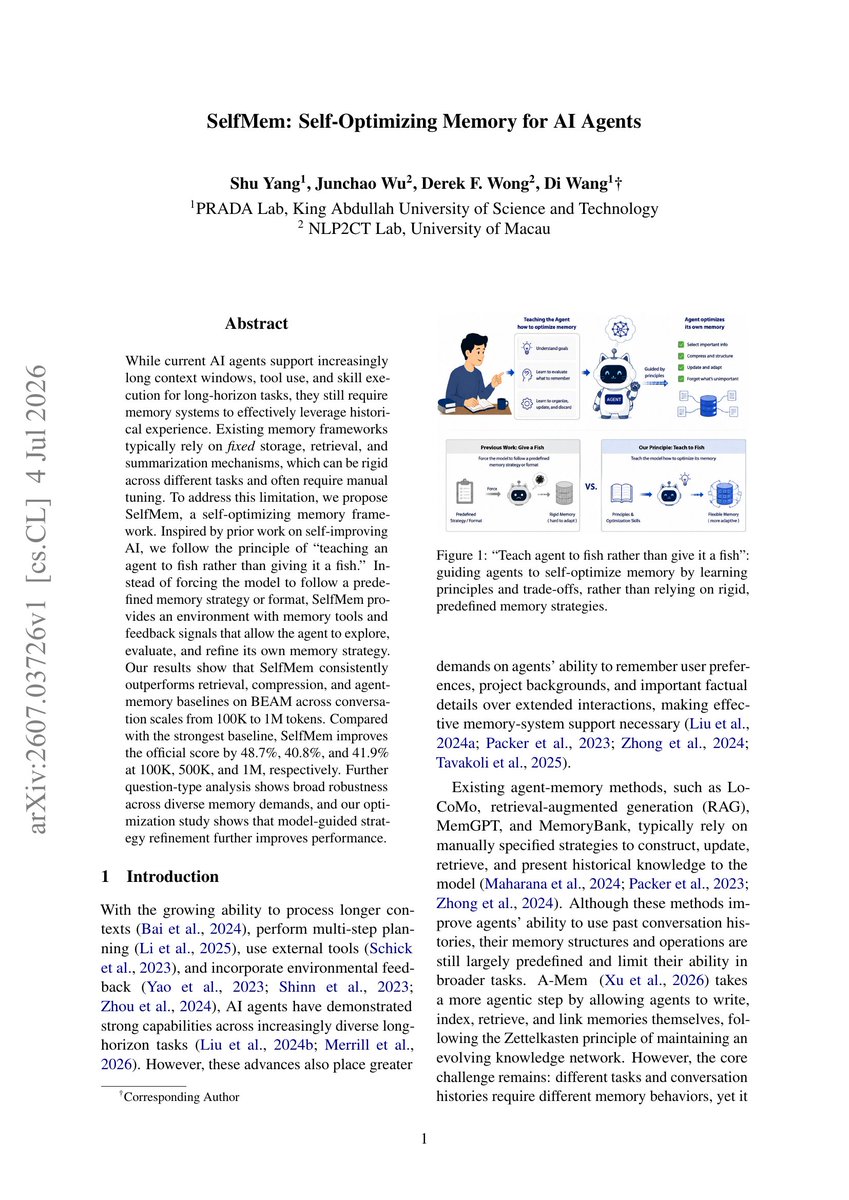
AI researchers just showed a useful way to give AI agents long-term memory
the interesting part is the control loop. instead of forcing every conversation into one fixed summary, the agent can inspect, write, review and revise its own memory
step 1 → keep the raw conversation as a read-only source of truth. memory is a guide, not the final authority on what happened
step 2 → give the agent tools to search the transcript and inspect the memory it already has
step 3 → let it choose what to store. stable preferences and project context may belong in memory; exact dates and changing facts can stay in the transcript until needed
step 4 → make each memory change explicit: what changed, where it went, and why
step 5 → run a review pass for weak source support, stale details, contradictions and facts that will be hard to find later
step 6 → revise the workspace after that feedback. memory writing becomes an inspect → write → review → revise loop
step 7 → when the user asks a question, pair the compact memory with the specific transcript turns that support the answer
the paper reports a 0.504 score at 100K tokens versus 0.339 for its strongest baseline. at 1M tokens, it reports 0.454 versus 0.320. those are benchmark results, not a production guarantee
my takeaway: the valuable design choice is keeping memory small and editable while keeping the original evidence close enough to check
save this, then read the article + paper below
AIRBNB FACILITATED $91.3B IN BOOKINGS IN 2025.
its own revenue was $12.2B. the gap is the marketplace: hosts supply the stays, guests book them, and Airbnb earns service fees.
here are 10 moves you can adapt:
1/ FIND A DEMAND SPIKE. Airbnb's first 3 guests came for a conference when hotels were sold out. pick a place and moment where existing options fail.
2/ BE THE FIRST SUPPLIER. the founders hosted those guests themselves. deliver the first few transactions by hand to learn what breaks.
3/ RECRUIT SUPPLY MANUALLY. they met hosts door-to-door. onboard your first sellers yourself before automating acquisition.
4/ FIX THE LISTINGS. the founders photographed homes. improve presentation until a buyer can judge quality quickly.
5/ GIVE SUPPLIERS TOOLS. Airbnb added calendars, pricing and listing tools. make it easier for sellers to show availability and fulfill orders.
6/ MAKE DISCOVERY SIMPLE. guests can search and book in one place. show the choices, price and availability without friction.
7/ ENGINEER TRUST. profiles, two-way reviews, secure payments and protections reduce uncertainty. identify the biggest reason each side hesitates and solve it.
8/ OWN THE BOOKING FLOW. Airbnb collects guest payments and pays hosts after check-in. use a payment provider to make checkout and payouts clear.
9/ MONETIZE THE MATCH. Airbnb earns service fees on facilitated stays. its $91.3B booking value is NOT its $12.2B revenue. charge for the transaction you enable.
10/ TRACK LIQUIDITY, THEN EXPAND. Airbnb logged 533M nights and seats booked in 2025. watch active supply, search-to-booking conversion and repeat bookings in one niche before copying the playbook elsewhere.
the real loop: better supply → more confident bookings → more value for suppliers → better supply.
save the 10-step map below ↓
holy sh*t, this paper is pure f*cking brilliant
AI researchers just showed a useful way to give AI agents long-term memory
the interesting part is the control loop. instead of forcing every conversation into one fixed summary, the agent can inspect, write, review and revise its own memory
step 1 → keep the raw conversation as a read-only source of truth. memory is a guide, not the final authority on what happened
step 2 → give the agent tools to search the transcript and inspect the memory it already has
step 3 → let it choose what to store. stable preferences and project context may belong in memory; exact dates and changing facts can stay in the transcript until needed
step 4 → make each memory change explicit: what changed, where it went, and why
step 5 → run a review pass for weak source support, stale details, contradictions and facts that will be hard to find later
step 6 → revise the workspace after that feedback. memory writing becomes an inspect → write → review → revise loop
step 7 → when the user asks a question, pair the compact memory with the specific transcript turns that support the answer
the paper reports a 0.504 score at 100K tokens versus 0.339 for its strongest baseline. at 1M tokens, it reports 0.454 versus 0.320. those are benchmark results, not a production guarantee
my takeaway: the valuable design choice is keeping memory small and editable while keeping the original evidence close enough to check
save this, then read the article + paper below
A friend at Anthropic told me this.
Anthropic pays $650,000 a year for people who truly understand how LLMs learn.
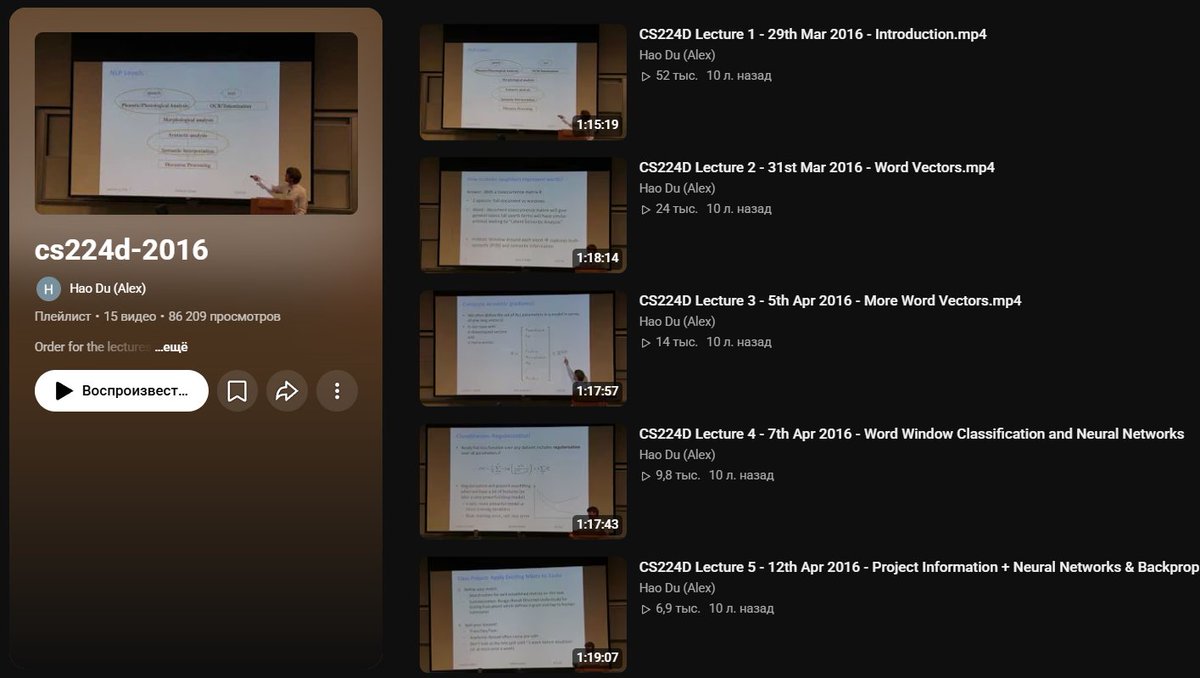
This exact Stanford course is free forever.
Most AI courses charge $2,000+ for this foundation.
This one is completely free.
You get the real technical foundation, taught at Stanford by Richard Socher.
Save this ⭣