@lkwarzecha A czy zauważył Pan, że nasi wybitni aktorzy, którzy grali arystokrację, nie musieli się za bardzo przygotowywać do roli, gdyż grali samych siebie?
@neosedziatuleye Kiedyś doszedłem do podobnych wniosków obserwując nasz kraj.A nasze powiedzenie: “jakoś to będzie”, najlepiej nas charakteryzuje. To nasz największy atut i jednocześnie nasze największe przekleństwo. Atut w sytuacji chaosu, przekleństwo w stabilizacji.
@MariuszJagora Idealny komentarz do Pana tekstu. Niby ten film mówi o Republice Południowej Afryki. A ja mam wrażenie, że o Unii Europejskiej oraz o Polsce: https://t.co/PeJwm4cnQY
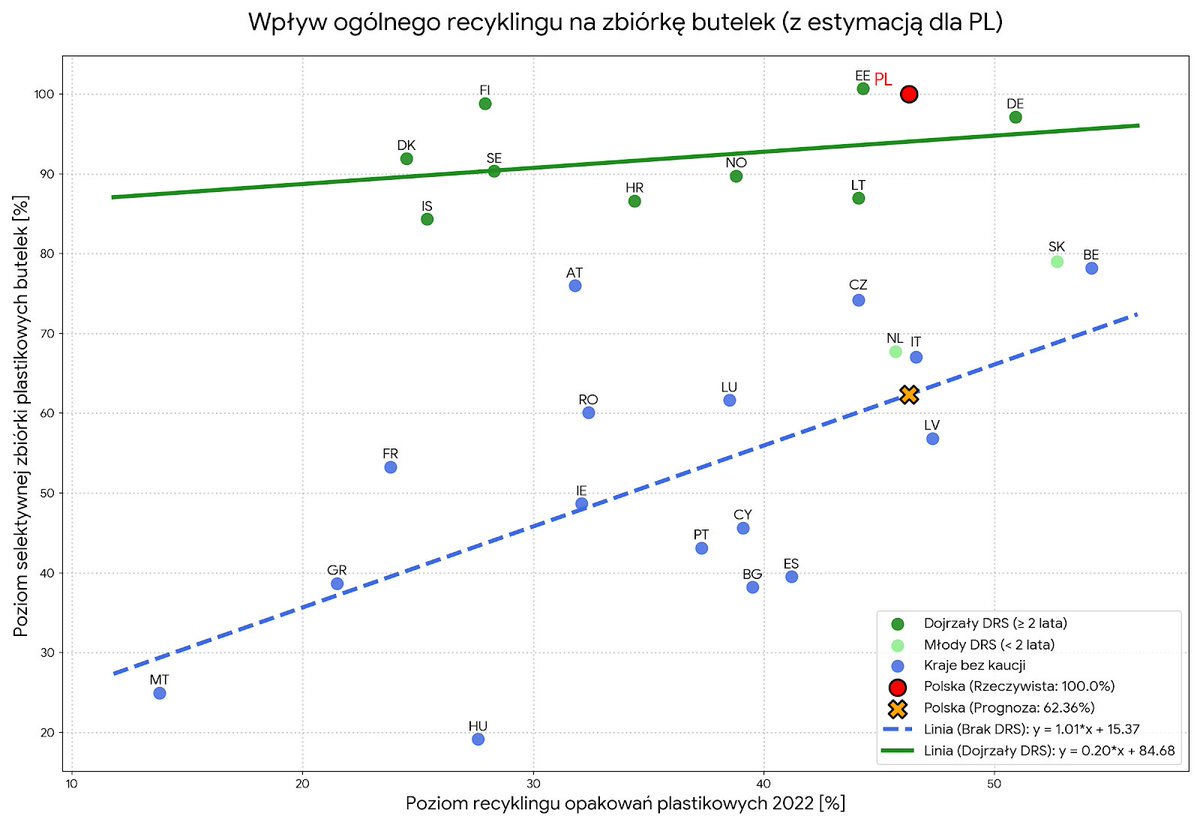
🇵🇱Polska przed wdrożeniem systemu kaucyjnego miała jeden z wyższych wskaźników recyklingu plastikowych opakowań w UE.
🤷♂️Co więcej, system kaucyjny sam w sobie nie powoduje wzrostu recyklingu opakowań plastikowych.
🔎Na poniższym wykresie widać zależność między poziomem recyklingu odpadów plastikowych w 2022, a poziomem selektywnej zbiórki plastikowych butelek w 2022.
📈W przypadku krajów bez systemu kaucyjnego widać wyraźną liniową zależność między obiema zmiennymi.
🚫Natomiast w przypadku krajów z systemem kaucyjnym ta relacja jest nieistotna statystycznie.
❌Innymi słowy, w analizie przekrojowej nie ma dowodów na to, że wysoki poziom selektywnej zbiórki butelek plastikowych w systemie kaucyjnym idzie w parze z wyższym całkowitym poziomem recyklingu opakowań plastikowych.
🚨 JUST IN: In a bombshell speech, German Chancellor Friedrich Merz just called the EUROPEAN UNION A COMPLETE FAILURE in front of global elites by stating, "Germany and Europe have wasted incredible potential. We have become the world champion of over-regulation and zero growth."
Yuri Bezmenov – The Long March in Four Stages.
In 1984, a former Soviet KGB propagandist sat in front of a camera in Los Angeles and explained how to destroy a country without firing a shot: by sowing demoralization and unrest, using its own local socialists, useful idiots and the like. Most people laughed. Today the clip goes viral every other week.
1. Born in 1939 near Moscow, the son of a Soviet army officer. He studied Indian languages and joined the Novosti press agency – in his account, a front for the KGB. Posted to India, his job was deception and subversion: handle foreign journalists and intellectuals, show them what they were supposed to see, and shape what they wrote home.
2. In 1970 he defected – disguised as a hippie, slipping out of India with a group of Western travelers. He settled in Canada under a new name and worked in radio. In 1984 he gave the interview that made him famous.
3. His core claim: espionage is the small part. The big part is subversion – and it works through demoralization: changing a society’s perception of reality so that, despite an abundance of information, nobody can reach sensible conclusions in defense of themselves, their family or their country. And it isn’t carried out by spies. It is carried out by the country’s own people – local socialists, useful idiots and the like: professors, teachers, journalists, entertainers, activists, most of whom have no idea whose work they are doing.
4. Stage one: demoralization. It takes fifteen to twenty years – the time needed to educate one generation. The targets are the schools, the universities, the media, the churches, the culture: Gramsci’s institutions. The result is a person who can no longer process facts. Show him the evidence, and he refuses to believe it.
5. Stage two: destabilization – a few years of sowing unrest in the economy, the defense, the institutions and the streets. Stage three: crisis – a few weeks of breakdown, after which a new power arrives promising salvation.
6. Stage four: normalization. Central Europe knows that word. After Soviet tanks crushed the Prague Spring in 1968, Moscow called the occupation "normalization." Poland lived its own version after martial law. The abnormal, declared normal. And the useful idiots who helped the revolution? Bezmenov said they would be the first to be discarded once it won. The revolution devours its own.
7. Not every number he gave can be verified – he was a dramatic witness. But the mechanism holds. And there is one thing he missed. The Soviet Union died in 1991. The demoralization didn’t. It no longer needs the KGB. It runs on its own fuel now – grants, careers, NGOs, prizes. Münzenberg’s machine outlived him; so did Moscow’s.
In 2020 his interview opened a Call of Duty trailer. A new generation met him through a video game – and recognized its own world.
The interview is linked below. If you haven’t watched it, you have to.
Poles lived stage four. The West has been living stage one for half a century.
Demoralization takes a generation. So does the cure. It starts at the kitchen table: tell the truth, teach the children, have courage and refuse to call the abnormal normal.
@piokub@tomasz_swaczyna@SpaceX@Tesla To jest skupianie się nad problemami,które nie istnieją.Z otwieraczem do puszki po jej otwarciu nie było co zrobić i ludzie wyrzucali.Zakrętkę można zakręcić.W US do dziś jej nie przytwierdzają.Kapsle też nie sa przytwierdzone.Jest za to problem z biurokracją i tłumieniem biznesu
@piokub@tomasz_swaczyna@SpaceX@Tesla Być może UE nie musiałem tego robić 50 lat temu bo zamieszkiwali ja ludzie którzy wiedzieli, że nie należy śmiecić,bo kultura na to nie pozwala. Ciesze się też, że jest szansa że za pół wieku UE w końcu będzie produkować latające samochody 💪.A wyprodukowała kiedyś Concorda.
@piokub@tomasz_swaczyna@SpaceX@Tesla Tego nie zauważyłem. Ale jeżeli Ciebie 10c lub 50gr ma zachęcić by nie śmiecić tylko oddawać opakowania, to wiedz że ja wyrzucałem śmieci do śmietnika bez zachęty finansowej.Cieszę się że UE mogła Cię ucywilizować i przestałeś śmiecić. Smacznej kawusi. Moja jest pyszna.