WHERE DO YOU COME FROM?
Imagine you're on a small volcanic island in the middle of the Pacific Ocean, surrounded by thousands of kilometers of ocean in every direction. For at least 1,000 kilometers, there's no land. And yet, rising before you is an ancient city made of basalt columns, some weighing up to 50 tons. Welcome to Nan Madol, one of the world's greatest archaeological mysteries.
Nan Madol is located on Pohnpei Island, a small island only 30 kilometers in diameter. Despite the island's small size, the city stretches for 1.5 kilometers and consists of about 90 artificial islands connected by canals and built from basalt columns.
Conservative estimates suggest that at least 750,000 tons of basalt were used to construct this "metropolis." For comparison, the Egyptians transported 8,000 tons of granite to build the interior of the Great Pyramid of Giza. Nan Madol weighs ten times as much as the granite core of the pyramid.
… But how was it possible to build such an impressive city on such a small and remote island? The inhabitants of Pohnpei, numbering only a few thousand, possessed neither the technology nor the resources for such a project.
Transporting 50-ton blocks of basalt would have required a highly advanced civilization with exceptional engineering and logistical skills. And yet, no traces of such a civilization have been found in the region.
… The scientific analysis of the rocks in Nan Madol revealed another mystery: Only 40% of the basalt originated on the island of Pohnpei. The source of the remaining 60% is unknown. Where did it come from?
And, most importantly, how was it transported to Pohnpei? If transporting the granite for the Great Pyramid down the Nile required the assistance of one of the greatest civilizations of the past, who transported ten times that amount across the Pacific Ocean?
Nan Madol exhibits all the hallmarks of a capital city: a complex structure, artificial canals, and islands with specific functions. But if it was a capital, where was the kingdom that ruled it? Around Nan Madol stretches nothing but ocean. It's as if the city was built by a civilization that has since vanished, leaving no trace.
Who designed and built this city? Where did its builders come from? Why did they disappear without a trace? Some speculate that Nan Madol was built by a highly advanced, vanished civilization that once dominated the Pacific.
Others believe it is the result of lost technology or even extraterrestrial intervention. One thing is certain: the inhabitants of Pohnpea, with their canoes and thatched huts, could never have constructed such a structure.
Nan Madol remains one of the greatest mysteries in human history. A city built in the middle of nowhere from materials of unknown origin, defying all logic and conventional explanation.
Perhaps one day we will uncover the truth about this "impossible city." Until then, Nan Madol will continue to raise questions and theories, further fueling interest in mysteries and the unknown.
They Dug Beneath The Statue… And Discovered Something Terrifying
For centuries, the mysterious Moai of Rapa Nui stood silently across the island, their giant stone faces watching the horizon like ancient guardians. Most people believed they were nothing more than enormous heads buried in the ground. But beneath the soil, a shocking secret had been waiting for centuries.
When archaeologists finally excavated around the statues, they uncovered massive hidden bodies buried deep underground — complete with carved torsos, arms, and strange ancient symbols etched into the stone. The discovery changed everything people thought they knew about the Moai.
Who created these giants? How were they moved across the island without modern technology? And why were so much of their bodies hidden beneath the earth for hundreds of years?
Standing beside one feels almost unreal. The statues tower above humans with an eerie silence, their expressions frozen in time as if they are watching something we cannot see. The deeper archaeologists explored, the more mysterious the island became.
Some believe the Moai were built to protect the island spiritually. Others think they represented powerful ancestors whose influence continued even after death. But no theory fully explains the haunting presence these statues carry.
Perhaps the most chilling part is this: the Moai still refuse to give up all their secrets. Even today, they remain one of the world’s greatest unsolved mysteries — silent stone giants guarding the forgotten story of a vanished civilization.
No-bake Strawberry Crunch Cheesecake
Servings: 12 Prep: 30 minutes Chill: 6 hours (or overnight) Pan: 9-inch springform
Ingredients
Crunch crumb
24 golden sandwich cookies (e.g., Golden Oreos), finely crushed
24 strawberry sandwich cookies, finely crushed
6 tbsp unsalted butter, melted (divide 3 tbsp + 3 tbsp)
Crust
2 cups (about 28) vanilla wafer crumbs or graham crumbs
8 tbsp (1/2 cup) unsalted butter, melted
2 tbsp sugar (optional)
Pinch salt
Cheesecake filling
24 oz (3 bricks) cream cheese, room temp
1 cup powdered sugar
1 tbsp vanilla extract
1/4 tsp fine salt
1 1/4 cups heavy cream, cold (or 8 oz thawed whipped topping)
Strawberry layer
1 cup fresh strawberries, small dice (pat dry)
1 cup strawberry jam or preserves, loosened
1 tsp lemon juice
Optional: 1–2 tbsp freeze‑dried strawberry powder for extra color/flavor
Topping
1 1/2 cups whipped cream (sweetened to taste)
1 cup sliced fresh strawberries
Instructions
Make the crust
Line the springform base with parchment. Mix wafer/graham crumbs with melted butter, sugar, and a pinch of salt until evenly moistened. Press firmly into the pan bottom. Chill while you make the filling.
Make the “crunch” crumbs
In one bowl, combine golden cookie crumbs with 3 tbsp melted butter. In a second bowl, combine strawberry cookie crumbs with 3 tbsp melted butter. Toss each until sandy. Set aside.
Cheesecake filling
Beat cream cheese until very smooth (2–3 minutes). Add powdered sugar, vanilla, and salt; beat until fluffy.
In a separate bowl, whip heavy cream to stiff peaks. Fold the whipped cream into the cream cheese in 2–3 additions until silky (or fold in whipped topping).
Strawberry layer
Stir jam with lemon juice to loosen; fold in diced strawberries (and strawberry powder if using). Pat berries dry first so the layer stays neat.
Assemble (four layers)
Spread half of the vanilla cheesecake over the crust; smooth.
Spoon the strawberry layer in an even layer over it.
Gently spread the remaining cheesecake over the strawberries, sealing to the edges.
Sprinkle a mix of the golden and strawberry crunch crumbs over the top (save some for garnish after slicing if you like). Lightly press so they adhere.
Chill
Cover and refrigerate at least 6 hours, preferably overnight, until fully set.
Finish and serve
Loosen the springform ring. Pipe or dollop whipped cream around the top and pile on sliced strawberries. Scatter any remaining crunch crumbs. Slice with a hot, dry knife (wipe between cuts).
Tips and swaps
Extra stability: dissolve 1 tsp powdered gelatin in 2 tbsp cold water; melt gently and whisk into the cream cheese before folding in whipped cream.
Crunch alternative: use shortbread + freeze‑dried strawberries (crushed) if you can’t find strawberry cookies.
Not too sweet: balance the jam with a squeeze of lemon.
Storage: keeps 3–4 days covered and chilled.
🏜️ The Desert Tomb That Still Watches…
Hidden deep in the silent sands of northwestern Saudi Arabia lies a massive rock carved with incredible precision—standing alone, as if guarding secrets no one has fully uncovered. This is part of Hegra (Al-Hijr), an ancient city built by the mysterious Nabataean civilization nearly 2,000 years ago.
At first glance, it looks like a grand doorway… but it leads nowhere. No windows, no life—just a tomb carved straight into stone for a powerful family of a forgotten era. The details are shocking—perfect columns, sharp edges, and elegant designs that have survived centuries of wind and sand. How did they achieve such precision in the middle of a harsh desert?
But here’s where it gets strange…
This place once stood along powerful trade routes, where caravans carried spices, incense, and untold riches across continents. Wealth flowed here. Stories were exchanged here. And then… silence. The city was abandoned, left to the desert as if something made people walk away.
Today, the structure still stands—untouched, isolated, and watching. No crowds, no noise… just wind echoing through history. Some say these tombs were not just for the dead, but symbols of power meant to last forever.
And maybe they have.
Because even now, staring at it, you can’t help but wonder…
What really happened here? 👁️
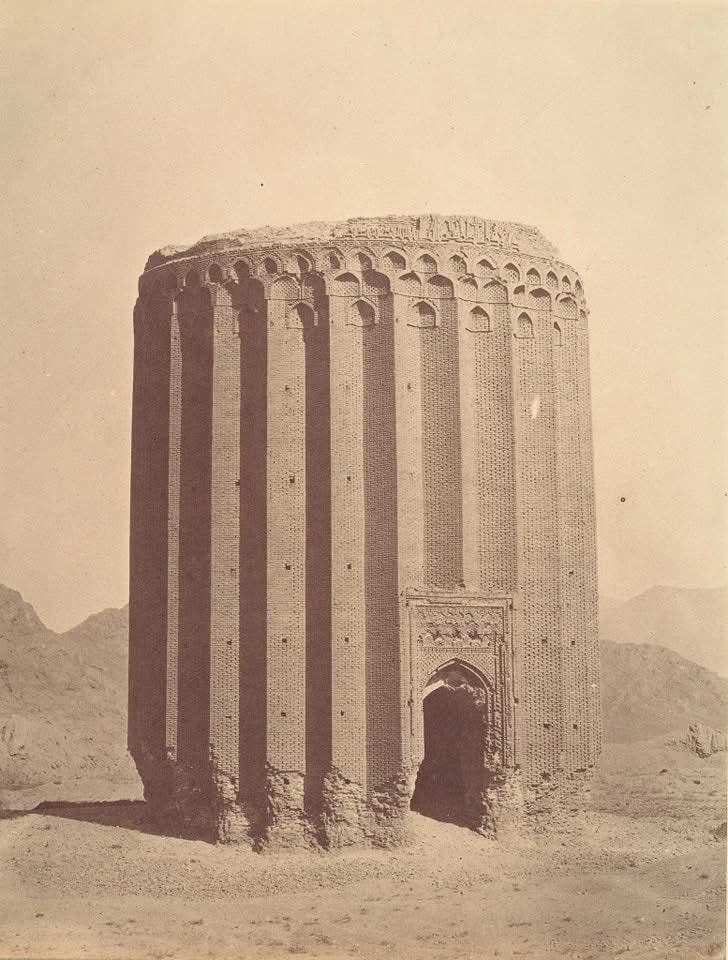
This 900-Year-Old Tower Still Stands… But What Has It Witnessed?
Rising silently from the ancient land of Rey, Iran, the Tughrul Tower has been watching the world change for nearly 900 years. Built in the 12th century during the powerful Seljuk Empire, this massive brick structure is believed to be the tomb of Tughril Beg — a ruler whose legacy once shaped an empire stretching across vast lands.
At first glance, it looks simple… but look closer.
The tower’s unusual 24-sided design isn’t just for beauty. As sunlight moves across the sky, shadows dance along its edges, almost like a giant clock marking the passage of time. Was it only a tomb… or did it serve a deeper purpose?
At the top, faint traces of ancient Kufic inscriptions and decorative carvings whisper secrets from a forgotten age. Its original مخروط-shaped roof is gone, lost somewhere in history — but the mystery remains.
Surrounded by a rugged landscape, the tower stands alone. No crowds. No noise. Just silence… and centuries of stories buried within its walls. It has survived earthquakes, invasions, and the fall of empires — yet it still stands, unbroken.
What did it see when the Silk Road was alive with travelers?
What secrets were sealed inside when it was first built?
And why does it still feel like it’s guarding something?
Some monuments are just structures…
But others feel like they’re watching back.
This picture is a detail from a famous medieval book called Très Riches Heures du Duc de Berry, painted in 1411. Shows what the Louvre looked like back then - very different than the museum we know it today....
The Louvre wasn't an art museum back then. It was a castle and looked like a castle. It had thick stone walls (that still can be seen as underground structures), spiked roof towers and a ditch around it to keep the enemies at bay. The castle was originally built in the late 1100s by King Philippe Auguste. The west end of Paris needed a strong defense to protect the city from attacks—especially from the British during the Centennial War.
Over time, the castle has become a royal residence. French kings stayed there while in Paris. They added more fancy rooms, gardens and decorations, but it was still a solid and gated building.
The Louvre has remained a royal palace for centuries. Converted into a more elegant palace with large courtyards and large lounges in the 1500s and 1600s. Eventually, it went from being a royal residence during the French Revolution and became what it is today: a public museum.
So in 1411 the Louvre wasn't a place to see the Mona Lisa. It was a powerful symbol of the kings protection and control over Paris. What you see in this painting is one of the oldest paintings of the Louvre, known as the medieval castle.
#archaeohistories
🚨 THEY BUILT THIS ROAD INTO THE MOUNTAIN… BUT WHY? 🚨
At first glance, it looks like nothing more than an old stone path stretching across a lonely mountain. But look closer…
Those deep grooves carved into the rock were not made overnight. Every crack, every cut, every worn line was shaped by human hands centuries ago. Thousands of people once stood here, hauling stone, carving paths, and leaving behind marks that time itself could not erase.
Who were they?
What were they building?
And why did they choose such a harsh, unforgiving place?
The silence of this road feels almost unnatural. The higher you climb, the quieter the world becomes, until all you can hear is the wind brushing across the ancient stone. It feels less like a road… and more like a doorway into a forgotten age.
At the top stands a single figure, staring across the endless landscape. In that moment, the past and present seem to collide. The modern world suddenly feels small compared to the weight of history beneath your feet.
Some places are beautiful.
Some places are mysterious.
And then there are places like this… places that make you feel as though the mountain itself is hiding secrets it was never meant to share.
Maybe that is why these ancient roads still fascinate us today.
Because somewhere within those weathered stones lies the story of people long gone… yet somehow, they are still speaking to us.
वॉलनट पाउडर का कमाल सफेद धब्बों को समाप्त कर जीवन को खुशहाल बनाता है।
यह घरेलू उपाय के बारे में जरूर जानना चाहिए यह समस्याएं आजकल तेजी से बढ़ रही है। 👇👇👀👇
Most probiotics you buy are dead on arrival.
Two reasons the probiotic aisle is a graveyard of wasted money:
1. Standard supplements transit through your GI tract without colonizing. You are paying $40 a month for bacteria that never take root. A placebo-controlled study identified two strains that actually engrafted: Lactobacillus helveticus R0052 and Bifidobacterium longum R0175. These strains moved in, shifted the microbial landscape, and reduced depression and anxiety in 12 weeks.
2. Every client I work with gets the same instruction: eat the bacteria, do not just swallow a capsule. Parmesan, Gruyère, kefir. These carry L. helveticus in a living matrix your gut can actually use. Chew fermented food alongside your protein. Co-mastication delivers microbes the way your biology was built to receive them.
Eat food that is alive.
In 1916, a pack of dogs attacked a private zoo in Hawaii. Two terrified wallabies broke out of their cage and escaped into the mountains.
What happened next is one of the wildest accidents in wildlife history.
After the wallabies vanished into the forested cliffs of Kalihi Valley, the zoo's owner called for a massive public hunt. Nobody caught them.
A local newspaper joked that they might eventually "produce a breed of Hawaiian wallabies."They were exactly right.
Despite being 5,000 miles from Australia, the steep volcanic rock faces in Hawaii turned out to be the perfect habitat.
By 1984, researchers counted roughly 250 wallabies thriving in the valley. They had even started developing their own unique evolutionary characteristics.
The craziest part?
They aren't considered invasive.They only eat non-native plants.
They don't compete with native species (Hawaii has no native land mammals).
Because they peacefully coexist with the ecosystem, the state of Hawaii officially protects them. It is strictly illegal to hunt or harm a Hawaiian wallaby.
Back in their native Australia, the brush-tailed rock wallaby is fighting for its life. Predators, habitat clearing, and the devastating 2019-2020 bushfires wiped out an estimated 70% of their remaining habitat.
But that accidental Honolulu colony?
They have no foxes. No feral cats in the cliffs. No bushfires.
Two wallabies that broke out of a cage 110 years ago accidentally founded what might be the most secure population of their species anywhere on Earth.