"What is Prepfully?"
Most interview content online is outdated, generic, or scattered.
Prepfully brings you up-to-date interview guides, predictive question banks and 1-on-1 coaching with people already working in your dream role at your dream company.
Everyone keeps debating whether AI will create more jobs than it destroys. But TBVH that debate feels very different when you look at what is already happening.
The jobs people point to are real, but they are also specific: data center electricians, power engineers, people who can fine-tune models, and the 10x engineer who can now ship what used to take a team of six.
That is quite not the same market as the one most displaced candidates are actually in. A mid-level marketer, designer, analyst, recruiter, or operator does not just wake up and become an AI infra expert.
And that is the genuine gap. AI may not directly take every job.
But the bar is moving toward people who can use AI well, communicate sharper, and prove they can do more with less.
A lot of people prepare for the Meta Data Scientist interview by grinding SQL and stats questions.That’s necessary, but it’s usually not enough.What makes these interviews difficult is that Meta evaluates how you think through product decisions:
- what metrics you prioritize & handle trade-offs
- how you reason with incomplete data
- whether your analysis leads to a clear decision
We put together a breakdown of the full interview loop: https://t.co/TfvdwsIAuG
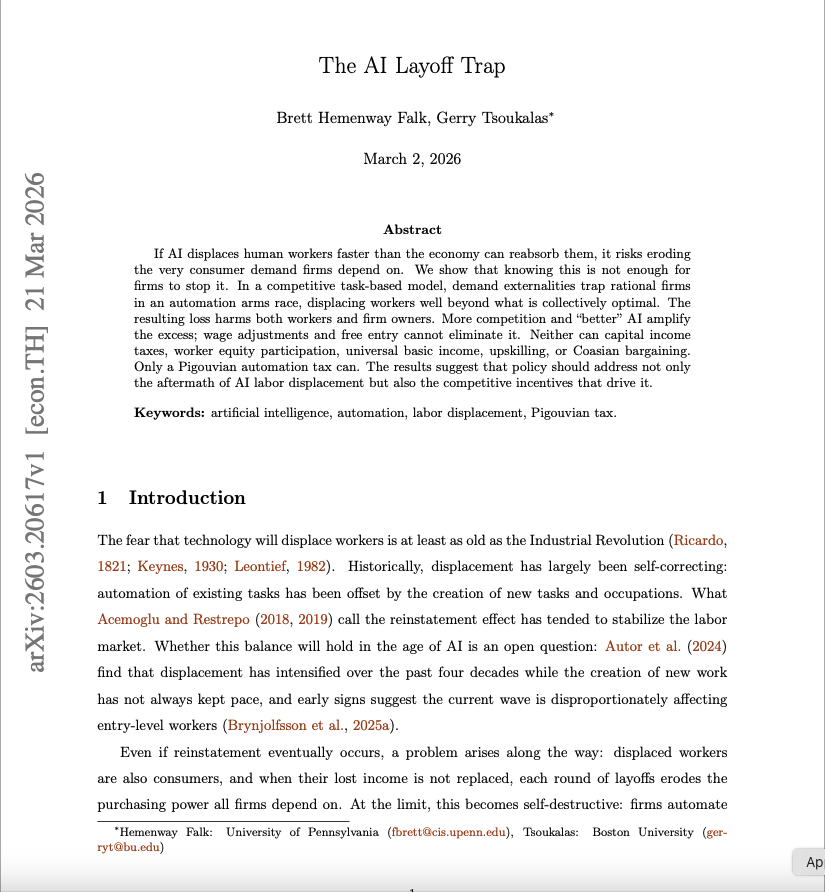
Two economists just came out with a proof that AI will destroy the economy.
It is not that it might happen or it could happen. It will happen if nothing changes.
The paper is called ""The AI Layoff Trap"". It was published on March 2 2026 by the Wharton School, University of Pennsylvania and Boston University.
Peer reviewed. Mathematically modeled. The conclusion is one sentence:
""At the limit, firms automate their way to boundless productivity and zero demand.""
This means the economy will produce everything. It will sell it to nobody.
Here is how this will happen.
A company fires 500 workers. Replaces them with AI.
A competitor fires 700 workers to keep up.
Another company fires 1,000 workers.
Every company is doing what makes sense.Every company is following the rules correctly. Every company is building a trap for itself.
The reason is that the workers who were fired were also customers.
When they lose their jobs faster than the economy can absorb them they stop spending money.
This means consumer demand falls. Companies respond by cutting costs, which means automating workers, which means less spending, which means more falling demand, which means more automation.
This loop has no exit. The researchers tested every proposed solution, such as basic income, capital income taxes, worker equity participation, upskilling programs and corporate coordination agreements.
Every single one of these solutions failed in the model. The only thing that worked was a tax on automation which's a fee charged every time a company replaces a human with AI forcing them to think about the demand they are destroying before they make a decision.
No government has implemented this tax. No major economy is seriously talking about it.
Meanwhile the numbers are already showing the trend.
In 2025 100,000 tech workers lost their jobs.
In the months of 2026 92,000 more workers lost their jobs.
Jack Dorsey fired half of Blocks workforce. Said publicly: ""Within the next year the majority of companies will reach the same conclusion.""
Nobody is doing anything. Companies are following their incentives perfectly.
That is the problem.
This is what happens when companies behave rationally at the time, with no mechanism to stop them.
Two economists built the math. The math leads to one place.
Source: Falk & Tsoukalas · Wharton School + Boston University ·
A Blind post about Shopify’s PM interview process is getting attention.
The candidate asks the difference between a mini case study and a full case study.
That is the market right now.
Even strong candidates are moving beyond just preparing for interviews.
They are trying to understand the exact format, expectations, and evaluation style before they walk in.
When the market looks like this, the interview bar goes up. Fewer roles, more applicants, and companies get pickier about who clears the interview.
If you're in the middle of a search right now, the one thing you can control is how prepared you are when you get in the room. Check out - https://t.co/Oivl0fZBKg
Read the complete Amazon DS interview guide here for free: https://t.co/RtBJnlFpFX
Amazon DS Bar Raiser rounds test far more than ML and SQL.
They evaluate judgment, communication, ownership, and how you solve ambiguous problems.
In this video:
• What Bar Raisers look for
• Common mistakes candidates make
• Practical tips to prepare better
#prepfully #interviewguidance #interviewtips #amazon #datascience #barraiser