Postdoctoral researcher at the Walter and Eliza Hall Institute in Matt Ritchie’s lab.
Research topic: Genomics | Transcriptomics | Long-read sequencing | Singl
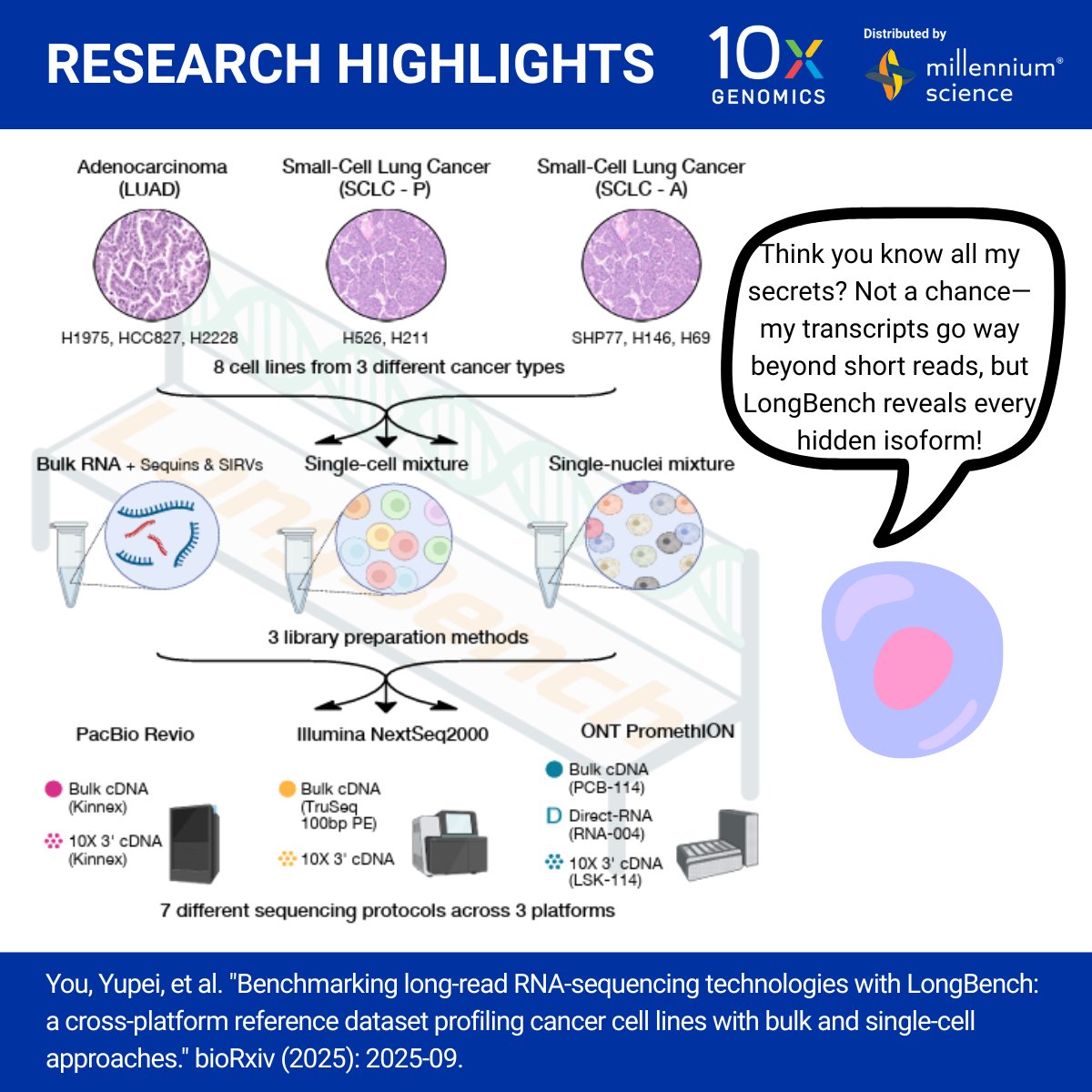
Benchmark long-read analysis with 10x Genomics + LongBench.
The LongBench resource from @mritchieau's lab, led by @youyupei showcases how @10xGenomics single-cell and single-nucleus workflows reveal full-length transcripts and uncover isoform diversity.
Interested in Honours, Masters, or PhD studies in medical research?
We have over 70 student research projects starting in 2025, across the breadth of research areas at WEHI.
Explore the opportunities here: https://t.co/KKvDhaKxex
#WEHIStudents#StudyInMelbourne#UniMelb
We have just released v0.4.0 of buttery-eel, a slow5 guppy/dorado basecaller.
It can now do barcode demultiplexing and works with the dorado server/client while maintaining compatibility with guppy.
https://t.co/68E07NoGPm
Amazing week for #DeepLearning in #spatial#singlecell biology, with 2🔥new Graph Neural Networks methods!
1.STELLAR🇺🇸 @jure: a cell type annotation & discovery atlas-type framework
2.NCEM🇪🇺 @fabian_theis: an approach to infer cellular communication patterns
Deep dive below🧵
We're hiring!
If you want to work with a great bunch of people on long-read scRNA-seq analysis to better understand brain development, please apply.
https://t.co/BsvW7DwoRa
#RNA#scRNA#Bioinformatics
Our tool BLAZE for identifying cell barcodes from @nanopore scRNA-seq is now published in @GenomeBiology https://t.co/dkXd0fbTsy
Lots of improvements from preprint
-faster
-high sensitivity mode
-output to run empty drops to save/discard cells
-robust to different read depths
Want to basecall faster? Want to scale your basecalling with hardware? Use our new tool: buttery-eel, to basecall SLOW5 files with the latest guppy basecaller and models, including methylation with remora -> uSAM.
https://t.co/atoX9QvWs4
We are happy to announce the preprint for Bambu - “Context-Aware Transcript Quantification from Long Read RNA-Seq data with Bambu” https://t.co/0IVtfNaRna. Available now from BioConductor https://t.co/haQlu0vZ3n and Github https://t.co/mbrItbzxLC 1/7
Long-read scRNA-seq is awesome for studying RNA isoforms. But @nanopore has relied on matched short-reads to identify cell barcodes and assign reads to cells.
Pleased to share BLAZE, a new tool to identify cell barcodes from nanopore scRNA-seq. Short-reads not required. 1/4
Excited to share our paper "NanoSplicer: Accurate identification of splice junctions using Oxford Nanopore sequencing" @nanopore
https://t.co/bwnphDtv7W
When annotations are available, NanoSplicer provides higher accuracy than FLAIR when there are multiple annotated junctions nearby, or the true junction utilised unannotated splice site. (3/3)
@goekelab I am very happy that you found it interesting. We are currently working on moving from the "corrected junctions" to "corrected reads/isoforms", so we can output in .bam files.
Thanks again to @heejungshim for giving a virtual seminar on 'NanoSplicer: Accurate identification of splice junctions using Oxford Nanopore sequencing'. If you missed it, you can watch here: https://t.co/dGqro8zmVV