@RomelloDuke Why not five or six eggs cooked in butter and whole raw milk 25 gram protein shake (especially for seniors)plus a ten or twelve ounce steak,consuming all the fat (this is my diet at 76 yrs old) lift heavy things and a walk in the sun for 40 min without sunscreen
@_The_Prophet__ The sublime intimacy the words point to subsumes all that appears and cannot be otherwise. No entrance or exit into/from “this”can actually be found.Completely alone,never lonely. Sigh…..
Very similar journey and I’m seventy six age didn’t blunt the transformation. Although I’m not as strict as I was a couple of years ago. Getting off Prilosec (reducing stomach acid for reflux)and all meds was notable the arthritis reduction was most notable ,as it allowed me to enjoy golf more..
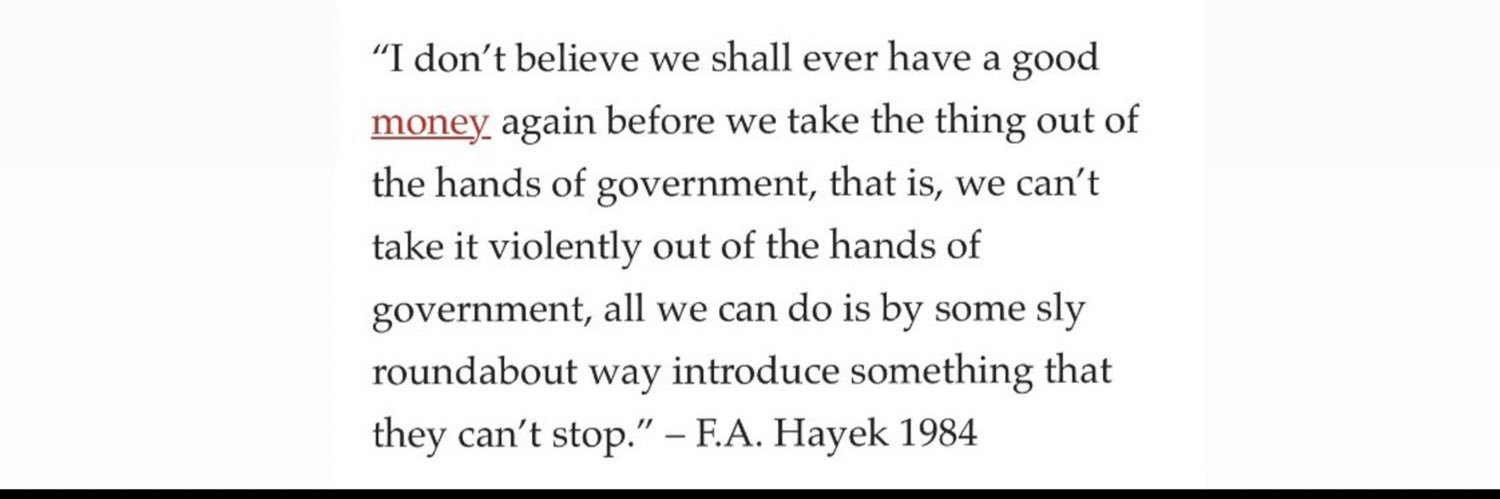
⚡️Bitcoin’s most profound breakthrough is this:
It created property that does not need a sovereign, bank, company, or custodian to exist as property.
That goes deeper than “digital gold,” deeper than scarcity, deeper than payments, deeper than Saylor’s “economic energy” metaphor.
For almost all of history, wealth ultimately depended on recognition by some external authority.
Land required law.
Bank deposits required banks.
Stocks required corporate registries.
Bonds required issuers.
Gold could escape some of that, but once you wanted to move it at scale, store it safely, or use it across borders, institutions came back into the picture.
Bitcoin did something historically strange.
It fused the asset, the ownership record, and the settlement system into one thing.
If you possess the keys, the network recognizes the claim because the claim is cryptographically valid. Nobody has to know who you are. Nobody has to approve the transfer. Nobody has to promise redemption. There is no issuer whose balance sheet sits underneath the asset.
That is the rupture.
And the 21 million cap makes it even deeper because now the monetary constitution travels with the property.
The future cannot casually decide that yesterday’s savings should be diluted because today has an emergency.
So the breakthrough is really two things welded together:
Ownership without permission, and scarcity without discretion.
That combination had never existed globally in a digitally native bearer asset.
And this is where Saylor’s “economic energy” language is reaching for something real.
Money is stored agency across time.
You work today.
You do not consume everything.
You carry that unused command over resources forward.
Bitcoin gives you a way to encode that deferred agency into a system whose monetary rules are extraordinarily difficult for any single actor to rewrite.
That is why the deepest description remains:
Bitcoin is incorruptible monetary memory.
It remembers that value was assigned here, transferred there, and remains under this key.
It remembers without needing the original owner.
It remembers without needing Satoshi.
It remembers without needing a bank.
It remembers without needing the government that happens to exist fifty years later.
That is almost mythic when you really sit with it.
Human civilization spent thousands of years asking:
Can we store sacrifice across time without trusting the future not to alter the terms?
Bitcoin is the first serious answer that says:
Make the promise survive the promisor.
And if it succeeds over generations, that will be its historical meaning.
Not that it made money digital.
That it made monetary ownership native to information itself, and gave the past cryptographic teeth against the future.