This is concerning. For the first time, a Chinese model Kimi K3 has taken #1 on the Frontend Code Arena and is scoring at or near the frontier on other benchmarks.
Meanwhile America is tying itself in knots: politicians and bureaucrats are banning new data centers, piling on state regulations, and pushing for new federal agencies to pre-approve frontier models.
This is how you lose the AI race. The rest of the world won’t play by our rules if we bog ourselves down. Permissionless innovation is how America won the internet and became the technological envy of the world. We can do it again with AI -- while addressing risks in a targeted way -- or we’ll watch our lead evaporate.
We've open-sourced Grok Build and have reset usage limits for all users.
Open sourcing Grok Build allows anyone to support making a reliable and robust harness. Check out our code, including the Git repo for the Grok Build CLI.
https://t.co/3SSvPu2Nrz
GM
@wejh69 wanted pressure on the mechanism. Pressure delivered 🥷
Dendrite starts mining on SN66 @Ninja_Subnet with Wejh’s blessing and Const’s approval. Public coldkey, documented methods, honest reporting.
Win or lose.
Think BIG... or they won't let you think at all.
Stories move the world so I thought I'd tell a story that is near and dear to my soul, with the help of my friend @Raleigh_CA.
Own your means of production. Own $TAO.
We’ve published a new public dataset from the Ninja validator: 600 qualified tasks and 1,675 screened-out task candidates, for 2,275 total, plus 44,752 qualification and duel rollouts from six retired kings.
The dataset will grow with the competition. Whenever a new king is crowned, the retiring king’s tasks and rollouts will be automatically archived.
https://t.co/8n2KbljkhI
We expect the dataset to become increasingly useful as full LLM traces accumulate. We will be exploring partnerships with model training subnets to post-train models for Ninja through SFT, preference optimization and reinforcement learning, with the goal of making Ninja their preferred agent harness.
You can force an architecture into decentralized training, or you can craft an architecture specifically for decentralized training (and ultimately insanely performant inference). Stop trying to fight gravity.
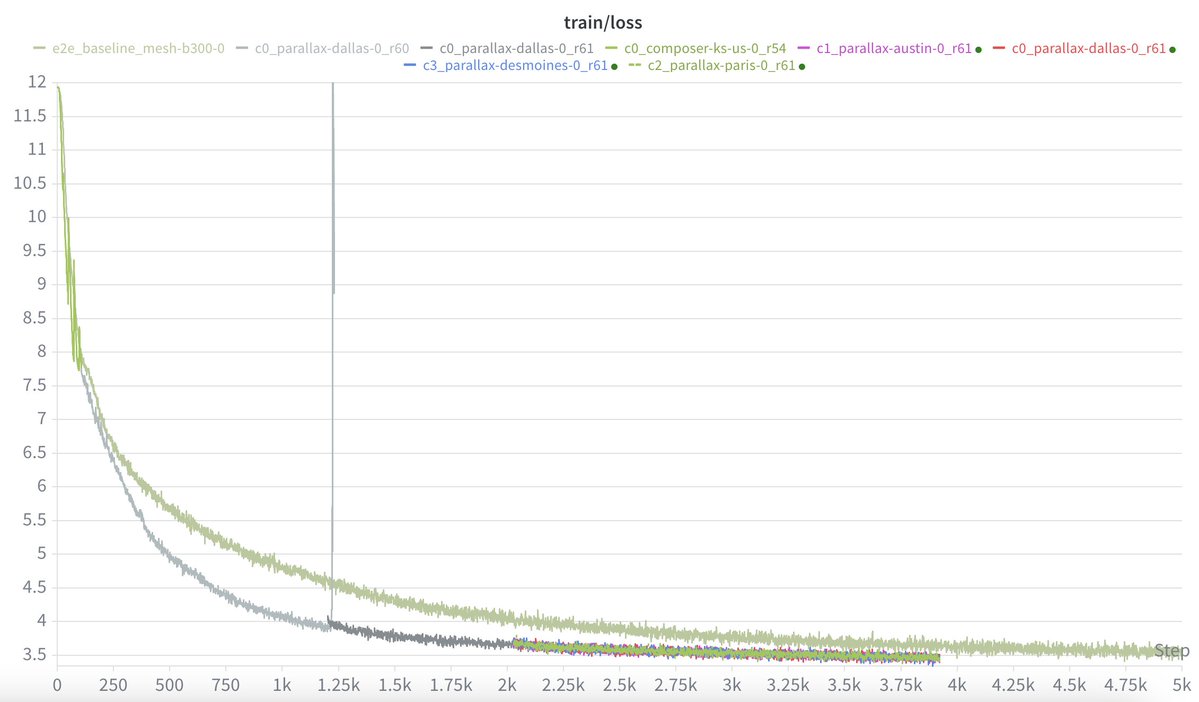
"Parallax", so far, is working exceptionally well.
Surrogates, expert offload, stratified decoupled diloco, etc. All pretty great to make training work at scale across the internet. But... The biggest benefits are actually AFTER training, via specific model architecture choices that drastically reduce VRAM and increase throughput.
These giant MoEs are wasting so much VRAM and compute for all of the many routed experts, it's insane actually. So much research already showing that MoEs can be massively compressed/pruned/ternary-distilled/etc., not to mention they are generally comparable to around 2.5-3x dense model equivalents of the ACTIVE parameter count. KV cache is a huge bottleneck, and these huge routed experts are often "dead weight" that consume it needlessly.
We need to do better, so we will.
Ep. 97 - Charlie Holt
Charlie @Wejh69 is building Ninja SN66 @Ninja_Subnet
Timestamps
0:57 - Charlie's Bittensor Start
3:07 - Mining, Miner Union, And Brainlock
3:32 - What Ninja SN66 Does
4:57 - Harnesses As AI Tool Belts
7:04 - Agent Files And Validator Tasks
8:55 - Katana And The Winning Harness
9:41 - LLM Judges At Scale
11:05 - Cheap Intelligence And Agent Work
15:04 - Determinism And Batch-Invariant Inference
19:04 - Brainlock And FHE Inference
22:57 - FHE, Privacy, And AI Agents
25:06 - Broken Tools And Agent Reasoning
26:58 - Should Subnets Act Like Companies?
28:59 - Why Breakthrough Subnets Lose Money First
31:00 - Tokens, Voting Power, And Accountability
32:58 - Total Addressable Market For Coding Agents
34:58 - Model Limits And Emergent Behavior
36:57 - Open Models, China, And Worldviews
39:00 - Holder Rights And Subnet Transparency
40:59 - Central Voices In Decentralized Systems
41:51 - Advice For New Bittensor Builders
I think the SEC would have words, not legal advice, of course.
https://t.co/5rknaMrZLB
Chutes is a DePIN, and the token is a utility token, aka it's a digital commodity not a security/etc. The chutes token being burned is what provides access to the commodity (hence any revenue from any payment type ultimately ends in burning of equivalent alpha token). This then also makes accounting less dubious because it's a COGS model, the revenue is immediately converted to alpha and burned, so there's no refunds/etc, and we have a much cleaner accounting posture because revenue is immediately matched to the tokenized cost required to deliver compute. It's programmatic purchase-and-burn for consumptive use. There is no discretionary treasury accumulation, no customer balance liability, no refundable stored value model, and no ambiguous promise that the OpCo will later use revenue in ways that benefit token holders, etc.
(§ III.A): "A digital commodity is a crypto asset that is intrinsically linked to and derives its value from the programmatic operation of a crypto system that is 'functional,' as well as supply and demand dynamics, rather than from the expectation of profits from the essential managerial efforts of others." And critically, it "does not have intrinsic economic properties or rights, such as generating a passive yield or conveying rights to future income, profits, or assets of a business enterprise or other entity, promisor, or obligor"
§ III.E and § IV.A relevant as well.
Projects claiming to be digital commodities but then not having token utility could be potentially violating those guidelines or have extraordinarily dubious interpretations that I would not want to be on the defending end of personally.
Projects that then do have utility to the token but that then take the revenue, at least by my reading... well I wouldn't want to defend that fact pattern because it looks more like a web2 OpCo with an associated token whose value depends on the company’s managerial decisions.
"the Federal securities laws generally do not apply to items that are purchased for use or consumption," whether physical or digital (§ II) and consumption = token purchase (and then we'd not want to be custodians and complicate things with yield etc. so burn)
And if it's instead the OpCo holding staked assets for customers, then... (from same sec link)
"Further, the deposited digital commodities: (1) are not used by the Custodian for operational or general business purposes; (2) are not lent, pledged, or rehypothecated for any reason; and (3) are held in a manner designed not to subject them to claims by third parties. To this end, the Custodian may not use the deposited digital commodities to engage in leverage, trading, speculation, or discretionary activities."
The cleanest and lowest-risk way I’d personally want to defend using revenue operating as a bittensor subnet if you want to be classified as a digital commodity and not risk the ire of the SEC/etc. Anything else...
Same with projects explicitly tying the token to equity in the OpCo, how can anyone interpret that as anything other than clearly a security?
Again, not legal advice and perhaps there are some other interpretations, but that's why, in a nutshell.
Another minor note here, just purely logistically it doesn't really make sense, we would have had to buy the servers with revenue we've accumulated until now when the servers were actually available and there was rack space/power/etc. to even use them in the first place, and unfortunately we don't have a time machine, or have taken out a massive loan etc.
And of course, we're not trying to build a web2 company that happens to have a coin. Some people/projects want to own a DC or have huge colocated racks etc. and fully self-mine and limit access to the network etc., we want the opposite of those things.
The facts are wrong, the premise is wrong, the idea is misguided, potentially illegal, etc. This is the same type of reasoning that has been driving teams away from bittensor historically, short-sighted lowest common denominator logic. Would it be better for hermes agent/nous research to be on bittensor today? Several teams doing the most ambitious work have decided this ecosystem isn't where they build, in some cases because of the constant toxicity/lambasting/cabaling from a handful of people including those who can't see or think past short term revenue maxxing. We must dream bigger and do better.
Inference is it. It's the whole game. At the end of the day, any fine-tuning, RL, pretraining, prediction models, whatever else you're trying to build, if you don't use it, it's useless. Tooling almost exclusively focuses on test-time compute now vs. better base models.
And, at the same time, inference needs to be more efficient. DFlash/DSpark are great, but we need algorithmic/architectural breakthroughs, not just extra add-ons post-hoc.
Creating/curating data pipelines and synthetic augmentation/etc. also need inference as a prerequisite to train the model. Using agents = inference. RL = largely inference. The goal of training a model = inference.
That's parallax's "why" - we need to address the compute/cost/energy efficiency crisis facing the AI space right now. Maximally compact and efficient models to extract every last IQ point per watt out of the hardware, vs. just throwing more hardware at the problem.
A̶t̶t̶e̶n̶t̶i̶o̶n̶ inference is all you need.
Price action past 6 months, basically the same across all 4 with lower mcap being higher volatility. They're the same chart. Tao people often lose sight and hyperfocus on bittensor itself vs. the broader market. Decoupling could be good, or bad, but let's not pretend it's not correlated. NFA.
In $TAO SN74 discord channel Const suggested this:
" @kimbologic I think you should explore what @Wejh69 is doing on 66. Competitions where agents submit PRs to repos but those PRs are accepted by AI who run benchmarks to determine their eligibility."
Then, a couple days later, SN74 owner posts a picture meeting with Wejh 🤣🤘🏻
...And that's when @const_reborn replied: "success guaranteed"
https://t.co/usXOmWuIDr
My entire AI stack is now Chinese 🇨🇳
87% cheaper. same revenue
swaps by task:
1. reasoning / backend brain
Opus 4.8 → Kimi K2.7
benchmark gap: ~8% · price: ~11x cheaper
2. code generation
GPT-5.5 → Qwen 3.7 Max
benchmark gap: ~18% · price: ~7x cheaper
3. agent loops + tool calling
Sonnet 4.7 → GLM 5.2
benchmark gap: ~3% · price: ~5x cheaper on input
4. cheap volume / bulk processing
GPT-5.5 mini → MiMo V2.5
benchmark gap: ~6% · price: ~12x cheaper
5. image generation
GPT-Image-2 → Wan 2.5
benchmark gap: ~5% · price: ~8x cheaper
6. video generation
Sora 2 → Kling 3.0
benchmark gap: roughly equal · price: ~6x cheaper
[ result after 30 days: ]
operating costs dropped 87%, output quality dropped 4% on average, revenue unchanged
the most important that these models will be not banned in a month and i can run them locally
nobody will steal my data and i can learn them as i need
full article drops tomorrow with:
> exact routing logic per task type
> the 2 cases where I still pay for American
> the migration playbook anyone can copy in a weekend
VERY IMPORTANT to get migrated now, while it's not too late







![DeRonin_'s tweet photo. My entire AI stack is now Chinese 🇨🇳
87% cheaper. same revenue
swaps by task:
1. reasoning / backend brain
Opus 4.8 → Kimi K2.7
benchmark gap: ~8% · price: ~11x cheaper
2. code generation
GPT-5.5 → Qwen 3.7 Max
benchmark gap: ~18% · price: ~7x cheaper
3. agent loops + tool calling
Sonnet 4.7 → GLM 5.2
benchmark gap: ~3% · price: ~5x cheaper on input
4. cheap volume / bulk processing
GPT-5.5 mini → MiMo V2.5
benchmark gap: ~6% · price: ~12x cheaper
5. image generation
GPT-Image-2 → Wan 2.5
benchmark gap: ~5% · price: ~8x cheaper
6. video generation
Sora 2 → Kling 3.0
benchmark gap: roughly equal · price: ~6x cheaper
[ result after 30 days: ]
operating costs dropped 87%, output quality dropped 4% on average, revenue unchanged
the most important that these models will be not banned in a month and i can run them locally
nobody will steal my data and i can learn them as i need
full article drops tomorrow with:
> exact routing logic per task type
> the 2 cases where I still pay for American
> the migration playbook anyone can copy in a weekend
VERY IMPORTANT to get migrated now, while it's not too late](https://pbs.twimg.com/media/HL-p_PyWoAA42S2.jpg)


