In a letter to Robert Hooke, Sir Isaac Newton states the following metaphor: "If I have seen further, it is
by standing on the shoulders of Giants".
A heartfelt thanks to @detlef_lohse and Andrea Prosperetti: the giants upon whose shoulders I stood, and got my Ph.D. degree.
@NidalSabeh أستاذ نضال، صرلي زمان بدي إسألك. كيف في الواحد يصير مثلك "باحث في الشأن السياسي"؟ في شي شهادة أو مسار جامعي؟ أنا حابب إستحصل عاللقب إذا ممكن تفيدني أفا��ك الله.
In the case the polygon is a triangle, assign a pair of numbers to each vertex, and jump 1/2 the distance instead. Otherwise, the algorithm is the same.
Here, too, the result is anything but random: another fractal called the Sierpiński triangle.
Chaos Game.
Draw a hexagon. Assign # from 1 to 6 to vertices. Start from a random pt inside the hexagon. Roll the dice. Jump 2/3 the distance on the line segment joining the pt and the dice-chosen vertex. Roll the dice again and repeat from the new pt. The result is a "fractal".
This a clear demonstration of the "butterfly effect", whereby the Lorenz attractor exhibits an erratic dependence on the initial conditions. The green tracers follow trajectories whose starting points belong to a circle of radius ε << 1 centered around the red tracer at t = 0.
This a clear demonstration of the "butterfly effect", whereby the Lorenz attractor exhibits an erratic dependence on the initial conditions. The green tracers follow trajectories whose starting points belong to a circle of radius ε << 1 centered around the red tracer at t = 0.
In 1963, Edward Lorenz designed a system of nonlinear ODEs to "represent forced dissipative hydrodynamic flow". Solutions to this system can be depicted as 3D trajectories settling onto a thin set that looks like butterfly wings, now famously called the "Lorenz attractor".
I wanted to go a bit old school, so I wrote a Dormand-Prince 5th order embedded Runge-Kutta method, in C language, and generated the above video using bash, gnuplot and ffmpeg.
Oh the joy of playing with pointers again!
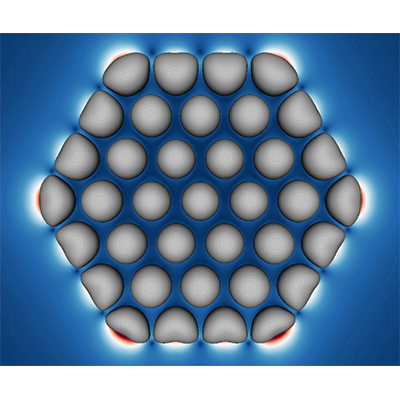
Excited to see our work, entitled "Finite speed of sound effects on asymmetry in multibubble cavitation", published in Physical Review Fluids.
Work with @mandeep19807139, Daniel Fuster and @detlef_lohse.
PRFluids Editors' Suggestion: In this new paper, @detlef_lohse and co. introduce novel insights into multibubble cavitation phenomena by focusing on the impact of the finite speed of sound on the asymmetry observed in bubble clusters under pressure waves. https://t.co/EcJvrQN77p