ሓደ ካብቲ ብዙሕ ንስለ #ኤርትራ እተኸፍለ ረዚን ዋጋ።
ዘልዓለማዊ ክብርን ዝኽርን ነቶም ብኣርኣያነቶም ዝመሃሩናን ዘጽንዑናን ጀጋኑ ሰማእታትና!
ዓወት ንሓፋሽ! 🙏🏾🇪🇷✊🏾
5 brothers who gave their lives so that #Eritrea could be free.
Eternal glory to our Martyrs!
Can Egypt trust South Sudan? No. Can it trust Uganda? No. Can it trust Kenya? No. Can it even trust Sudan or Somalia? No. All those counties can easily be influenced by Ethiopia. Egypt's only ally in Sub-Saharan Africa is Eritrea. Friends & allies until judgment day. 🇪🇷+🇪🇬
#Eritrea's Martyrs' Day on June 20 honors those who died for independence, inspiring responsibility, discipline, and gratitude. Their sacrifice will not be forgotten, and honoring them means defending the nation's sovereignty, dignity, and unity.
👇👇👉
https://t.co/zMY4CLLuBP
What the Music Kept: How Music Made Eritrea
May 21, 2026
By Raymok M. Ketema, PhD
@RedSeaBeacon
The arena was full. Selali’a stood at the center of the Bologna stage, straight-backed and unhurried, in a red button-up and black pants the kind of posture that doesn’t need to announce itself. Behind him, the backup singers and musicians caught the light in golden-yellow tops, some wearing them long and belted at the waist, others tucked in. The koboro players and backup singers kept the energy surging traditional drums driving the rhythm forward, hands clapping in unison, bodies moving. And then, from somewhere in the crowd, a woman pressed through to the stage and decorated his face with a paper bill, another tucking one into his lapel then another, and another, some reaching the stage to place it on his forehead, others tossing bills from the floor where they stood, too overcome to wait.
This was August 1991. Eritreans had gathered in Bologna, Italy, for the festival’s first liberated edition, still catching their breath from a historic milestone just months earlier, on May 24th, Eritrea had finally broken free from a grueling thirty-year revolutionary struggle for independence. The liberation had been fought on many fronts: on the ground in Eritrea, through the blood, sweat, and tears of soldiers who gave their lives and those who survived to tell the story alongside the doctors who saved them, the artists who documented and gave creative voice to the struggle, and the civilians who supported it in countless ways. But independence was never only a local fight. It was sustained, too, by a fast-growing diaspora scattered across Europe, North America, the Middle East, and the African continent itself.
Emblazoned across the stage backdrop was a declaration: ጸሓይና መሊኣ በሪቓ tseHayna melia beriQa “our sun is fully shining.” Above the words, a gerbera daisy, Eritrea’s national flower, burst free from its chains. It was the perfect visual distillation of the moment. And then came the music.
ReadMore @RedSeaBeacon@hawelti@Sudan #Djibouti #Somalia #Egypt #SaudiArabia #Turkey #Qatar #UAE
@EmbassyEritrea@hadnetkeleta@SirakBahlbi@EliasAmare@Ghidewon@Yehdavid@GhideonMusa@SharronYemane@PMEthiopia@MFAEthiopia@AfricanUnion@antonioguterres@cnni@AJEnglish@BBCWorld@Reuters@AFP@AlAhramWeekly@FT@latimes@nytimes@BBCWorld@AlJazeera @
@shabait@ERiTV_Official
https://t.co/UFtkdBmMsx
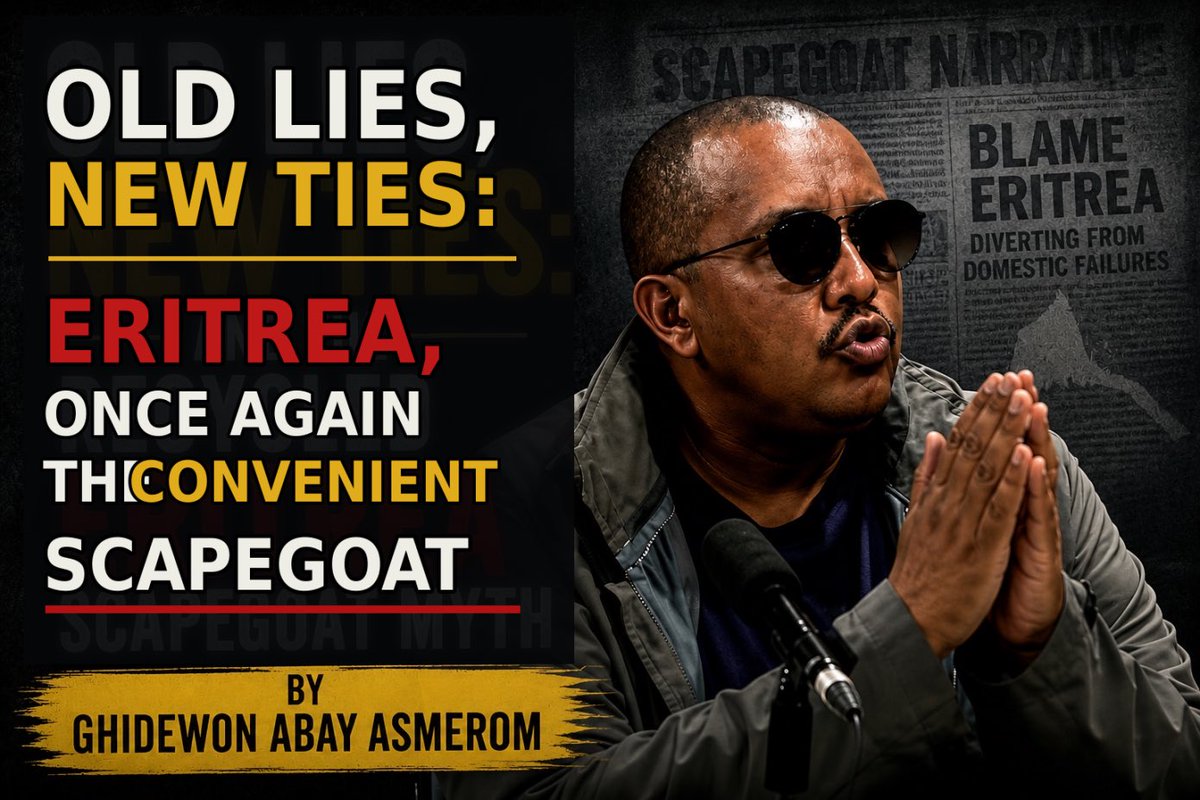
Old Lies, New Ties: Eritrea, Once Again the Convenient Scapegoat
June 12, 2026
By Ghidewon Abay Asmerom
@RedSeaBeacon
There is a familiar ritual in Ethiopian politics: when the center cracks, blame Eritrea. When agreements fail, blame Eritrea. When Ethiopian factions betray one another, blame Eritrea. When the Red Sea obsession alarms the region, blame Eritrea. When Addis Ababa and Tigray cannot honor their own commitments, blame Eritrea again. This is the oldest trick in the Ethiopian political playbook: externalize the crisis, invent a foreign hand, and hide domestic failure behind the convenient shadow of Eritrea.
The latest performance comes from Getachew Reda, now serving as Prime Minister Abiy Ahmed’s adviser on East African affairs. In a June 11, 2026 Al Jazeera opinion article, Getachew and Redwan Hussein, the director general of Ethiopia’s intelligence and security services, attempt to portray Eritrea as the principal source of danger to Ethiopia’s fragile peace. Their argument is simple: “the Pretoria Agreement is under threat because Eritrea is allegedly backing ‘hardliners’ and pushing Ethiopia toward another war.” But this claim collapses under the weight of Ethiopia’s own record.
The Uncertainty Principle of Ethiopian Elite Politics
Getachew Reda is not an accident. He is the latest incarnation of a familiar Ethiopian ruling-class habit: treachery dressed as strategy, deception packaged as diplomacy, and flip-flopping elevated into statecraft. In the political culture of Ethiopia’s Abyssinian elite, yesterday’s enemy can become today’s patron, yesterday’s accusation can become today’s slipup, and yesterday’s principle can be sold by evening for a seat at the palace table.
Getachew’s career seems designed to outdo even the uncertainty principle of quantum mechanics. With some politicians, one may not know both position and momentum at the same time. With Getachew, Abiy, and their circle, one cannot know whether a position taken in the morning will still exist by lunchtime, let alone by evening. Their politics has no fixed moral location. It moves with office, opportunity, and survival.
If Meles Zenawi was the arch-deceiver who turned tactical ambiguity into a governing method, Abiy Ahmed, Getachew Reda, and Tsadkan Gebretensae represent a more shameless generation of the same tradition: men of shifting loyalties, convenient memories, and selective outrage. They speak of peace while preparing for war. They speak of accountability when out of power and forget it when near power. They speak of sovereignty when it protects them and dismiss it when it belongs to Eritrea.
This is why Getachew’s latest attack on Eritrea must not be read as serious regional analysis. It is the speech of a man who has changed camps without changing habits. Once Abiy’s loud accuser, he is now Abiy’s adviser. Once a voice claiming to speak for Tigrayan suffering, he now echoes the very political center he condemned. Once a critic of betrayal, he has become one of its most polished practitioners.
ReadMore @RedSeaBeacon@hawelti@Sudan #Djibouti #Somalia #Egypt #SaudiArabia #Turkey #Qatar #UAE
@EmbassyEritrea@hadnetkeleta@SirakBahlbi@EliasAmare@Afc2012Alula@Ghidewon@Yehdavid@GhideonMusa@globalezra@SharronYemane@Winta_eri@PMEthiopia@MFAEthiopia@MOFAEGYPT@AfricanUnion@antonioguterres@cnni@AJEnglish@BBCWorld@Reuters@AFP@AlAhramWeekly@FT@latimes@nytimes@BBCWorld@AlJazeera@tberhan0437898@shabait@ERiTV_Official@ForeignPolicy@TheAtlantic@CanadaFP@AmbStesfamariam@AmbassadorEstif
#AmbsBeyeneRussom
@reda_getachew
ETHIOPIA — Abiy Ahmed may not have delivered the prosperity he promised, but he has managed to put #Ethiopia at the top of one list: the country with «the highest number of people living in extreme poverty in Africa» since 2020.
Quite a legacy for a government that branded itself as "Prosperity.".
Red Sea Is Calling: How a Covert Smuggling Network Is Reshaping the Horn of Africa
January 28, 2026
By Alula Frezghi
https://t.co/4b4hH2ys5E
The Red Sea is no longer a mosaic of isolated crises. It has become a single, interconnected security ecosystem in which weapons, fighters, and political agendas circulate more efficiently than humanitarian assistance. A recent Ayin Network investigation into modified G3 rifles traced from Yemen to Sudan’s Rapid Support Forces (RSF) does more than document illicit arms trafficking. It exposes a regional proxy architecture, maritime, deniable, and deeply corrosive, that now links conflicts from Aden to Darfur.
At the center of this architecture lies a familiar pattern: indirect power projection through logistics, intermediaries, and plausible deniability. While no single actor controls the entire chain, the operational coherence of the network points to state-enabled systems rather than ad hoc criminality. The consequences are regional in scale. And few states feel them more acutely than Eritrea, which sits astride the Red Sea while attempting, often quietly to contain instability it did not create.
The Red Sea is calling. What it is revealing should alarm anyone concerned with the Horn of Africa’s future.
One Rifle, Three Wars
The Ayin investigation follows a single platform: the Cold War–era Heckler & Koch G3 rifle. On its own, this is unremarkable. The G3 is ubiquitous across conflict zones. What is notable is the rifle’s modification, movement, and reappearance across three distinct wars.
In Yemen, prolonged conflict has transformed local arms markets into refurbishment hubs. Gunsmiths restore aging G3s and apply distinctive markings, such as “AlMRENZ” (“the Marines”) and counterfeit “USA” stamps, not for functionality, but for branding and obfuscation. Open-source intelligence analysts have documented identical markings across multiple rifles, suggesting coordinated modification rather than isolated improvisation.¹²
From Yemen’s southern coast, these weapons traverse the Gulf of Aden toward Bosaso, Somalia, a port city long embedded in transnational smuggling economies. Weak regulatory oversight and entrenched networks allow weapons to be repackaged, re-brokered, and quietly redirected. This maritime corridor is not new. It has previously been associated with covert political and military movements linked to Gulf actors, indicating an established logistical pipeline rather than an opportunistic route.³. Read More
@RedSeaBeacon@hawelti@Eritrea_UN@Sudan #Djibouti #Somalia #Egypt #SaudiArabia #Turkey #Qatar #UAE
@hawelti@shabait@EmbassyEritrea@hadnetkeleta@SirakBahlbi@EliasAmare@Ghidewon@DahlaKib@Yehdavid@GhideonMusa@hagerawiDihnet@PMEthiopia@MFAEthiopia@MofaSudan@MOFASomalia@KagutaMuseveni@MOFAEGYPT@AfricanUnion@antonioguterres@cnni@AJEnglish@BBCWorld@Reuters@AFP@AlAhramWeekly@thenation@DailyMonitor@haaretzcom@PressTV@DailySabah@TheDailySomalia@BBCWorld@ne_handa@washingtonpost@latimes@nytimes@chicagotribune@BostonGlobe@nprn@FT@cnnbrk@Newsday@TheEconomist@CongressLibrary@Sertseyonas@EritreaUNGeneva
https://t.co/FmN8Pjo7Go
The Covenant of the Martyrs: Remembering Eritrea’s Finest Children
By Red Sea Beacon
June 15, 2026
June 20 is not an ordinary date on the Eritrean calendar. It is a day written in sacrifice, memory, grief, gratitude, and obligation. On this day, Eritreans honor the men, women, children, elders, fighters, prisoners, workers, students, mothers, and fathers whose lives were given so that Eritrea could live.
Martyrs’ Day, Me’alti Sema’tat, is more than a national commemoration. It is a covenant between the living and the fallen. It reminds every Eritrean that independence was not granted by others or won through negotiation. It was earned through extraordinary sacrifice.
The martyrs gave everything. They left behind families, dreams, youth, comfort, and life itself. Some charged fortified positions so their comrades could advance. Some faced tanks with little more than rifles and determination. Others endured torture and death rather than betray a secret or endanger their comrades. Their courage was not merely bravery; it was selflessness in its purest form.
A Living Memory
The martyrs are not remembered only on June 20. Their memory is woven into Eritrean daily life. Public gatherings begin with moments of silence. Families preserve photographs and stories of loved ones who never returned. Their absence is deeply felt, but their legacy remains present in the nation they helped liberate and defend.
This memory also lives in Eritrea’s moral culture. Oaths are sworn in the name of the martyrs, and appeals to duty, honesty, and national responsibility are often made by invoking their sacrifice. The message is simple: do not dishonor the foundation upon which the nation stands.
Martyrs’ Day honors not only those who fell in battle but also those who perished in prisons, those tortured or disappeared, and countless civilians who became victims of war and repression. Entire villages suffered massacres, bombardment, and destruction. Yet despite immense suffering, Eritrea did not break.
The story of sacrifice began at the very start of the armed struggle. Abdu Mohamed Fayed, the first martyr of the Eritrean revolution, fell in September 1961, only days after the war began. From that moment onward, generation after generation of Eritreans carried the struggle forward.
The liberation of Eritrea was achieved not by outsiders but by Eritreans themselves, peasants, workers, students, women, youth, and elders who rose to reclaim their dignity and determine their own future.
Approximately 65,000 Eritreans gave their lives during the thirty-year struggle for independence. Nearly 19,000 more were martyred defending Eritrea’s sovereignty during the 1998–2000 border war and some more defending the country from TPLF’s reckless adventure in 2020-22. Behind every number is a family, a story, and a sacrifice that continues to shape the nation.
June 20 was chosen because of its association with the defeat of Ethiopia’s Sixth Offensive in 1982. That offensive was designed to destroy the Eritrean revolution once and for all.
ReadMore @RedSeaBeacon@hawelti@Sudan #Djibouti #Somalia #Egypt @AmbassadorEstif@AmbStesfamariam #UAE
@EmbassyEritrea@hadnetkeleta@SirakBahlbi@EliasAmare@Afc2012Alula@Ghidewon@Yehdavid@GhideonMusa@globalezra@SharronYemane@Winta_eri@FikreJesus@MOFAEGYPT@AfricanUnion@antonioguterres@cnni@AJEnglish@BBCWorld@Reuters@AFP@AlAhramWeekly@FT@latimes@nytimes@BBCWorld@AlJazeera@tberhan0437898@shabait@ERiTV_Official@ForeignPolicy@TheAtlantic@CanadaFP@tewerwari_1@shabait@OgbazgyAA@OgbeMekonnen@SirakBahlbi@alazarabrah1991@beyene195737@ERIEMBAET@HijiwunMekete
https://t.co/Bot9APy9cK
Eritrea’s Resilience: A Corollary of Unremitting External Hostility
May 22, 2026
By Tesfay Aradom, PhD
@RedSeaBeacon
“I conclude that Eritreans will meet these challenges with the same determination and resourcefulness that characterized their long struggle for international recognition as a sovereign nation ”
(Pateman, 1998)
Introduction
During the last ten decades, the people of Eritrea have endured immense suffering for asserting their inalienable right to dignity and self-determination. Following an arduous, protracted and definitively successful military and diplomatic struggle, they achieved their long-sought political independence. Currently, having foiled relentless regional and international political and diplomatic intrigues, the Eritrean people and government find themselves in a favorable diplomatic, political, financial and military situation. As a result, they are well poised to consolidate their hard-won achievements and pursue their national reconstruction and social justice programs with more vigor and resolve. It is, therefore, incumbent upon every Eritrean to develop the necessary historical and political insights to sustain the uniquely Eritrean political, social and psychological conditions created and nurtured by the Government of Eritrea.
An objective historical analysis of the global community reveals that a small minority has been engaged in a protracted practice of human servitude, persecution of minority populations, oppression of people in far-away lands and unfettered exploitation of their human and natural resources. Racially motivated acts of genocide have also been committed to advance and protect geopolitical and economic interests. The experience and destiny of the Eritrean people have parallels that of the peoples in Asia, Africa and Latin America. For the last several decades, Eritrea has been a victim of horrendous injustice and persistent political, diplomatic and economic conspiracies perpetrated by successive US administrations, Western Europe and Russia, formerly the USSR and their regional client, Ethiopia. As a result of their collective experience of discrimination and national oppression and their long struggle against them, the people of Eritrea gradually forged a cohesive national identity and its concomitant national characteristics of resilience, tenacity, self-reliance and unflinching commitment to justice.
British, Italian and US Collusion
Italy’s racist policy and actions in Eritrea have been well documented. For instance, in the late nineteenth-century rabidly racist Italian officials and officers unleashed an intensive campaign to hunt, detain, torture and kill innocent Eritreans in Nakura within the Dahlak Archepelago (east of Massawa) based on fabricated charges of political subversion (Bruner, 2017). As the British had retained much of the Italian colonial system and personnel, a willful collusion with the racist Italian officials in the commitment of additional unprovoked atrocities against innocent Eritrean civilians was common practice (Almedom,2006). From the outset, the British made it abundantly clear that their intention was not to liberate nor advocate for the self-determination of Eritrean people. On the contrary, they left no stone unturned to concoct and advance patently fallacious political, economic and historical narratives aimed at mutilating it and eventually erasing it from the world map. Historical documents have also revealed that upon their victory against the Italian
ReadMore @RedSeaBeacon@hawelti@Sudan #Djibouti #Somalia #Egypt #SaudiArabia #Turkey #Qatar #UAE
@EmbassyEritrea@hadnetkeleta@SirakBahlbi@EliasAmare@Ghidewon@Yehdavid@GhideonMusa@EzraMusa26@SharronYemane@PMEthiopia@MFAEthiopia@antonioguterres@BBCWorld@Reuters@AFP@AlAhramWeekly@FT@latimes@nytimes@BBCWorld@AlJazeera@tberhan0437898@shabait@ForeignPolicy@TheAtlantic@FCDOGovUK
https://t.co/4P5rZMAfNp
Understanding Eritrea and the Need for a New Chapter in Eritrea – US Relations
June 14, 2026
By Sirak Kifle
@RedSeaBeacon
Introduction
The difficult relationship between Eritrea and the United States is often explained through narrow political narratives that focus only on recent events, sanctions, or diplomatic disputes. Yet the roots of mistrust run much deeper. They are tied to history, geopolitical choices made by the USA after World War II and during the Cold War, fundamentally different understandings of sovereignty and nation-building, and persistent misinterpretation.
The tensions between Eritrea and the United States are not primarily the result of an inevitable clash of national interests. Rather, they stem largely from decades of historical betrayal: US role in imposing bogus Federal Arrangement with Imperial Ethiopia, in brazen denial of Eritrea’s right of decolonization and a profound misunderstanding of Eritrea’s political culture, historical memory, and state-building priorities.
At the same time, continued hostility and estrangement serve neither Eritrean nor American interests today. In a rapidly changing global order marked by instability in the Red Sea region and the broader Horn of Africa, there is a growing need for a more realistic and respectful relationship based on mutual understanding rather than outdated and narrow geopolitical calculus.
Part I - Historical Foundations of Eritrean Political Consciousness
Eritrea’s Colonial Experience and the Denial of Self-Determination
Modern Eritrea was formally established as an Italian colony in 1890 during the colonial partition of Africa following the Berlin Conference. Before the colonial era, the territories that now comprise Eritrea and neighbouring states in the northern Horn existed under various local kingdoms, sultanates, chieftains, communities, and regional authorities, as was the case throughout Africa before European colonization.
A major source of confusion in regional politics comes from retroactively projecting modern state relations into historical periods when present-day political entities did not yet exist in their current form. The modern political relationships among Eritrea, Ethiopia, Sudan, Djibouti, and Somalia emerged largely during and after the colonial partition of Africa and cannot simply be projected backward as if they existed unchanged for thousands of years.
The modern Ethiopian state itself largely took shape during the territorial expansion of Menelik II in the late nineteenth century. Prior to that period, much of present-day Ethiopia existed as separate kingdoms, communities, and regional political entities with distinct histories and structures. The political entity widely known internationally as Abyssinia referred primarily to the highland kingdom centred in parts of present-day northern Ethiopia. Indeed, the term Abyssinia continued to be commonly used internationally until the mid-twentieth century before Ethiopia became the dominant modern state …
ReadMore @RedSeaBeacon@hawelti@Sudan #Djibouti #Somalia #Egypt #SaudiArabia #Turkey #Qatar #UAE
@EmbassyEritrea@hadnetkeleta@SirakBahlbi@EliasAmare@Afc2012Alula@Ghidewon@Yehdavid@GhideonMusa@globalezra@SharronYemane@Winta_eri@PMEthiopia@MFAEthiopia@MOFAEGYPT@AfricanUnion@antonioguterres@cnni@AJEnglish@BBCWorld@Reuters@AFP@AlAhramWeekly@FT@latimes@nytimes@BBCWorld@AlJazeera@tberhan0437898@shabait@ERiTV_Official@ForeignPolicy@TheAtlantic@CanadaFP@tewerwari_1
https://t.co/2IZ8zTFTGR
@achayegodfrey The true measure of a country’s success is not how many high-rise buildings it has, but how well it develops its industries and improves the lives of its people.
@Eritrea_Erey@yohanethio These midget minded people they know Alex is Eritrean but they want to provoke us anger. It is a deliberate act so better to ignore them .
Shattered Kinship: June 12, 1998, and the Mass Expulsion of Eritreans from Ethiopia
June 14, 2026
By David Yeh
@RedSeaBeacon
The political geography of the Horn of Africa has long been defined by shifting alliances, hard fought liberation struggles, and the fluid movement of peoples across porous borders. Yet, few events in the modern history of the region illustrate the catastrophic intersection of state sanctioned nationalism and ethnic targeting as vividly as the events of June 12, 1998. On this date, a bureaucratic decree issued by the Ethiopian government shattered the social, economic, and familial fabric of the region. Following the sudden eruption of a border war over the disputed territory of Badme, the ruling Tigray People’s Liberation Front (TPLF) regime orchestrated a systematic, nationwide campaign of mass arrest, asset seizure, denationalization, and expulsion targeting Eritreans and Ethiopians of Eritrean origin. Over the course of the next two years, over 80,000 individuals were uprooted from their homes. Most were legal Ethiopian citizens who held standard national identification documents, owned established businesses, and had spent generations deeply integrated into Ethiopian society. Stripped of their citizenship, denied the right to secure their property, and deliberately separated from their loved ones, these individuals were packed into buses and trucks, transported to heavily militarized frontlines, and forced to walk across active combat zones into Eritrea. The campaign generated an acute, long-lasting humanitarian crisis that permanently altered the geopolitics of East Africa. By examining the structural triggers, the mechanics of the state dragnet, the human cost, and the divergent state responses, we uncover a profound narrative of institutional cruelty countered by profound community resilience.
Historical Context: From Allied Victory to Sovereignty
To fully comprehend the swiftness and intensity of the June 12 campaign, one must examine the unique and highly integrated political landscape that preceded the conflict. In 1991, the long and brutal Ethiopian Civil War concluded with the overthrow of the Marxist Mengistu Haile Mariam regime (the Derg). This victory was achieved through a strategic military alliance between two primary liberation movements: the Eritrean People’s Liberation Front (EPLF) and the Tigray People’s Liberation Front (TPLF). Following the devastating fall of the Derg, Eritrea achieved de facto independence under the EPLF in 1991, a status that was formally ratified through a peaceful, internationally monitored referendum in 1993 with the full unconditional agreement of the newly established TPLF led government in Addis Ababa. Because the leadership of both nations had at some points fought side by side in the trenches, the post-independence transition was characterized by a highly porous, cooperative framework. Borders remained open, trade flowed freely, and millions of people of Eritrean descent continued to live, work, and thrive within Ethiopia. This community was highly diverse, spanning prominent business owners, top-tier civil servants, intellectuals, and working-class families. The legal reality of this population was equally nuanced; while many had proudly participated in the 1993 Eritrean independence referendum, they legally retained their Ethiopian citizenship, held local passports, voted in Eth
ReadMore @RedSeaBeacon@hawelti@Sudan #Djibouti #Somalia #Egypt #SaudiArabia #Turkey #Qatar #UAE
@EmbassyEritrea@hadnetkeleta@SirakBahlbi@EliasAmare@Afc2012Alula@Ghidewon@Yehdavid@GhideonMusa@globalezra@SharronYemane@Winta_eri@PMEthiopia@MFAEthiopia@MOFAEGYPT@AfricanUnion@antonioguterres@cnni@AJEnglish@BBCWorld@Reuters@AFP@AlAhramWeekly@FT@latimes@nytimes@BBCWorld@AlJazeera@tberhan0437898@shabait@ERiTV_Official@ForeignPolicy@TheAtlantic@CanadaFP@tewerwari_1@UNHumanRights@shabait@OHCHR_MENA
https://t.co/vFnDyLS8To