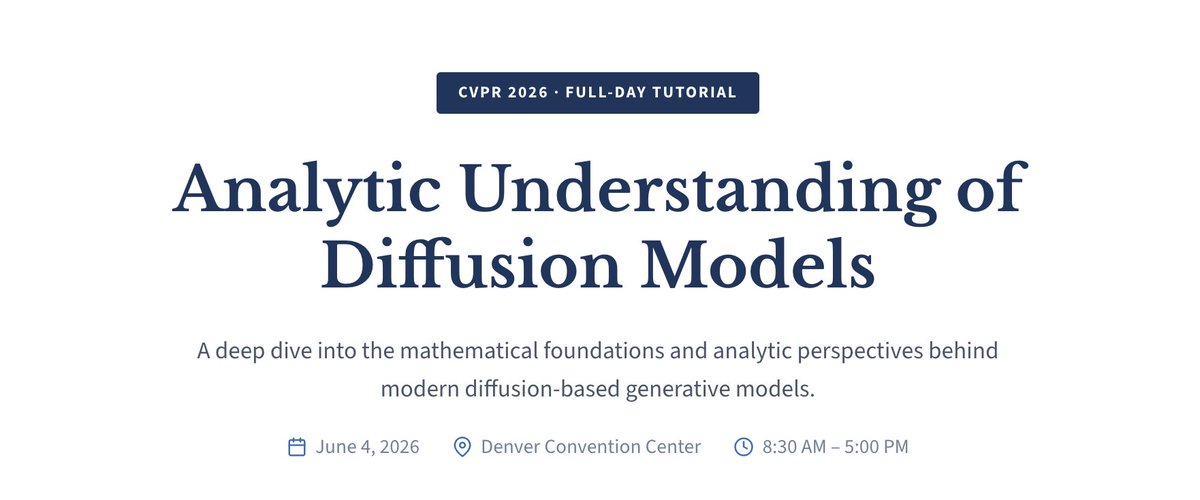
Tomorrow at #CVPR2026
Come join our full-day tutorial on analytic understanding of diffusion models.
How do diffusion models generalize? What outputs can you expect from your generative model? Where should you direct resources to make it better?
This and much more on a full day tutorial with wonderful @yuancy@MasonKamb@CScarvelis@WangBinxu@ZKadkhodaie
Links in the reply.
4/4 The model I used was GPT 5.4 xhigh on Codex. The code, prompts, harness, verification scripts, generated proof blueprint and Lean formalization are in this GitHub repo: https://t.co/Y25hyQCbkn
I wrote a blog post about a Codex harness/workflow I built to autonomously prove a new mathematical result after 3 days of continuous work producing ~60k lines of Lean, where the input is a Lean theorem statement and output is a fully formalized proof.
1/4
https://t.co/QQUeAGc3OC
3/4 The harness gave the agent a computational toolkit to autonomously search for counterexamples using optimization solvers, so it can infer structure from dual certificates, write a blueprint, formalize the proof, and keep going until Lean accepted the final theorem.
I'm helping to organize this CVPR tutorial on analytic understanding of diffusion models, join us if you are interested in learning more about how diffusion models generalize!
Join us at @CVPR in Denver for a full-day tutorial about Analytic Understanding of Diffusion Models.
The training objective of diffusion models has a closed-form solution -- yet it only memorizes. How do real models generalize? We'll unpack this paradox and the emerging analytical theory behind it.
@yuancy@CScarvelis@MasonKamb@WangBinxu@vincesitzmann@JustinMSolomon@SuryaGanguli
Why do diffusion models produce new images instead of just memorizing the dataset? We show that they learn pixel correlation patterns from the data and therefore denoise locally, which promotes generalization.
To test this idea, we compare trained diffusion models with a training-free algorithm that mixes local patches from the dataset. Surprisingly, this simple procedure already reproduces many properties of the trained models.
🧵 Check out this thread for more details about our Spotlight NeurIPS paper with @yuancy, @JustinMSolomon and @vincesitzmann.
At #NeurIPS today in San Diego?
Come check out poster #4409 (4:30–7:30 PM) today. We’re excited to share our spotlight paper on the generalization properties of diffusion models.
Looking forward to great research conversations!
@yuancy@JustinMSolomon@vincesitzmann
I played a small part in the production of this video, and I'm really happy with how it addressed common misconceptions about diffusion models, as well as the beautiful visualizations and animations!
New video on the details of diffusion models: https://t.co/rRjJehNuF3
Produced by @welchlabs, this is the first in a small series of 3b1b this summer. I enjoyed providing editorial feedback throughout the last several months, and couldn't be happier with the result.
In the problem sets, we use the library introduced in the first lecture (https://t.co/HOJiC4DkrU) to train diffusion models on custom data, as well as using pretrained models as building blocks for a variety of downstream tasks (see examples above)
(4/4)
Last month I cotaught a class on diffusion models at MIT during the IAP term: https://t.co/IZ1KO76jp6
In the lectures, we first introduced diffusion models from a practitioner's perspective, showing how to build a simple but powerful implementation from the ground up (L1)
(1/4)
Using score distillation for 3D shape generation (L5) and wrapping up with a summary of the latest research making diffusion models better and faster (L6)
The lecture recordings can be found here: https://t.co/dmi4tWFByS
(3/4)