Can a robot “feel” without a tactile sensor? 🤖
Introducing FELT: a vision-to-touch framework that generates per-finger pressure signals directly from RGB.
Trained on paired visuo-tactile data, FELT can augment vision-only datasets—and deploy without tactile sensors. 🧵
I want to offer some unsolicited advice to computer vision researchers jumping into robotics. Don't focus too much on VLMs, VLAs etc. That's fine, but the real action is at the sensorimotor level. Most of the open problems in robotics are in manipulation, which is about hand-object interaction, and contacts and forces are central. Proprioception and tactile sensing are as important as vision. Don't get seduced by cherry-picked demos. You can't do robotics without doing robotics.
Tactile interaction in the wild can unlock fine-grained manipulation! 🌿🤖✋
We built a portable handheld tactile gripper that enables large-scale visuo-tactile data collection in real-world settings.
By pretraining on this data, we bridge vision and touch—allowing robots to:
✅ Perform robust in-hand reorientation
✅ Control contact and force with precision
🔗 Project page: https://t.co/zcJBEzd23i
(1/6)
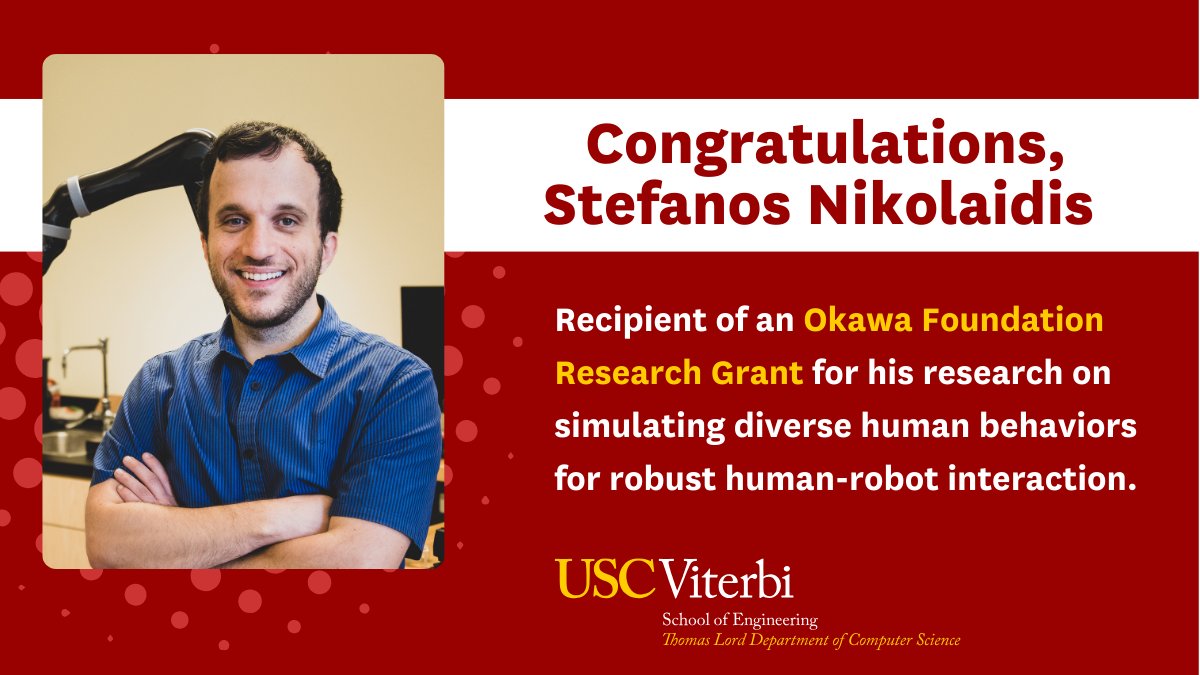
Congratulations, @snikolaidis19, who has been awarded a prestigious @OkawaFoundation Research Grant for his groundbreaking research in human-robot interaction 👏
https://t.co/etzmHn34w7
@USCViterbi @USCAdvComputing @gauravsukhatme
Introducing Dream Machine - a next generation video model for creating high quality, realistic shots from text instructions and images using AI. It’s available to everyone today! Try for free here https://t.co/rBVWU50kTc #LumaDreamMachine