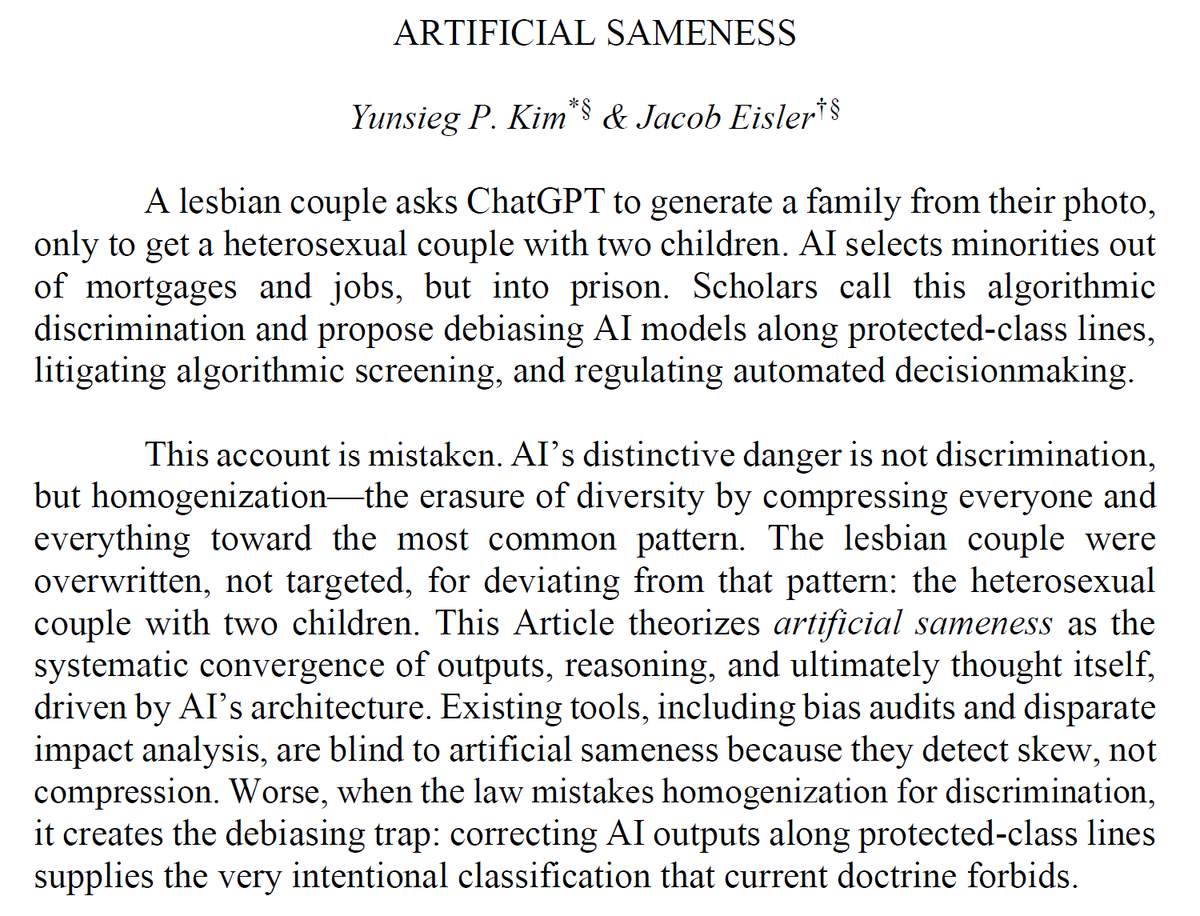
AI can homogenize even as it promises personalization. That's the thesis of Artificial Sameness, my new paper with @jacob_eisler. We argue that the AI debate focuses on bias while neglecting substantive convergence beneath surface-level variation. SSRN: https://t.co/pxc1zp5Hv7
Can AI make civil rights enforcement easier? @yunsieg and @jacob_eisler argue that algorithms are more consistent and replicable than humans, which makes proving disparate impact easier. The real obstacle for litigants is informational. https://t.co/TvNMuBWCze
AI can homogenize even as it promises personalization. That's the thesis of Artificial Sameness, my new paper with @jacob_eisler. We argue that the AI debate focuses on bias while neglecting substantive convergence beneath surface-level variation. SSRN: https://t.co/pxc1zp5Hv7
"Disparate (Algorithmic) Advantage," forthcoming in the @StanLRev Online, co-authored with @jacob_eisler. If disparate impact law was built to police opaque human judgment through outcomes, why do scholars assume that it can't handle algorithms? We argue that the consensus has it backwards because algorithms are *more* amenable to disparate impact analysis than the humans the doctrine was designed to police. Draft on SSRN: https://t.co/BhnJEPHS97. Feedback welcome!
"Incognito Consumer Harm," forthcoming in @WashULRev. It asks: what good is a legal system built for visible injuries in a world where injury is designed to be invisible? I identify and theorize consumer-facing wrongdoing that is designed to remain unnoticed by most victims. Incognito consumer harm is particularly significant in an age when technology scales the number of victims, enhances the magnitude of harm, and helps conceal the harm. SSRN: https://t.co/G0SLyhuXOW
NEW: @yunsieg (@Hofstra_Law) argues that economic regulation, including antitrust, can only be democratic if it is the choice of well-informed citizens.
https://t.co/FHtc4e53bW
In an age when academia is accused of irrelevance (obsolescence, even), Prof. Eisler says what sorely needs to be heard: a transpartisan defense of a judiciary increasingly under attack. I strongly recommend his book. If you're unsure, why not start with my 22-page review of it?
Truly honored and delighted that @yunsieg@Hofstra_Law has written this wonderfully thoughtful, generous, & insightful book review on the Law of Freedom in the South California Law Review.
https://t.co/22L2Mkj0gn
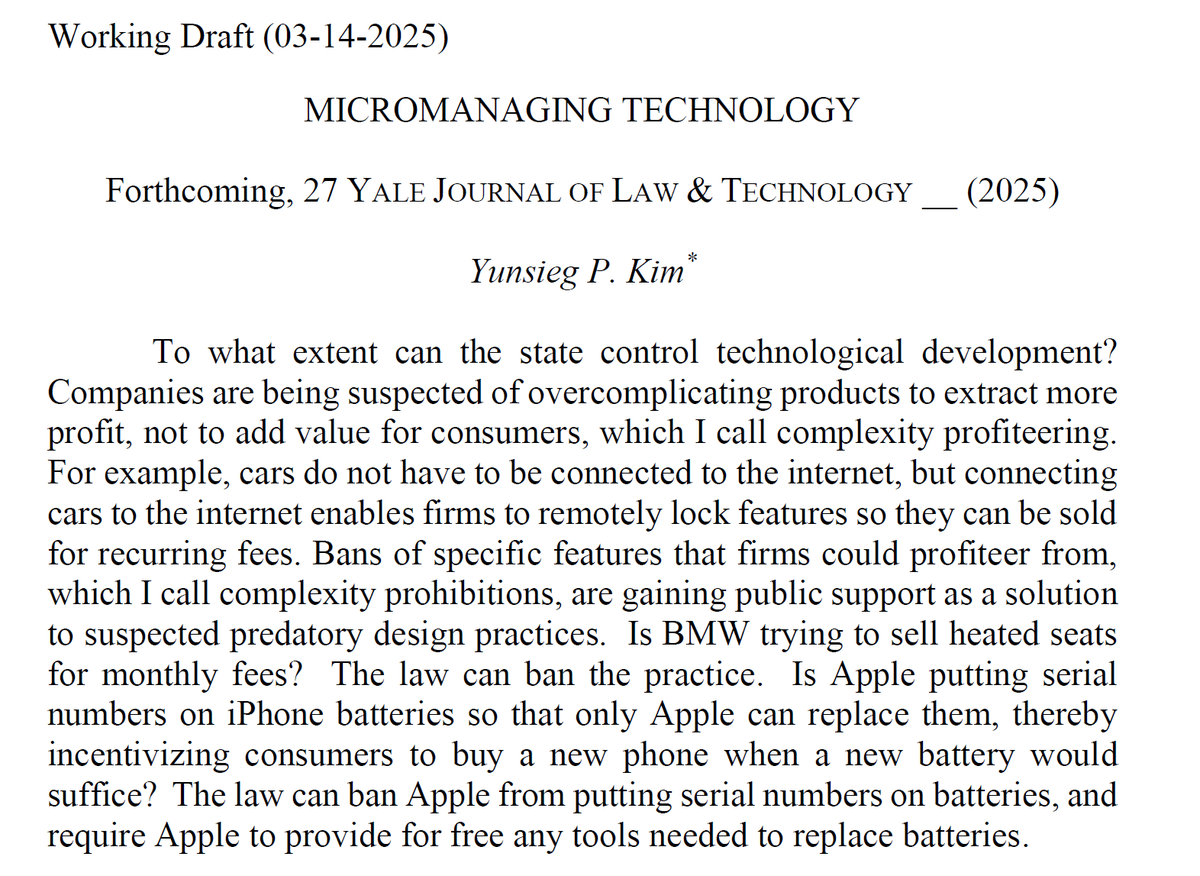
My article, Micromanaging Technology, will be published in the Yale Journal of Law & Technology @YJoLT. I argue that direct regulation of product design, such as banning Apple from gluing batteries into iPhones, may exacerbate predatory design practices. https://t.co/Q5HGxWuGzG
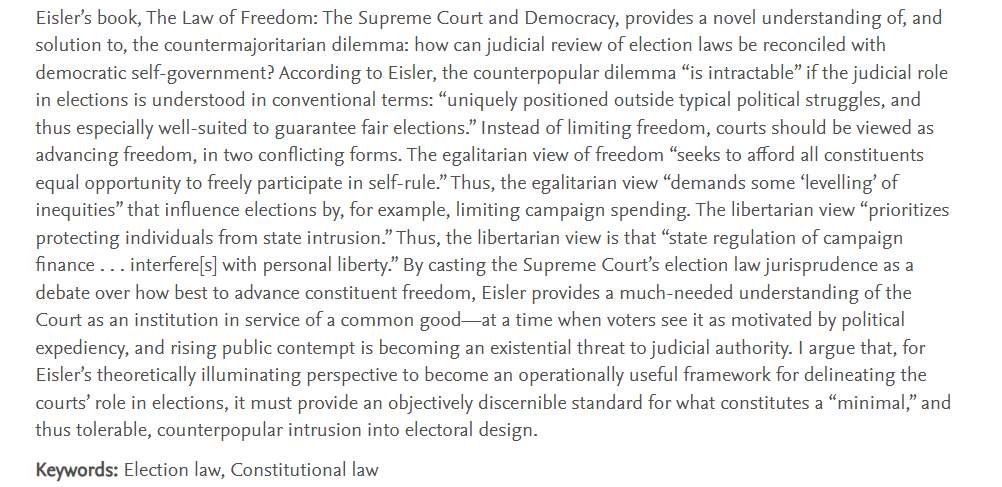
My review of @jacob_eisler's book, The Law of Freedom: The Supreme Court and Democracy (@CambridgeUP), will be published in the Southern California Law Review Postscript @SCalLRev. I strongly recommend the book for anyone interested in courts & election law. #newlawreviewarticles
@jacob_eisler@CambridgeUP@SCalLRev@jacob_eisler provides a much-needed understanding of the courts as an institution in service of the common good of advancing freedom--particularly when the public perception that courts are motivated by partisan expediency is becoming an existential threat to judicial authority.
My new article, The Faster Horse Fallacy: How the Law Idealizes Technology, will be published at the University of Illinois Law Review (@IllinoisLR). I argue that a cognitive shortcut used to understand technology warps legal outcomes. https://t.co/8Ww7EdRXfB #newlawrevarticles
My article argues that the Digital Markets Act may not achieve its immediate objectives of restraining gatekeeper platforms such as Google and Apple from unfair business practices, and could even be counterproductive to the EU's ultimate goal of improving consumer welfare.
My recent article on the European Union's Digital Markets Act was nominated for Best Academic Article in the 2024 Antitrust Writing Awards. Please do consider voting for it! #AWA2024#AntitrustWritingAwards
https://t.co/X94cOs67LW