Consensus guidance of practical recommendations in the use of advanced migraine treatments based on the current literature, guidelines, real-world experience and opinion from an expert consensus group. By British Association for Study of Headache (BASH)
https://t.co/hchRk2K8bD
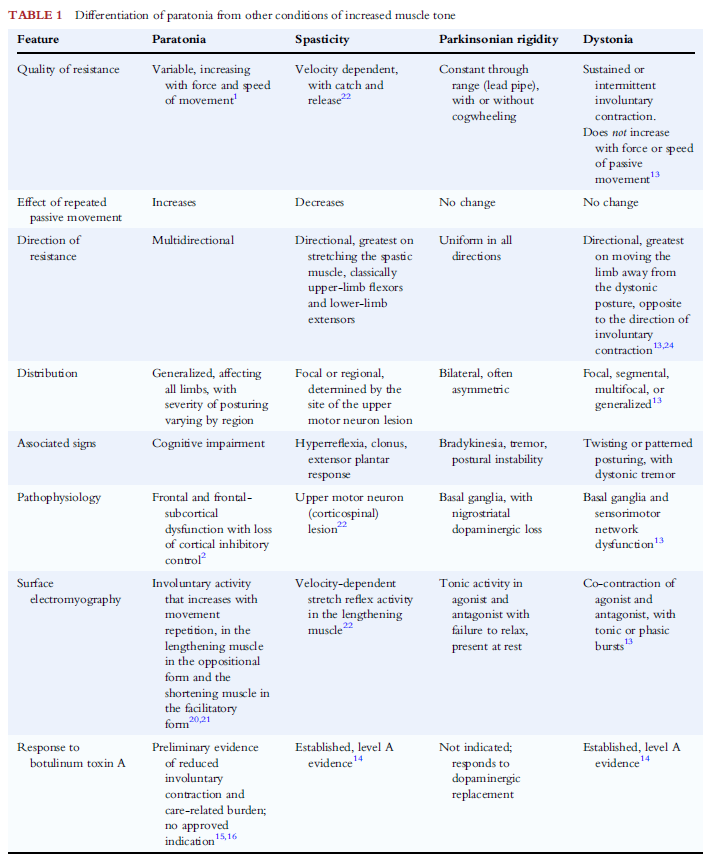
How Paratonia differs from spasticity/rigidity/dystonia? #neurotwitter
A nice article on Paratonia from Dr. Kleiner, Dr. Ganos and Prof. Lang @MDCP_Journal
Should Paratonia Be Considered a Movement Disorder? Implications for Clinical Management https://t.co/3SXpzV8RGq
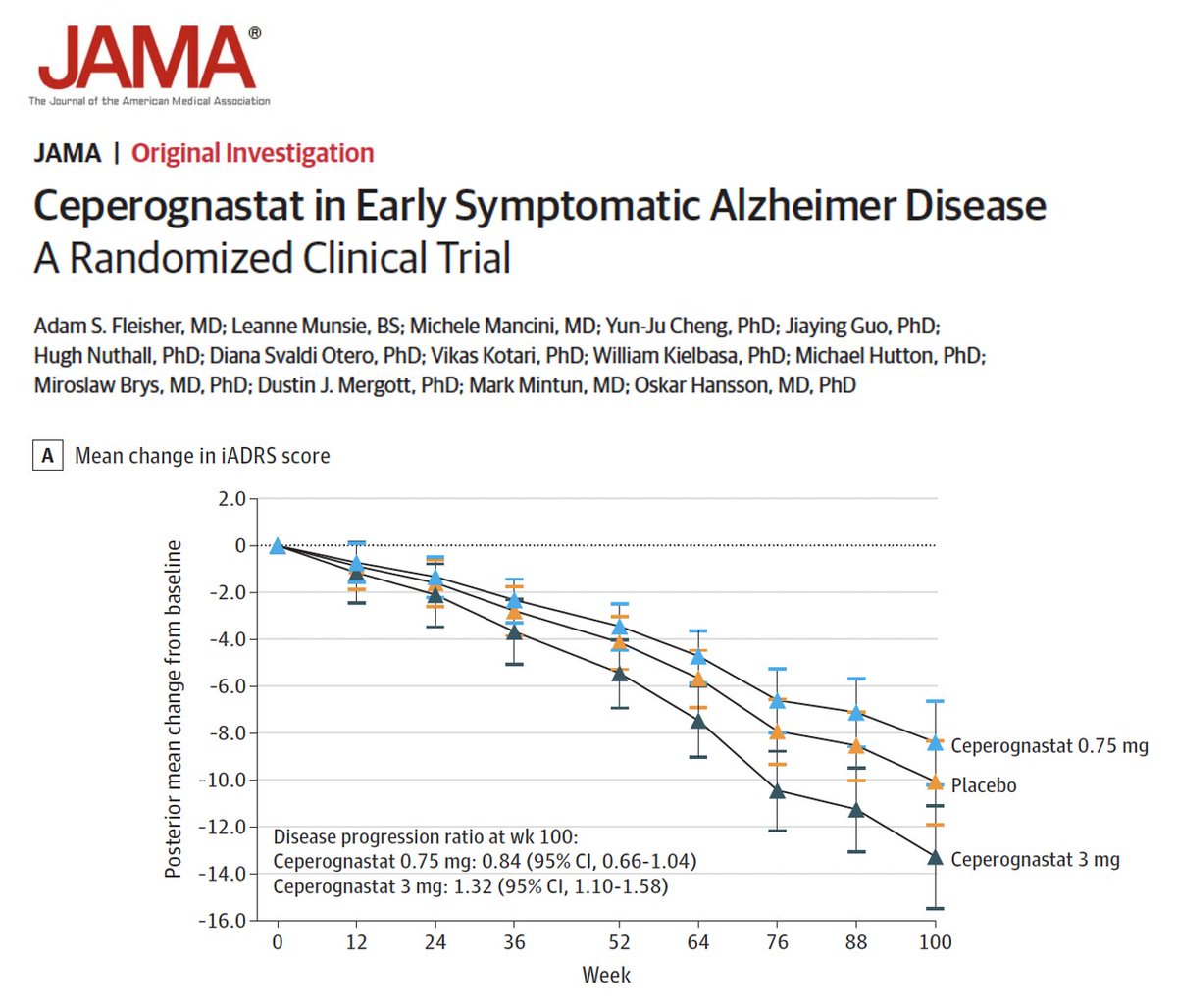
My take on the negative ceperognastat trial is that it may ultimately teach us as much about how we develop Alzheimer’s therapies as about tau itself. Ceperognastat was designed to inhibit OGA and thereby alter tau biology, but in people with early symptomatic Alzheimer’s it failed to slow cognitive and functional decline; importantly, the higher dose was associated with greater, not less, clinical progression and more serious adverse events. What makes this trial especially instructive is the disconnect between what happened to the biomarkers and what happened to people: despite signals of less tau accumulation in some regions and substantially less brain-volume loss, patients did not improve, and those receiving the higher dose actually did worse. The accompanying editorial makes what I think is the critical point: biomarkers are enormously valuable for demonstrating target engagement and understanding mechanism, but until they are rigorously validated as surrogates, we cannot confuse moving a biomarker in the right direction with helping a person. The high-dose findings also remind us that OGA and O-GlcNAc biology extend well beyond tau, so manipulating a seemingly attractive pathway can have unintended biological consequences. I would not interpret this as evidence that tau is the wrong target; tau burden remains closely linked to neurodegeneration and clinical decline, and several next-generation tau approaches remain under study. Rather, the lesson is that the target, the drug, the dose, the timing and, above all, the clinical outcome all matter. At the end of the day, the patient, not the biomarker, must be the sun.
https://t.co/oDNSMsu43R
The “too late” defense of anti-amyloid trials has been tested in 6 preclinical #Alzheimer's trials (amyloid-positive, cognitively normal people). They range from futility to worsening. When does “early is better” become unfalsifiable?
https://t.co/EqY1tsNUXg
One of the most challenging areas of neurology right now is care for patients with functional neurological disorders (FND).
It’s actually one of the most common conditions seen in a general neurology clinic.
Neurologists are often best positioned to make the diagnosis, especially when there are positive neurological signs. It can be a difficult diagnosis to make at times and patient interactions can be challenging (sometimes a reflection of the patients experience with the health care system, or being dismissed in a previous encounter).
But once the diagnosis is established, what does good care actually look like?
The challenge is that access to psychiatry and psychology is often limited, multidisciplinary FND services are scarce, and patients can easily fall between services. Psychiatry in particular seems to play a less central role than it once did, possibly since the field moved away from the older “somatoform disorder” terminology toward the current framing of FND as a neurological condition (for good or bad).
There are some rare dedicated FND clinics in Canada, often led by clinician-scientists, but these are few and far between. Even when patients are accepted, wait times can be up to a year, leaving a significant gap in care.
Neurologists themselves often struggle with the longitudinal management of these patients, and in many settings the wider healthcare system is simply not well equipped to provide consistent, integrated support.
FND sits at the intersection of neurology, psychiatry, psychology, and rehabilitation. It is a challenging area with variable patient outcomes.
https://t.co/KJf7K6bu6B is a good place to start for patient education.
How can we support & cultivate a satisfied academic neurologist workforce?
My viewpoint anchored on survey results (included) of 102 academic movement disorders neurologists is now in @MDCP_Journal
Likely relevant for all of academic neurology.
Link: https://t.co/hov6bUoJNz
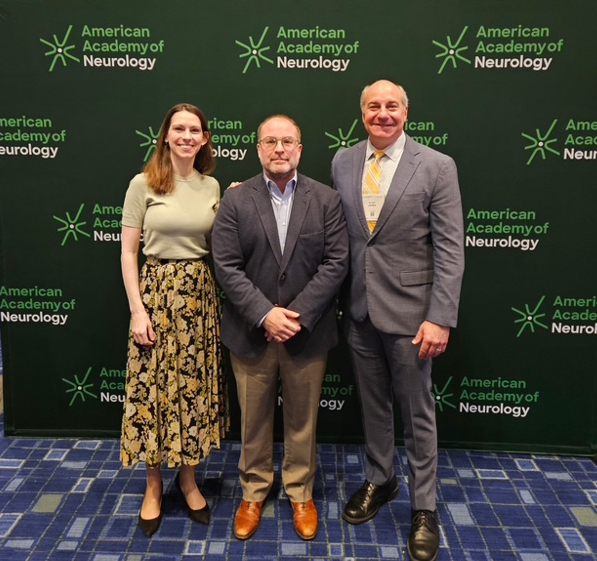
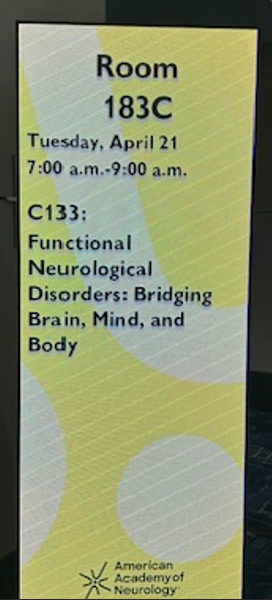
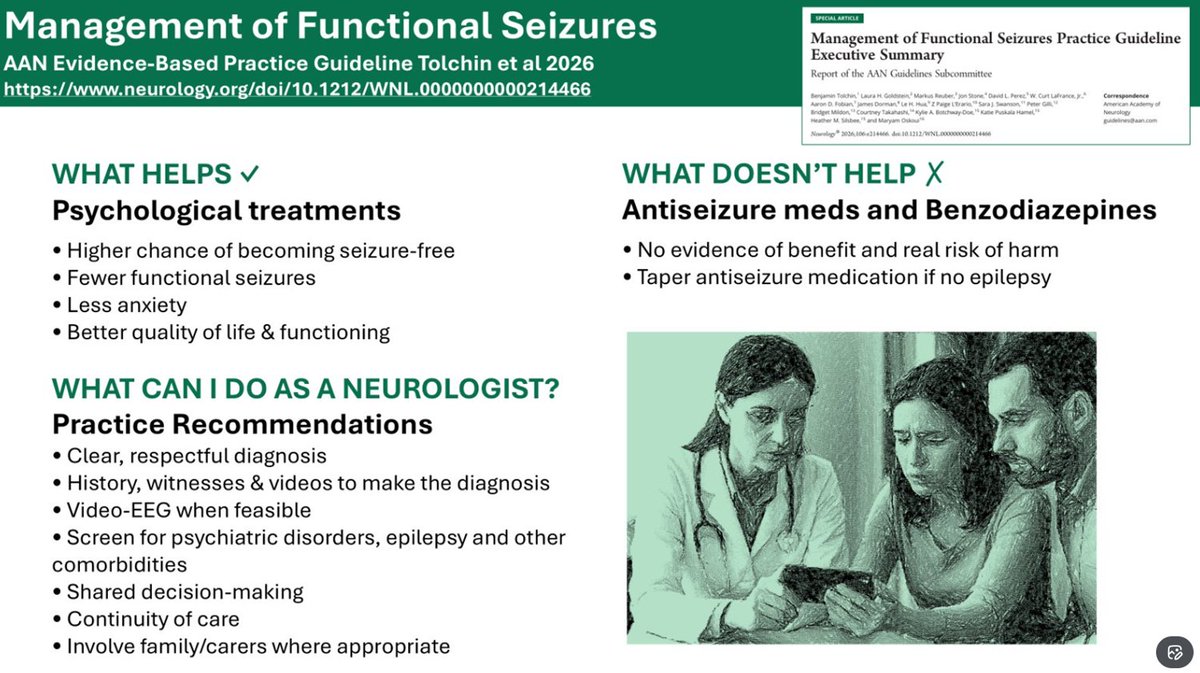
Grateful for the opportunity to speak on Functional Neurological Disorder at the 2026 #AANAM alongside Curt LaFrance & Sara Finkelstein. Part of the content covered included highlighting the @GreenJournal@AANmember practice guideline on the management of functional seizures.
Grateful for the opportunity to speak on Functional Neurological Disorder at the 2026 #AANAM alongside Curt LaFrance & Sara Finkelstein. Part of the content covered included highlighting the @GreenJournal@AANmember practice guideline on the management of functional seizures.
Happy to share @andreuvilaseca7 et al collaboration with @ESotirchos on the TRUE-MOGAD Score to discriminate true & false positive MOG-IgG
➡️ We have created an online calculator for ease of use:
https://t.co/zjc0YR5JHh
The article link is below:
👇 https://t.co/KbgdKpupVR
In the latest #NeurologyRF Patient Perspective article, read two unique perspectives of a multidisciplinary functional neurologic disorder (FND) clinic: one from a person with FND applying to med school, another from an incoming neurology resident. (1/2)
We know Painful Leg and Moving Toes; now it's time to remember 'Painful Jaw and Moving Tongue' as a clue for anti-IgLON5 @AlbertoEspay#neurotwitter@MDCP_Journal
https://t.co/sjymwMyUGS
Neuropathy in parkinsonism: 2025 update. Neuropathy refers to damage to peripheral nerves that can affect sensation, pain, strength and autonomic functions such as blood pressure and digestion. Cristina Moreno Lopez and colleagues describe in a new paper in Movement Disorders Clinical Practice how peripheral neuropathy is far more common in parkinsonism than many of us recognize, and why it may matter.
Key Points:
- Peripheral neuropathy frequently coexists w/ parkinsonism and is commonly overlooked or misattributed to non motor symptoms.
- Multiple mechanisms can be involved including levodopa related metabolic changes, small fiber neuropathy and genetic contributions.
- A practical diagnostic framework can help health care providers identify causes that are treatable or actionable
My take: This review is an important reminder that parkinsonism is not just a brain condition. Peripheral nerves are frequently involved, and we miss opportunities to improve gait, balance, comfort and quality of life. If you are on dopamine replacement, you need to be on a multi-vitamin and have homocysteine levels checked. Five points that resonated w/ me: 1- Neuropathy can precede motor symptoms and may be an early clue. 2- Small fiber neuropathy is common and can drive pain, autonomic symptoms and fatigue. 3- Long term levodopa exposure can contribute to neuropathy through vitamin and metabolic pathways however it is not the only cause. 4- Genetic forms of parkinsonism and inherited neuropathies frequently overlap and should be considered, especially in younger onset cases. 5- Systematic screening for neuropathy can change management and help to avoid unnecessary disability.
https://t.co/2URZtjTqA5 @FixelInstitute@ParkinsonDotOrg #parkinson @movedisorder
@MichaelOkun This is a very moving Tribute to Mark Hallett,MD.
Another tribute and a special webinar from FNDS where DR Hallett was the first and founding President: https://t.co/UzqScEVxfk