Dlicom 101
#12: What Does "Digital Ownership" Actually Mean?
You've probably heard people throw around the phrase "digital ownership" in Web3.
But what does it actually mean?
Let's make it simple. 👇
@retreeq_@Web3isdark@JustSamm020
This is a thread 🔻
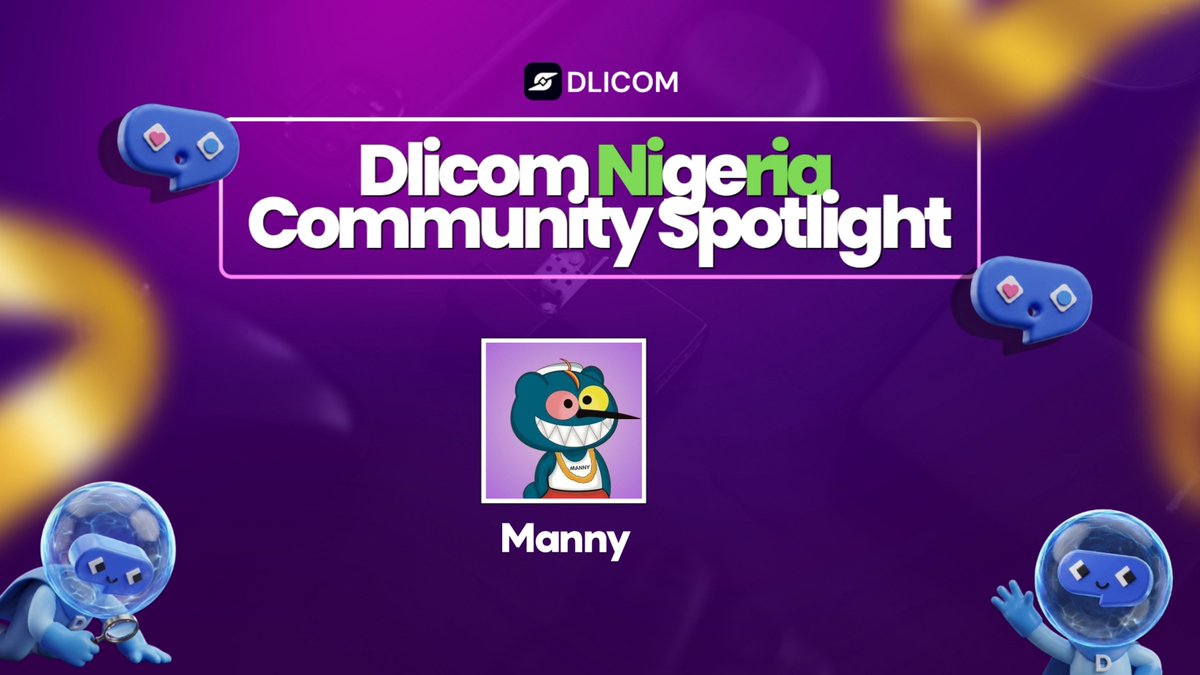
Dlicom Nigeria Community Spotlight #14
This week, we picked up a voice from the Dlicom Nigeria community that showed up and have said something that's worth it.
Congratulations to @0x_manny2 for making it to this week's spotlight.
In his thread, he shares a relatable experience many Web3 users can identify with, and that's constantly switching between different apps to manage different aspects of their digital lives.
He highlights how @DlicomApp brings social posts, encrypted messaging, voice calls, communities, short form videos, and a self custody wallet into one platform.
We appreciate contributions like this that help highlight what Dlicom is building and the bigger picture behind it.
If you're creating content around Dlicom and you're active in the Nigerian region, keep going.
We're watching and the next spotlight could be yours! 🇳🇬
Day 41 of saying gDlic till TGE 💙
One for the Dlicom community!
Q: What is the entry-level community role in Dlicom?
A) DCO
B) dcoded
C) Dliever
Drop your answer! 👇🏽
Learn something about Dlicom today:
Your Account vs Your Wallet
A username and a wallet address might both identify you online.
But they don't do the same thing.
Here's the simple difference on @DlicomApp@dlicom_ng@retreeq_@JustSamm020
This is a thread 🔻
Your Web3 journey starts with more than just creating a wallet. It starts with understanding what you own and how to use it.
But first, what exactly is Dlicom?
@DlicomApp is a Web3 social platform that brings digital ownership, communication, community interaction and access to decentralised applications into one mobile experience.
It combines social networking with a self-custody multi-chain wallet, encrypted messaging, communities, short-form videos through DliClips and an in-app Web3 browser.
But beyond these features, there’s something interesting about how users get started on Dlicom.
Let’s break it down.
1. Creating Your Web3 Wallet
When you create a new Dlicom account, you can create a wallet or import an existing one.
This gives you access to a self-custody wallet where you maintain control of your private keys and digital assets.
You don’t have to start your journey by connecting a separate wallet.
2. Understanding Your Recovery Phrase
During wallet creation, you’ll receive a 12-word recovery phrase.
This is an important part of wallet security because it allows you to recover your wallet if you lose access to your device.
Keep it somewhere secure, never share it with anyone and don’t store it carelessly.
Remember, self-custody comes with personal responsibility.
3. Building Your Digital Identity
After creating your wallet, Dlicom assigns you a username that becomes your identity within the app.
You can complete your profile, add an avatar and begin building your presence.
This gives other users a way to recognise and connect with you.
4. Connecting With People and Communities
Web3 isn’t only about transactions, tokens and smart contracts.
People are an important part of the ecosystem.
Dlicom allows users to connect through its social feed, participate in communities and communicate through private messaging.
It also supports audio and video communication, giving users different ways to interact.
5. Exploring Decentralised Applications
There’s more to Web3 than the platform you initially join.
You might want to explore DeFi protocols, blockchain applications or other decentralised services.
Dlicom’s built-in Web3 browser allows users to access dApps directly within the application.
This opens another way to explore the wider Web3 ecosystem.
6. Managing Your Digital Assets
With its integrated multi-chain wallet, users can manage supported digital assets within Dlicom.
This brings financial activity closer to the social experience instead of treating them as completely separate activities.
7. Understanding Ownership
This is perhaps one of the most important parts of the experience.
In traditional platforms, users often depend on the platform to manage their accounts and digital activities.
With Dlicom’s self-custody approach, users maintain control of their wallet keys and assets.
That doesn’t mean every part of a social platform is decentralised, but it introduces an important element of personal ownership into the experience.
Looking at the Bigger Picture
Dlicom is bringing together different parts of the Web3 experience, from creating a digital identity and managing assets to communicating, building communities and exploring dApps.
And I think this is an important direction for Web3 adoption.
The easier it becomes for people to understand and navigate these tools, the more approachable the ecosystem can become.
Because getting people into Web3 is one thing.
Helping them understand how to participate, protect their assets and take control of their digital presence is another.
That’s what makes Dlicom worth exploring.
Discord link: https://t.co/ITFxTiYsn6
@DlicomApp@dlicom_ng #NaijaContest
gdlic guys 💙
having a public profile doesn't mean giving everyone unlimited access to you.
today, let's talk about privacy beyond encryption and the @DlicomApp settings that give users more control over their social experience.
i want you guys, the readers to think about it.
now, you're a creator who wants everyone to see your posts, but you don't want random accounts filling your inbox.
or maybe you want to share certain posts without making everything visible to the entire internet.
you shouldn't have to make your whole account private just to control these things.
this is where Dlicom's privacy controls become interesting.
~ users get different controls around:
→ who can see their profile
→ who can view their posts
→ who can send them messages
→ who they want to block
→ who they want to report
what I find interesting is that these controls allow you to manage different parts of your social experience instead of treating privacy as one big public or private decision.
and I think this matters even more in Web3.
we talk a lot about ownership, self-custody and control of our digital identity.
but that control should also extend to how people interact with us online.
owning your social space should mean more than just owning your account.
it should mean having a say in who gets access to you, what they can see and how they interact with you.
that's one part of @DlicomApp I think deserves more attention.
because a good social platform shouldn't just give you a place to connect with people.
it should also give you control over how you connect.
CC: @retreeq_@JustSamm020
Hey.
A special invitation to someone new to Dlicom.
I’ve been meaning to tell you about this app I’ve been using called Dlicom. I think it might be something you’d actually enjoy trying.
It’s different from the usual social apps.
It has a normal feed where people post, short videos, private chats that are encrypted, and communities you can join.
There’s also a wallet built into it, so everything lives in one place instead of jumping between different apps.
If you want to take the first step, the easiest way is to download the Dlicom app.
Once you’re in, you can also join the official Discord server.
That’s where a lot of the conversations and updates happen, and it’s a good place to ask questions if you’re confused about anything.
I can send you both the app link and the Discord invite. And if you get stuck at any point, just tell me I’ll walk you through it.
No pressure at all.
Just thought I’d invite you properly instead of just dropping a random link.
Let me know if you’re down.
Links in the comment section.
𝐎𝐧𝐞 𝐃𝐢𝐠𝐢𝐭𝐚𝐥 𝐇𝐨𝐦𝐞, 𝐂𝐨𝐮𝐧𝐭𝐥𝐞𝐬𝐬 𝐖𝐚𝐲𝐬 𝐭𝐨 𝐂𝐨𝐧𝐧𝐞𝐜𝐭.
Think about how much of your digital life is spread across different apps. You discover content in one place, watch videos somewhere else,
🧵