Journalist with @XHNews. Previsouly in Fujian, Hubei, now Beijing. My Substack Newsletter on China👇 views not representing my employer "撑起两根穷骨头,养活一团春意思。"
[Newsletter update]
To make sense of #China’s policy decisions, it is necessary to understand the people who make them. And the rank of these officials matters much, if not the most. Below is a practical guide to identify their rank, including a number of special cases.
Peng Wensheng, former CICC chief economist, said #China's #AI challenge is not just chips or money, but investors' reluctance to take risks. He calls for reforming government-backed funds and boosting consumer demand to make innovation pay.
https://t.co/quamNcRJxr
Wang Yongli, former Bank of China VP, argues that licensing stablecoins is what will eventually hollow them out, and China should stay out of the race and finish building the digital yuan instead
https://t.co/3JlmaGA4ZN
Kimi’s Global Moment—and a Very Chinese PR Habit
An alleged influencer marketing brief for a Chinese frontier AI model by Moonshot reveals a familiar approach to paid promotion—and an unnecessary geopolitical turn.
https://t.co/tHhHPH0BhZ
The Jensen Huang spy story doesn't add up. If you say Alice Huang hired by Chinese tech firms, that makes the story more reasonable. But a spy issue....come on. Chinese gov’s goal is to secure self-dependence, not to deepen dependence on US chips.
https://t.co/5a1l17Hqje
A small but meaningful step of mine! My piece is finally out in Limes, Italy's leading geopolitics monthly. It covers the debate surrounding China's AI. Beijing can’t and won’t stop AI, and the hard part isn't chips. It's jobs, welfare financing, and algorithm-simulated intimacy.
“High-speed rail for computing power” in Qiushi:
“More fundamentally, computing power is a matter of national security. If computing resources cannot be supplied efficiently, the AI industry, smart manufacturing and even national defense will be constrained.”
Qinhuangdao photo thread and mini-blog 🧵
Last Friday, I rented a car for a day of sightseeing Qinhuangdao. It was 150 RMB, the same as the cost of a taxi ride back to the (very distant and very small) airport, so I figured it made more sense to rent a car and give myself flexibility for the day.
I booked a Geely Xingyuan - my first time with this EV. I appreciated the tall cab that gave me lots of headroom in what is a pretty compact vehicle (I'm 6'1/185cm). It didn't feel like a small car at all, thanks to that. It's just 70k CNY brand new (10k USD).
[Newsletter Update]
Pan Gongsheng, governor of #China's central bank, in his latest speech rejects claims that Beijing relies on a weak renminbi and details plans to open financial markets and expand the currency's international use
https://t.co/BVlxdghSIL
Professor Zheng Ge on why America keeps misreading China, a Chinese scholar’s perspective on American China-watching.
He also turns the mirror toward China and asks how both countries produce knowledge about each other.
https://t.co/t8zwydX2kV
[Newsletter Update]
Reviewing the @IMFAsiaPacific latest book on #China's growth model, China National Petroleum Corporation Research Chief @LuRuquan calls for stronger social protections, harder budget constraints and fairer competition.
https://t.co/fhAamPGD0U
Zhu Tian: China’s Employment Problem Is Closer Than It Appears
CEIBS Economist argues that flexible employment is masking labour-market strain and that weak aggregate demand calls for a stronger fiscal response.
https://t.co/rcXkR63Q1h
Another excerpt from the transcript of the 2026 Tsinghua PBCSF Chief Economists Forum. Huang Yiping, Wu Ge, Zhang Xiaojing, and Shi Kang on China and global rebalancing. I particually enjoyed reading Wu's part
https://t.co/RN8VfOpBQf
A look inside the main exhibition of the 2026 World Design Cities Conference (WDCC) in Shanghai, where one new feature turns the idea of “Shanghai design” into something visitors can actually browse and buy.
Do not follow this advice, unless you want to be wrong.
Chinese officials concurrently hold positions within both the Party and the PRC government. If you don't know the difference, you aren't qualified to comment.
Xi's proper top title within the Party is the General Secretary of the Central Committee of the Communist Party of China. There is no "Chairman of the Communist Party" (this role was abolished in the 1980s). In Chinese, it would be 习总书记, i.e. "General Secretary Xi" although you'd typically only see this used in readouts or summaries of Party affairs specifically.
If we're being precise, Xi could be correctly referred to as "Chairman" in his capacity as leader of either the Central Military Commission or National Military Commissions (i.e., the Party one or the State one; he is Chairman of both) but we know that is not the intention here.
Because Chinese leaders almost always travel abroad in their capacity as PRC state leaders, and not Party officials, it's correct on his visit to the US to refer to him by his state leader title, which is President of the PRC, 国家主席 or just President Xi.
Typically the only time he would travel abroad with his title of General Secretary (and not just as the PRC President) is for explicit Party business, for example party-to-party exchanges in Vietnam.
If you wanna be a pedantic twit, don't half-ass it. You'd think a former diplomat would be more sensitive to the precision of diplomatic protocol.
I have publicly disagreed with the journalis's reporting on multiple occasions — including literally yesterday.
Disagreeing with a journalist’s reporting is one thing.
Calling her work a ��CCP info op” because you dislike her sourcing or conclusions is something else entirely.
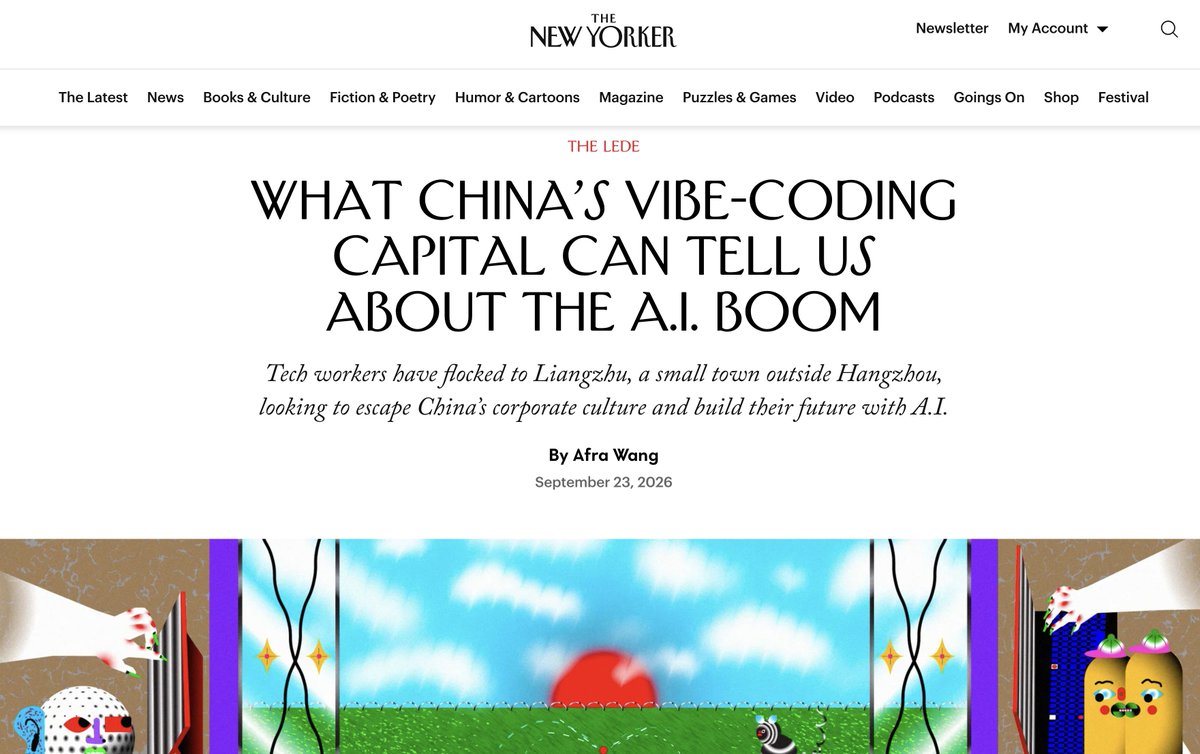
My first piece for @NewYorker is out today!
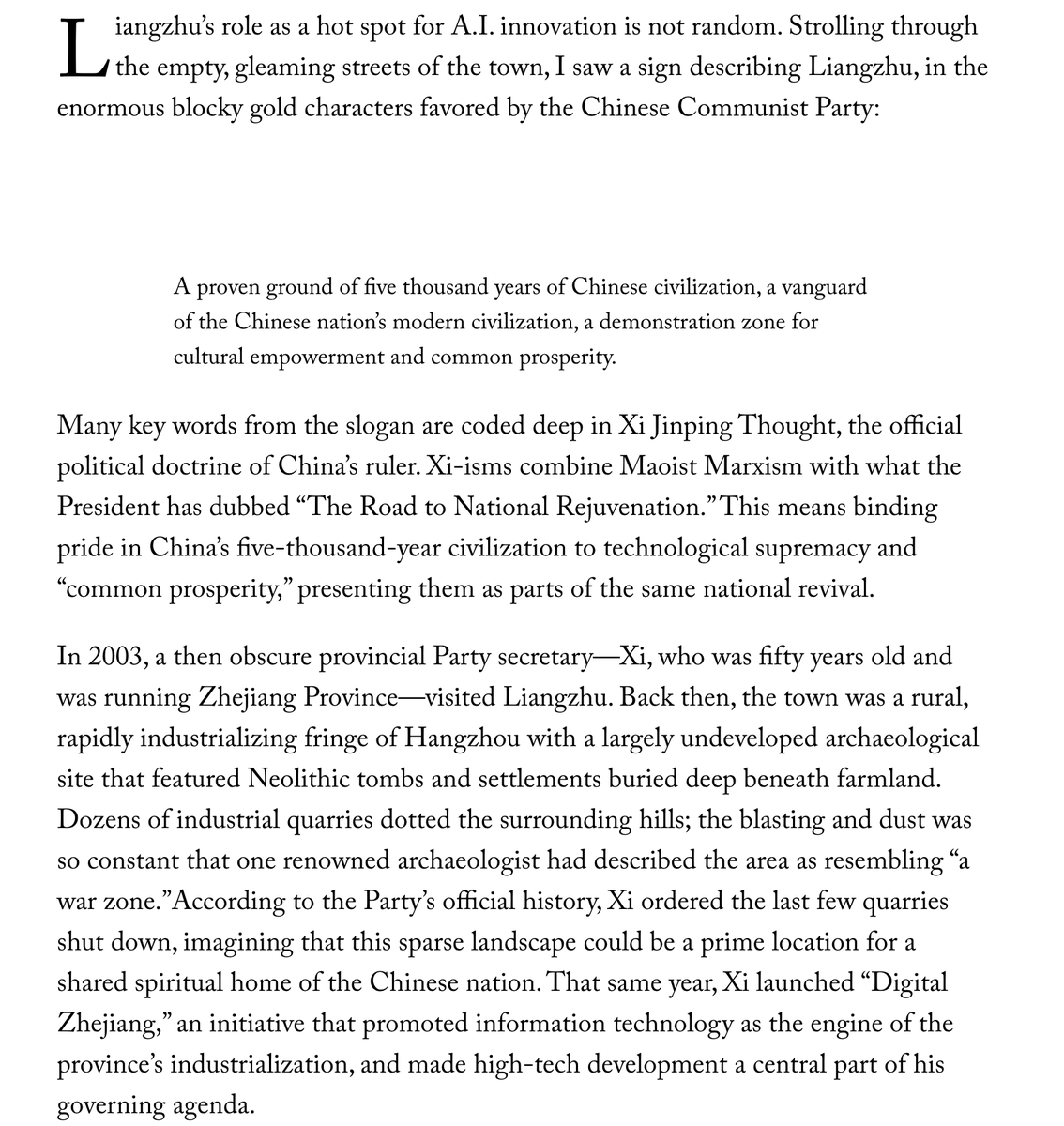
As Xi Jinping lands in DC to start his state visit, you'll hear a lot about the US-China AI race. I'd like to tell a complementary AI story.
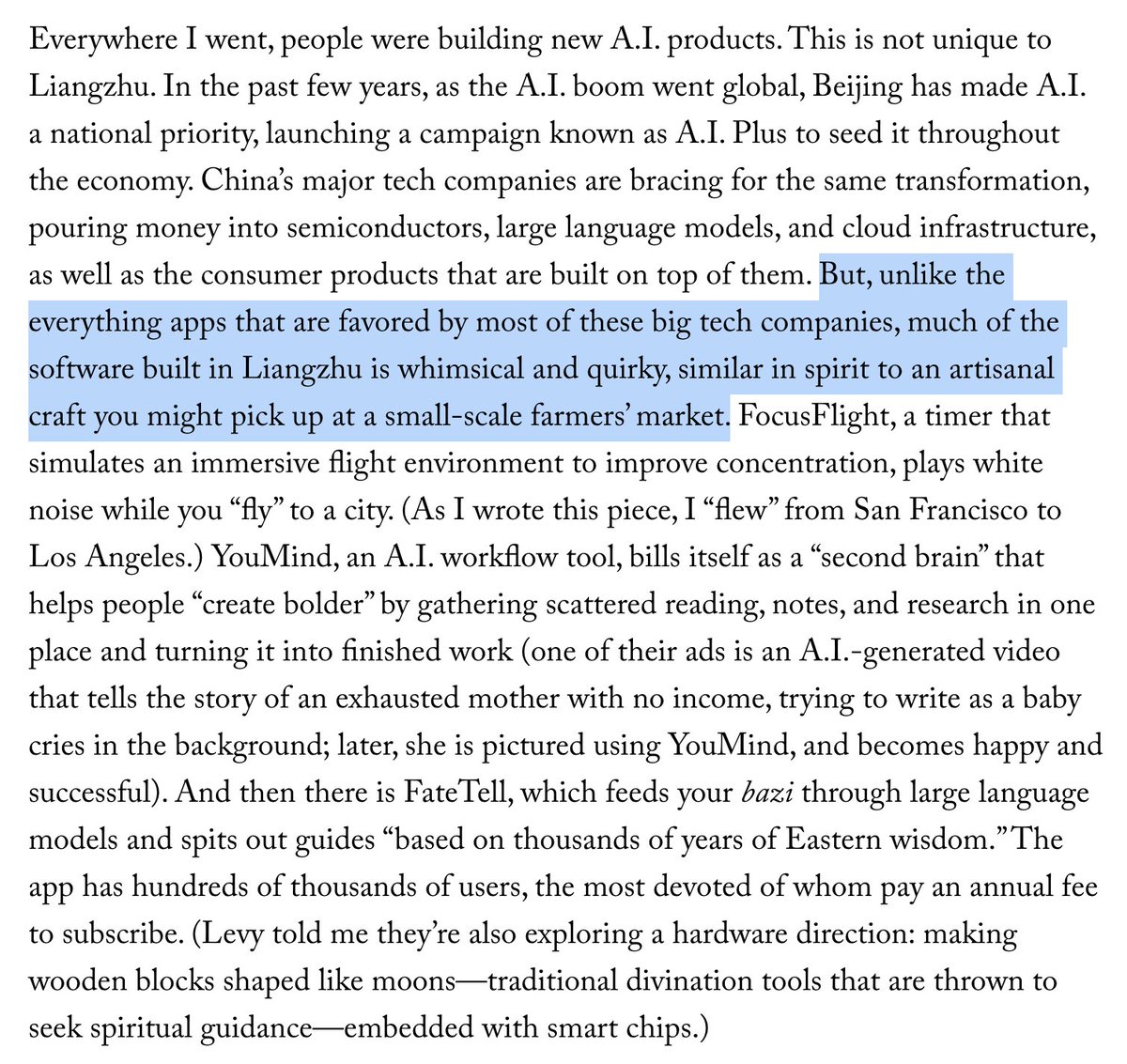
This past May, a few days after Trump visited Beijing, I went to the town people call China's vibe-coding capital, Liangzhu. There, you learn that China's AI scene is not monolithic. It's also full of contrarians, cool vibe coders, spiritual seekers, and people who love AI but refuse to join the 996 grind.
Liangzhu is on the edge of Hangzhou. I hung out with a group of anti-mainstream builders who use AI to make whimsical apps for fortune-telling, mental well-being, and creativity. Some of them run their lives entirely by bazi astrology (their founder almost became a Taoist monk). They meet on "Crazy Thursday" to vibe-code together. Rent is cheap, so they can get a bigger place with a living room to have friends over (unthinkable in Beijing or Shenzhen). In Liangzhu, they want to use AI to forge their own future.
It’s a ground-level story—less about model capabilities, hyperscalers, or AI policy, and more about how people in China are using AI, and the human stories behind it.
Has "Beijing" put up Da Wei @mawangcun1 to write in Foreign Affairs?
His answer is unusually explicit:
"Nobody approved it, or even encouraged or discouraged me from writing it."
“I’m 100 percent sure I cannot represent the Chinese government.”
https://t.co/CG5KIcOOj4
[Newsletter Update]
ANBOUND, a private Chinese think tank, examines the obstacles facing #China's low-altitude #economy, including how airspace is controlled, the limited role of market demand and safety technologies that have yet to catch up.
https://t.co/ZW4nE6mh57
China’s AI Realism Is Not Conspiracy
Some of my arguments on why Chinese researchers don't like Dario. "If it walks like a duck and quacks like a duck, it probably is a duck" https://t.co/BEwM1VREAq