@AlexTISYoung Claude is really good at software engineering. Tried both paid version of Gemini (edu version) and ChatGPT. I think Gemini is better for scientific research. But it needs very precise prompting, so I usually first ask it to optimize my prompt, then answer its own prompt.
@dougthespeed We first copy each chromosome in plink format to active environment, extract HM3 SNPs, and then merge all the HM3 SNPs from each chromosome. The copying process is slow (~1h for one larger chr?), but doable. You can run the job in background. Hail is always painful to me.
update: The filter function on data browser does not give accurate results: some categories and some variants meet the criteria are missing. Guess we have to use VAT for more serious work.
Wow! Need a LoF variant list in AllofUs. Filter the giant variant annotation table? Hours of waiting! Ended up copying and pasting data browser results to DeepSeek and in 10 seconds I got a clean tab-separated file! Cool!
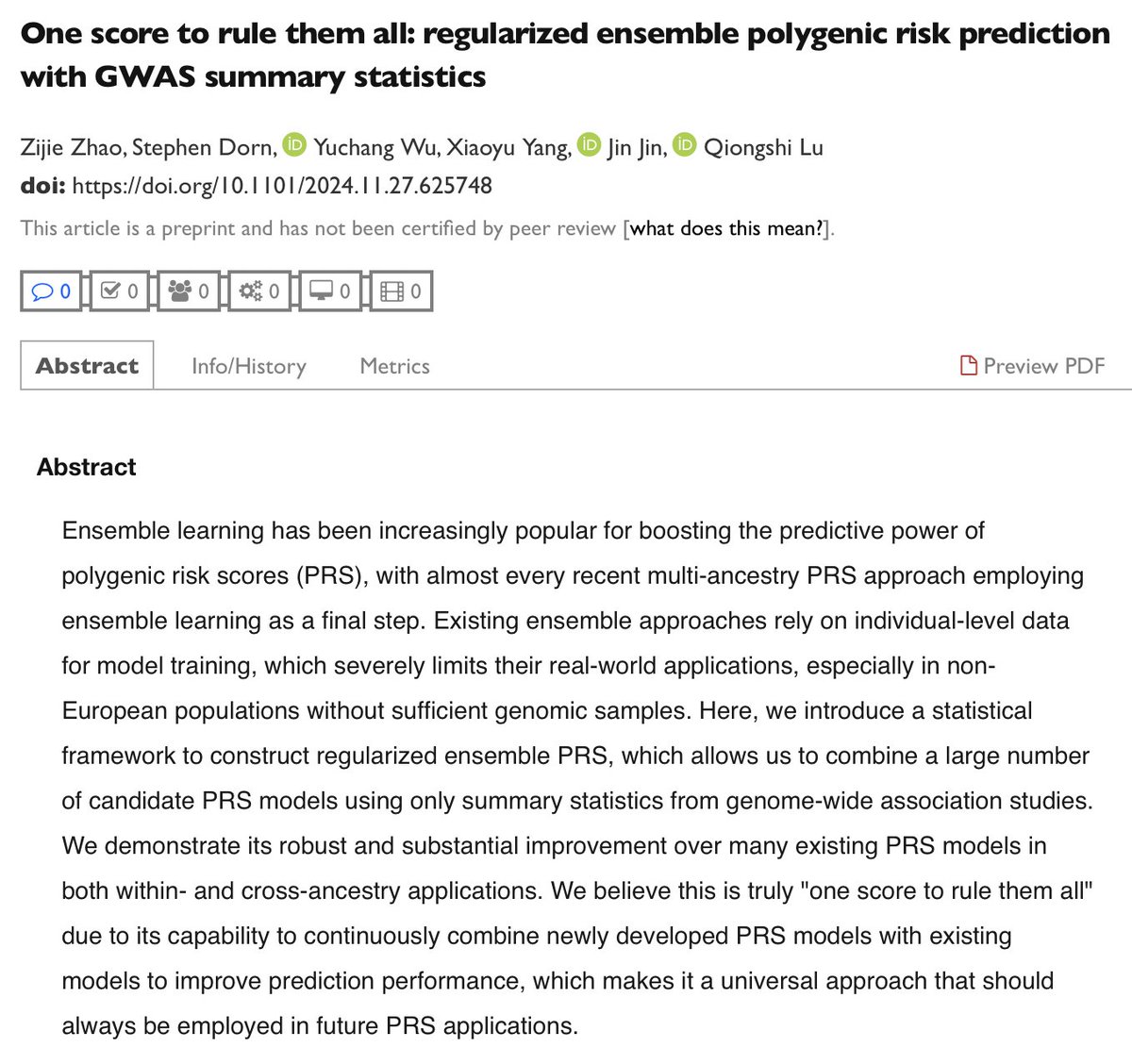
My first co-author paper is now preprinted! With
@ZijieZhao1996 and @Q_StatGen
we introduce PUMAS-ensemble, a regularized ensemble PRS requiring only GWAS summary statistics and LD reference data as input.
https://t.co/nmjR8ftPjg
Our new PRS paper is out! We introduce a method to create regularized ensemble PRS on GWAS sumstats. Individual-level data is no longer needed for sophisticated ensemble learning @ZijieZhao1996@stphn_drn
Paper📰:https://t.co/fUZD6TXzdj
Software🧑💻:https://t.co/YIYhPAIDpY
pain in using cloud computing: took 1 day 10 hours and 44 minutes to finish some analysis using AllofUs data, and I accidentally deleted the "environment" and all the results are gone forever ... 😭😭😭
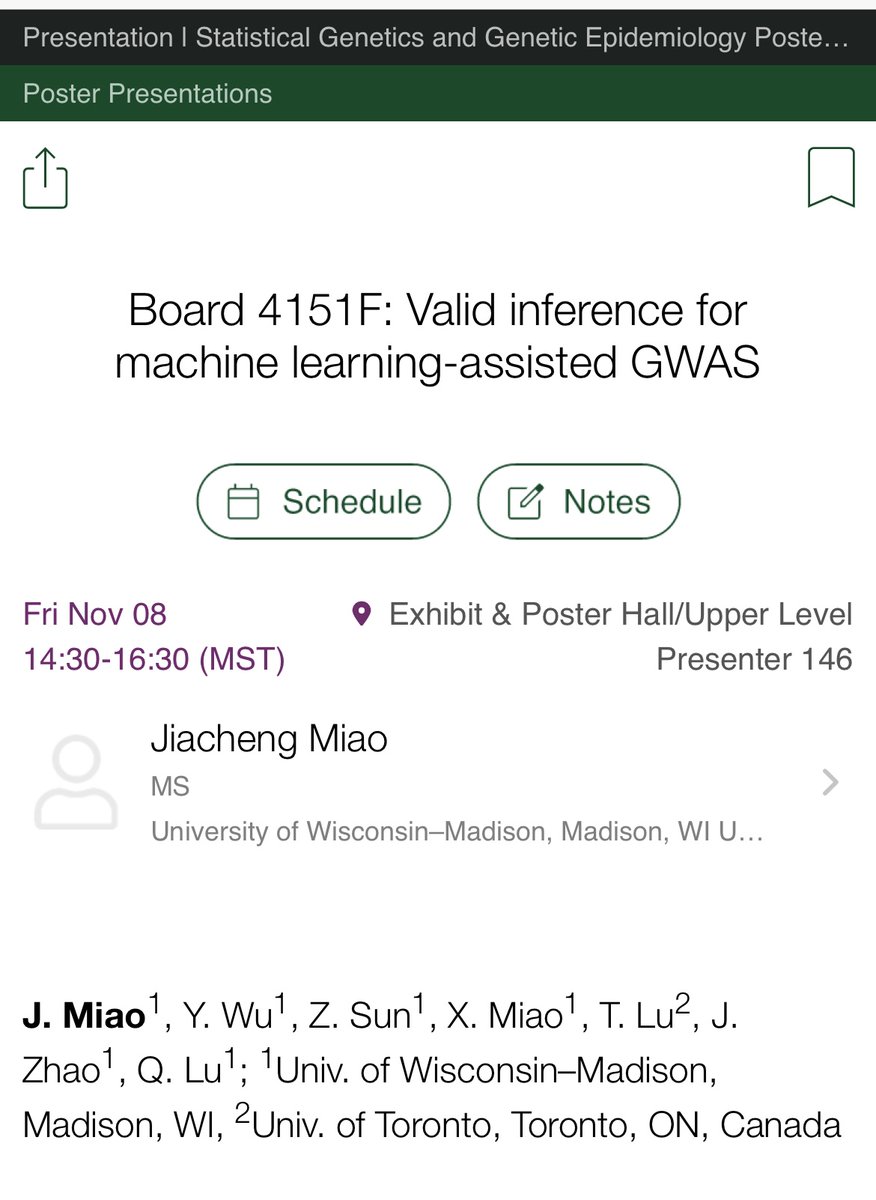
Four presentations from us this year, covering very diverse topics. Stop by and say hi🍷#ASHG24#ASHG2024
1) Genetic effect heterogeneity @yy_stat
2) Genetics of partner choice @S5b6bY284u9qqoa
3) Perturb-seq/GWAS data integration @stphn_drn
4) ML-assisted GWAS @Jiacheng_Miao
While we didn't explore it in this paper, another tool (POP-GWAS) from our lab (https://t.co/yQdolmx6W6) may offer a better solution when dealing with phenotypes with biases. --- also check it out!
POP-GWAS led by @Jiacheng_Miao is published today in @NatureGenet. This work showcases modern data science leveraging the power of machine learning while maintaining statistical validity. It also provides a GWAS solution when the outcome is ML-predicted https://t.co/XBrZ7MBpcd
Thrilled to see this published on Nature Genetics! We found weird results using AD GWAX in another project and discovered that the bias is actually a very serious issue in the AD field. This underscores the importance of data quality. Larger is not always better!
Our paper on misleading biases in AD GWAS-by-proxy is published @NatureGenet. We identify the source of biases and explore strategies to reduce them @yy_stat@SunZhongxuan
Paper📰: https://t.co/Xdq51wVBw6
Software🧑💻: https://t.co/564QCMFIEV
Sumstats⬇️: https://t.co/0LJOblAgxj