🚨 𝗝𝗘𝗨 𝗖𝗢𝗡𝗖𝗢𝗨𝗥𝗦 🚨
On vous fait gagner un maillot floqué au nom de Kylian Mbappé ! 🔥
Pour participer :
1️⃣ S’abonner à @onzemondial
2️⃣ Reposter ce post
3️⃣ Commenter « Je participe »
🍀 Tirage au sort le jeudi 12 novembre. Bonne chance à tous !
No more trick-or-treating! The countdown to Christmas officially begins… Mariah Carey has fired the starting gun!
#ChristmasSpirit 🪅🎶🧑🎄
🎃જ⁀ 🔫 ➴ 👻∘˚*🎄*˚∘
A legend. An icon. A legacy that will live on forever. 🕊️
We are deeply saddened by the passing of legendary British actor Sir Patrick Stewart, who has passed away at the age of 86.🥲
With an extraordinary career spanning more than six decades, Sir Patrick Stewart captured the hearts of generations worldwide through his unforgettable performances as Captain Jean-Luc Picard in Star Trek and Professor Charles Xavier in the X-Men franchise.
From X-Men (2000) to Logan (2017) and Doctor Strange in the Multiverse of Madness (2022), his portrayal of Professor X became one of the most beloved and iconic characters in superhero cinema.
His legacy will continue with his final on-screen appearance as Professor Charles Xavier in Marvel Studios’ Avengers: Doomsday, releasing this December. One final appearance that will now hold an even deeper meaning for fans around the world. 💔
Thank you, Sir Patrick Stewart, for the incredible stories, unforgettable characters and countless memories you brought to the big screen. Your legacy will continue to inspire generations to come.
Rest in peace, Sir Patrick Stewart (1940–2026). You will be deeply missed, but never forgotten. 🕯️
#PatrickStewart #AvengersDoomsday
Patrick Stewart was once filmed dancing and singing on the bridge of the USS Enterprise-D in 1991 as a birthday surprise for Star Trek creator Gene Roddenberry. Though never intended for public release, a copy of the clip eventually surfaced as a bonus feature on a DVD.
Rest in peace 🙏
British actor Patrick Stewart, known for his work in "Star Trek: The Next Generation" and the X-Men film franchise has died aged 86, according to a statement on his X account on Thursday.
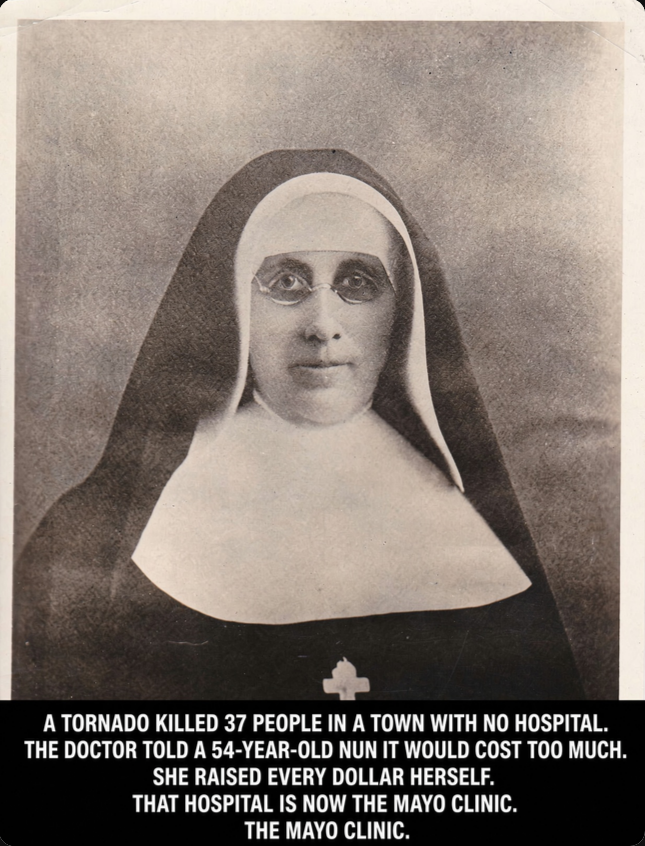
August 21, 1883. Just after six in the evening, the sky over Rochester, Minnesota turns the color of a bruise. Twenty minutes later, a third of the town is gone. Thirty seven people are dead. More than two hundred are bleeding in the streets.
Rochester had no hospital. Not one.
So a convent school on the edge of town emptied out. The nuns walked into the wreckage in full habits, and a woman named Mother Alfred Moes, an immigrant from Luxembourg who had come to America with almost nothing, sent word to the only doctor in town who could handle that many wounded.
His name was William Worrall Mayo. He was 64, an English country doctor, a hard skeptic on the subject of religion.
The sisters took over Rommel's dance hall and turned it into a hospital overnight. None of them had ever been trained in nursing. They learned it standing up, with Mayo giving orders and the injured laid out on the floorboards.
When the last patient was gone, Mother Alfred went to see him.
She told him Rochester needed a real hospital. A permanent one. She said she had seen it, a great hospital rising out of the cornfields on the west edge of town, and that she wanted him to run it.
Mayo told her the truth. A building like that would cost $40,000. Well over a million in today's money. He said no congregation of school teaching nuns could possibly raise it.
She did not argue with him. She simply told him that if he would take charge of the hospital, the sisters would take charge of paying for it.
Then she went out and did it.
For six years, her sisters taught school and handed over their wages. Every dollar. She bought nine acres of farmland. She hired the builders. She oversaw the plans herself, and when the money ran short, she found more.
Saint Marys Hospital opened on September 30, 1889. Twenty seven beds. Thirteen sisters, none of them nurses by training. Dr. Mayo, now 70, walked in as chief of staff with his two sons, Will and Charlie, beside him.
Those two boys built their surgical practice inside her building. Patients started arriving from Chicago, then from every state, then from overseas. The brothers formalized the partnership in 1919 and gave it their family name.
Mayo Clinic. Today it treats more than a million patients a year and is ranked the best hospital in the United States.
Mother Alfred Moes died on December 18, 1899, ten years after the doors opened. She never saw what it became.
The Mayo brothers always said it plainly. Their father did not want the hospital. The nun did. She built it, and then she handed them the keys.
Millions of Americans have made the drive to Rochester with someone they love in the passenger seat. Almost none of them know that the whole thing started with a 54-year-old woman standing in tornado wreckage, refusing to accept a no.
h/t: Minnesota | FB
A 4th Gold event title for @sangari_99 ⭐️
She wins her first PSA title of the season and maiden @SVOpenSquash title 🏆
Result: Silicon Valley Open 2026 Women's Final
🇲🇾 [3] @sangari_99 beats [8] Farida Mohamed 🇪🇬
3-0: 11-7, 11-6, 11-8 (31m)
2005 stellte Sony in San Francisco offenbar die einzig vernünftige Frage, die man sich beim Bewerben neuer Fernseher stellen kann:
„Was wäre, wenn wir 250.000 bunte Gummibälle einen Berg hinunterhüpfen?“
Und dann taten sie es einfach.
Eine Viertelmillion echte Flummis, zwölf gesperrte Straßen und ein Team, das vermutlich sehr schnell bereute, im Vertrag nicht nach einer Gefahrenzulage gefragt zu haben.
Für den legendären Werbespot „Balls“ kaufte die Produktion angeblich praktisch jeden verfügbaren Gummiball westlich des Mississippi auf. In amerikanischen Kaugummiautomaten herrschte daraufhin für eine Weile vermutlich jene trostlose Leer.
Damit die Bälle nicht bloß bergab kullerten, baute das Effektteam gewaltige Druckluftkanonen.
Und wie es funktionierte.
Die Flummis erreichten Berichten zufolge Geschwindigkeiten von über 160 km/h. Das Kamerateam trug Schutzkleidung, Helme und benutzte teilweise Schutzschilde.
Beim ersten Abschuss verwandelte sich die Straße in ein kontrolliertes Experiment zur Chaostheorie. Bälle flogen über Häuser, sprangen einen ganzen Häuserblock wieder bergauf und landeten in Abflüssen, die eigentlich weit außerhalb der berechneten Flugzone lagen.
24 eigens bereitgestellte Autos und sechs Häuser wurden beschädigt; allein kaputte Fenster sollen rund 74.000 Dollar gekostet haben. Ein Crewmitglied sah später beim Einchecken ins Hotel – mehrere Meilen vom Drehort entfernt – noch einen einzelnen Gummiball über den Bürgersteig hüpfen.
Nach jedem Take begann die eigentliche Heldentat: das Einsammeln von 250.000 Flummis an den steilsten Straßen San Franciscos. Dafür gab es besondere Schaufeln, Netze und sogenannte „Ball Wranglers“.
Noch Jahre später sollen Anwohner einzelne Bälle in Dachrinnen und Abflüssen gefunden haben. Manche bewahrten sie als Souvenir auf. Damit ist der Spot vermutlich die einzige Werbekampagne, deren Requisiten zwei Jahrzehnte später noch selbstständig in Garagen auftauchen.
Das Ergebnis war aber eine der schönsten Werbungen der 2000er: eine unwirkliche Lawine aus Farbe, gefilmt in Zeitlupe und begleitet von José González’ „Heartbeats“. 🔴🟡🟢🔵
Tahniah dan syabas kepada Profesor Dr. Kuik Cheng-Chwee, Felo Utama Institut Kajian Malaysia dan Antarabangsa (IKMAS), Universiti Kebangsaan Malaysia (UKM), atas kejayaan tersenarai dalam kelompok 2 peratus saintis teratas dunia bagi tahun 2026.
Pengiktirafan ini bukan sahaja mencerminkan kecemerlangan dan sumbangan beliau dalam bidang ilmu, malah turut mengharumkan nama Malaysia di peringkat antarabangsa.
Semoga kejayaan ini terus menyemarakkan budaya ilmu, memperkukuh tradisi penyelidikan dan menjadi inspirasi kepada generasi ilmuwan untuk menyumbang kepada kemajuan negara.
#MalaysiaMADANI
#YakinMADANI