okay so the hyperliquid announcement is omega giga bullish and there are enough tldr's around for you to read the basics but here are my favourite parts:
- the core team clearly has high leverage even with the biggest players in the game as they secure a deal with extremely favourable terms
- one of the biggest friction points (bridging to HL) will soon be direct through circle's cross-chain protocol
- hard to describe how big of a win this is from a regulatory standpoint just before the clarity act is likely to pass. two of the most scrutinised and regulation-friendly teams just threw a massive amount of reputation and money at HL right before it goes through the senate. that timing isn't an accident
- this deal reaffirms the HL team remains extremely aligned with the growth of the token and redistributing the wealth created on chain back to users
- there are no 'leaks' in the HL team, in crypto it's very common to see tokens outperforming into unknown announcements, $HYPE has been bleeding coming into this announcement
- there is no other chain where increasing TVL feeds directly into token increase, $HYPE now does
this announcement really helps smooth over the bear cases and creates an even higher ceiling for the bull cases
hyperliquid will be the house of all finance and all others will be competing through builder codes
hyperliquid
To state the obvious... Satoshi candidates need to plausibly cover the following, in addition to the table-stakes stuff like cryptography experience and interest in digital money:
- will & ability to start/run/manage a community
- always write intelligibly, almost always politely
- enough knowledge of p2p networking design to write the original gossip protocol
- enough distributed systems engineering experience to run the initial patoshi cluster
- the product/market sense to release a Windows GUI client before anything else
- the character to seed, grow, and steward the ecosystem from 0, including the forum, early collaborators who showed up, and the auto-throttling patoshi cluster to keep the network alive.
Almost every Satoshi theorist ignores these factors, focusing more on superficial stuff. But the above, taken together, are the most remarkable thing about what satoshi did. Lots of people can have a flash of brilliance, few have the determination & background to follow up with highly competent execution on taking the idea through from concept to self-sustaining ecosystem.
And yes I think it's overwhelmingly likely it was one person. The entire thing screams passionate, motivated, highly competent single person to me. It's *harder* to do something like that as a team from the get go, not easier.
I think it's healthy for us in the Ethereum world to have a more bold and open mindset to many things, particularly on the application layer and on how we see ourselves in the world.
We should not compromise on core properties: censorship resistance, open source, privacy, security (CROPS). We should not have "open mindedness" of the type that leaves people with no confidence of what security properties the L1 will still have one year from now. We should not ask ourselves questions like "do we really need light clients to be able to trustlessly verify correctness of the chain?". But especially on the layer of applications and Ethereum's interface to the world, we should be more willing to radically rethink various concepts and step outside our comfort zone.
This includes issues of technological direction, eg. "what if AI basically means that wallets as browser extensions and mobile extensions are dead within a year?"
One example last year was the shift to thinking about privacy as a first-class consideration, something we value equally to the other types of security. This implies a radically different Ethereum application stack, because the entire stack so far has not been built around privacy. Great, let's build a radically different Ethereum application stack!
An example this year is the growing work on the networking side of privacy, both inside the EF and outside.
It includes application-layer issues, eg. "what if the rest of defi is basically just universal futures markets on top of a good decentralized oracle and letting users self-organize on top of that?", and "what if the ideal decentralized oracle is just a SNARK over M-of-N small LLMs over zk-TLSes of some major news sites?"
(BTW this is interrelated with the AI issue: one consequence of AI is that it moves "applications" away from being discrete categories of behavior with discrete UIs, and more toward being a continuous space, so "build fewer apps and rely on users to self-organize around them" should inevitably expand as a pattern)
One example this year is rethinking from zero the role of L2s, and what kind of L2s are actually most synergistic and additive to Ethereum.
It also includes culture. This is a big part of "the whole milady thing" for myself, @AyaMiyagotchi and others. Yes, it's a silly meme. Yes, I find the political takes of some milady partisans cringe and sometimes outright bootlickerish (though other milady partisans are quite the opposite). But the core underlying subtext, the message behind the message, is: rip off the suit and tie. If you have your suit and tie on, be willing to grab the nearest wine glass and spill it all over your suit and tie, so you have no choice but to rip it off and reclaim your body's full flexibility and freedom. Actually imagine yourself doing this the next time you get invited to a richpeopleslop formal gala dinner. Take the preconception that you are "respectable", write it down on a piece of paper, crumble it up and burn it. The psychological baptism of doing this leads to the intellectual baptism of unlocking greater creativity and expanding overton windows.
For too long, our algorithm in Ethereum has been: we have this existing ecosystem, what's the logical next step to make it one step better? Now, our algorithm should be: we have this L1 that is amazing and will become more amazing, we have a growing array of tools, both those built within our ecosystem and outside it, what are the most valuable things to build, knowing what we know now? If YOU had to write the section of the 2014 Ethereum whitepaper that talked about applications, and take a first-principles perspective of what makes sense in defi, decentralized social, identity, and elsewhere, what would you write? At least take the step of marking all path-dependence concerns down to zero, pretend for a brief moment that the Ethereum chain today has exactly zero usage and you're the one suggesting or building the first apps, and see what comes out. Do this even if you're the one building today's existing apps. This is how Ethereum can grow back stronger.
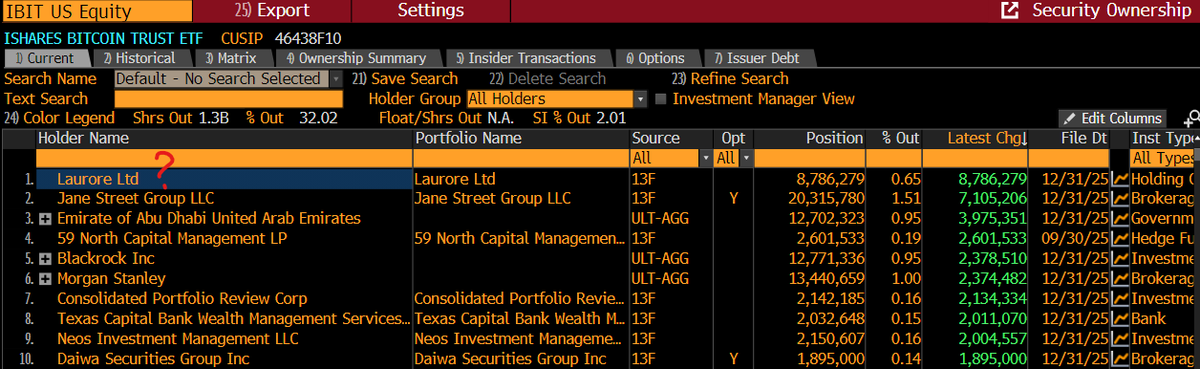
Something caught my eye in the latest 13F filings.
The biggest new entrant into IBIT, from a brand new entity, is something called Laurore Ltd. No website. No press. No footprint. The only public information is that the filer's name is Zhang Hui and it's HK based.
Let's double click on that for a second.
Zhang Hui is the Chinese equivalent of John Smith. It's what I like to call it a "non-anonymous anonymous" name, something hiding in plain sight buried under the statistical weight of millions to make it untraceable. The "Ltd" suffix suggests a Cayman or BVI structure, the classic offshore wrapper for accessing US markets. And the portfolio? A single holding. Nothing but IBIT. This isn't a diversified fund. It's a $436 million Bitcoin access vehicle dressed in institutional clothing.
Why would you do this?
Because Chinese investors can't hold Bitcoin.
If this is what it looks like, it might be an early sign of institutional Chinese capital moving into Bitcoin, not through crypto exchanges or gray market channels, but through a BlackRock ETF, filed with the SEC in a regulated jurisdiction hiding in the most "transparent non-transparent" place imaginable.
Funny that the name Laurore likely derives from the French l'aurore: the dawn.
Smells like capital flight to me.
when i started building echo 2 years ago, i knew it had 95% chance of failing. to be honest, i couldnt really imagine any other outcome, but i thought at least it may be a noble failure worth attempting.
i certainly didn't think echo would be sold to coinbase, but, here we are: today coinbase bought echo for ~$375m.
echo will remain a standalone platform under its current brand for now, but we will integrate sonar's public sale product into coinbase, and likely introduce new ways for founders to access investors, and for investors to access opportunities into coinbase itself.
over the years i have chatted to brian a handful of times, and mostly to complain at him honestly. i have always respected how brian would listen to an outsider chat shit at him on the phone and take the feedback seriously. now, instead of complaining, i will have the opportunity try to do the work to make things better.
crypto itself has moved on a long way since we started working on echo. i guess partially this is because of the election result. but, i feel energised by a lot of the cool things being built in crypto again: hyperliquid, zcash, stablecoin supercyle, and so on.
feels like a good time to be on the field instead of an idiot with a twitter account yapping nonsense. well, i guess i still will be that.
anyway, job's not finished. onwards.
oh fuck yeah, before i go, the final season of up only (now "unc only" due to our severe old age) will commence when we figure out who the guests should be lol
cobber
Tempo Thoughts
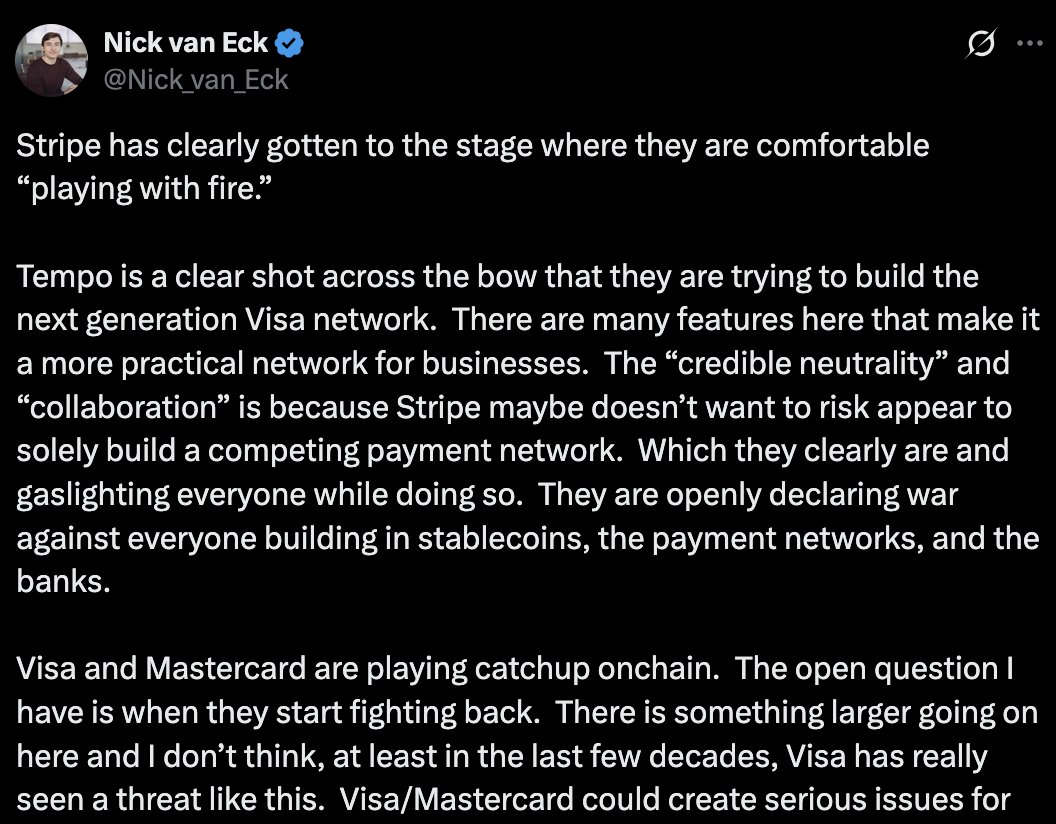
Stripe is making a full-stack play from being the fintech middleman (passing point-of-sale data to settlement networks) into owning all three bits
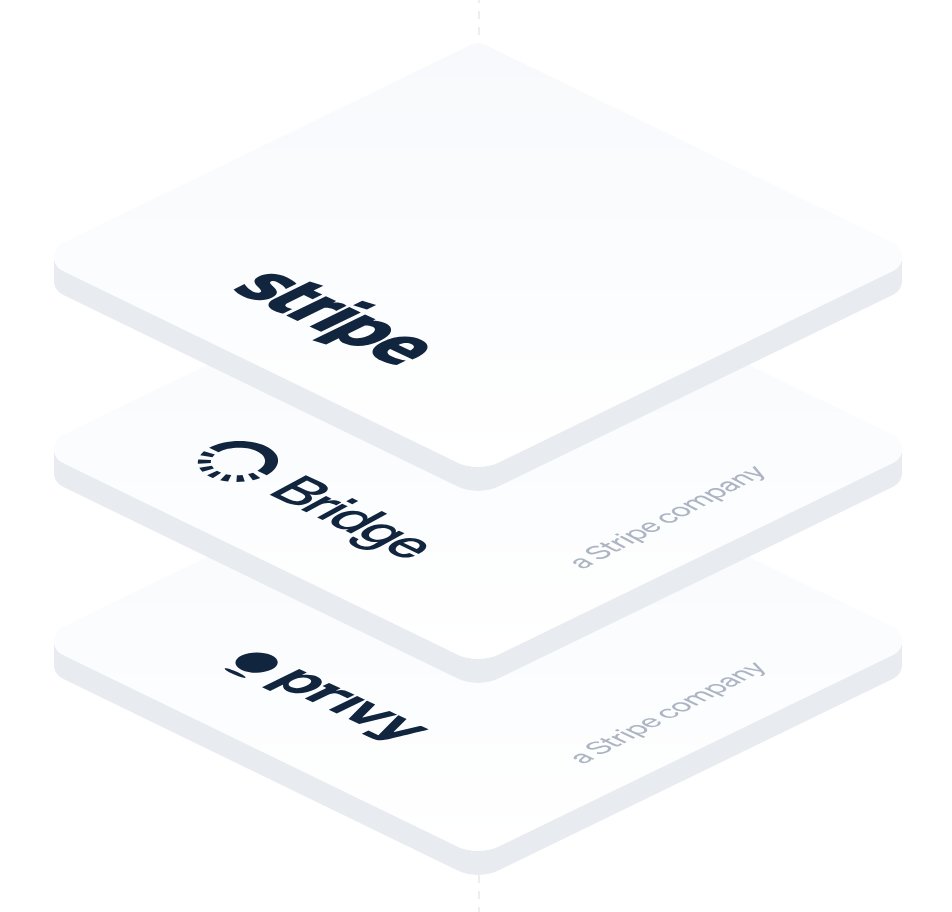
- They bought Privy for 70m consumer wallets
- They bought Bridge for native stablecoin issuance
- They partnered w Paradigm to build a chain
Consumer (wallets) + Rails (stablecoin) + Settlement (blockchain). They even made an image
Great points from Nick (founder of the Agora stablecoin-as-a-service platform) about Stripe's need to move as fast as they can before their partners turn adversarial. Moving fast is hard to do as a $90 billion company, but Stripe is a cut above.
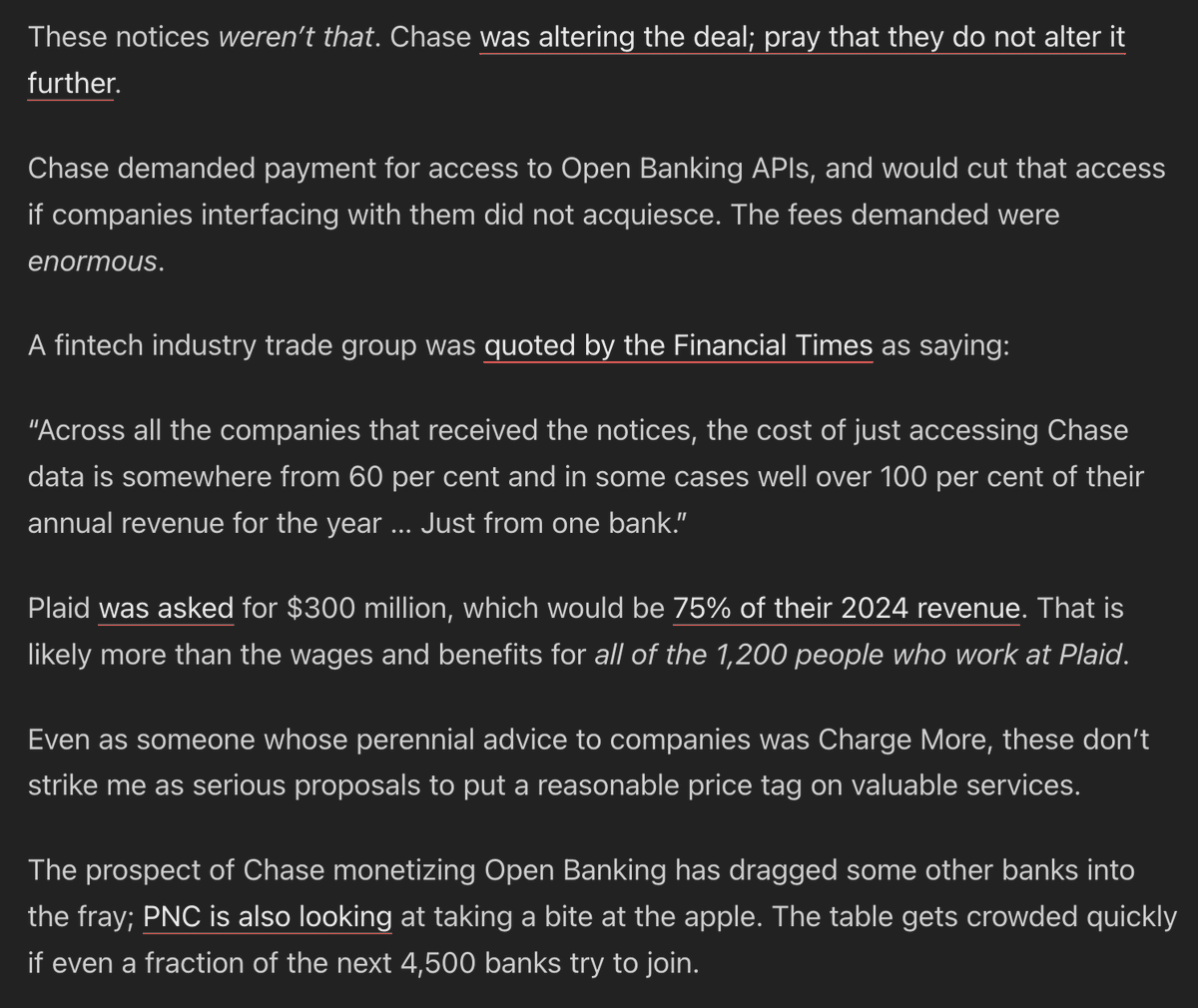
Consumer payments is the one domain where they're still at mercy of the card networks. And banks/cards are playing ugly now. In the last few months, Chase announced plans to absurdly overcharge, functionally cutting off fintech access to basic functionality such as querying someone's balance or running a charge.
Even the banks are getting debanked.
Payments are a great business because everyone is used to paying 2% interchange fees that get partially passed back to the consumer through opaque promos.
A modern payments system needs several features:
- instant finality
- guaranteed low fees
- high throughput
- privacy but also compliance
- reconciliation memo data
Ethereum does...none of this very well today. If you do really fancy cryptography and risk commingling with North Korea, you kinda get privacy. And you can put memo fields in transactions. But no reliable finality, fees, or throughput.
An L2 could solve the privacy problem by writing a new VM instead of using EVM, and it could beef up a massive sequencer for low fees. Doesn't solve the finality problem but maybe this gets fixed at EVM level by 2028 or so.
The real core issue that nobody has focused on is Ethereum speed of development. A single Paradigm developer (and team), Georgios Konstantopolous, has lapped nearly all of Ethereum's existing infra. Porto crushes 4337. Reth destroys geth. Many recent EIPs have been handheld by him.
What is the point of depending on a chain that itself depends on you?
Iteration speed matters when you're trying to overtake Visa. And Ethereum hasn't even solved basic problems like L1 execution throughput or L2 data availability throughput. Best-case scenario, another 2-3 years for these things to percolate into prod.
There are mild benefits at best to becoming an L2. Distribution advantages of a marginal fraction of a percent of Stripe's existing userbase. Some good vibes from the chain maxis, and more defensibility under President AOC 2028.
But these are simply dwarfed by the practical business realities of needing to win, today. Plus owning full value accrual. Don't give it away if you don't have to.
A new BIS paper on Bitcoin dropped yesterday. To cut through the jargon:
It concluded that Bitcoin use rises when inflation surges, remittances get pricey, and capital controls increase.
In other words, when people need it most.
Source: https://t.co/pVpNv9XZDl
Introducing Stablecoin Financial Accounts. Hold a stablecoin balance. Send and receive funds with fiat and crypto rails. Accessible from 101 countries: https://t.co/yXtE9cdeaz.
My thesis for where we are at:
- Trump is doing a traditional PE deal. He is taking the USA of the exchange and into private hands.
- He's acquired the company, he purging senior leadership as to be able to exert full control.
- With that well underway, he's now starting to gut it to cut cost and improve the P&L and balance sheet (ie firing a bunch of people; getting rid of useless business lines; shutting down inefficient departments; lowering overhead)
- As a side note: Tariffs massively work in his favor. They are easy to administer (just ports of entry), don't require a ton of paper submissions, and crucially don't require hundreds of thousands of IRS agents to make sure that people file their taxes and pay them correctly). And moreover they are not distortive to the real economy, whereas other forms of taxes are. Tariffs are only distortive to the global econonmy but who cares.
TLDR: So the end result is that he's maintaining revenue while massively requiring the cost to produce said revenue.
- Going forward he's going to IPO the USA again. He'll probably spent 9-12 months cleaning up the accounts, but afterwards we'll see an IPO. And for that to work well he's going to inflate the top-line revenue numbers.
- I'm guessing it's going to be massive tax breaks plus helicopter money. This has worked well in previous cycles and is going to work well now.
- This will also nicely co-inside with the mid-terms which he knows he must win.
- As a side note: This just means turning on the money printer and for it to go BRRRR.
TLDR: In 9-12 months @realDonaldTrump will IPO the USA to the public markets just in time for the mid-terms in a way that'll probably melt all our faces off.