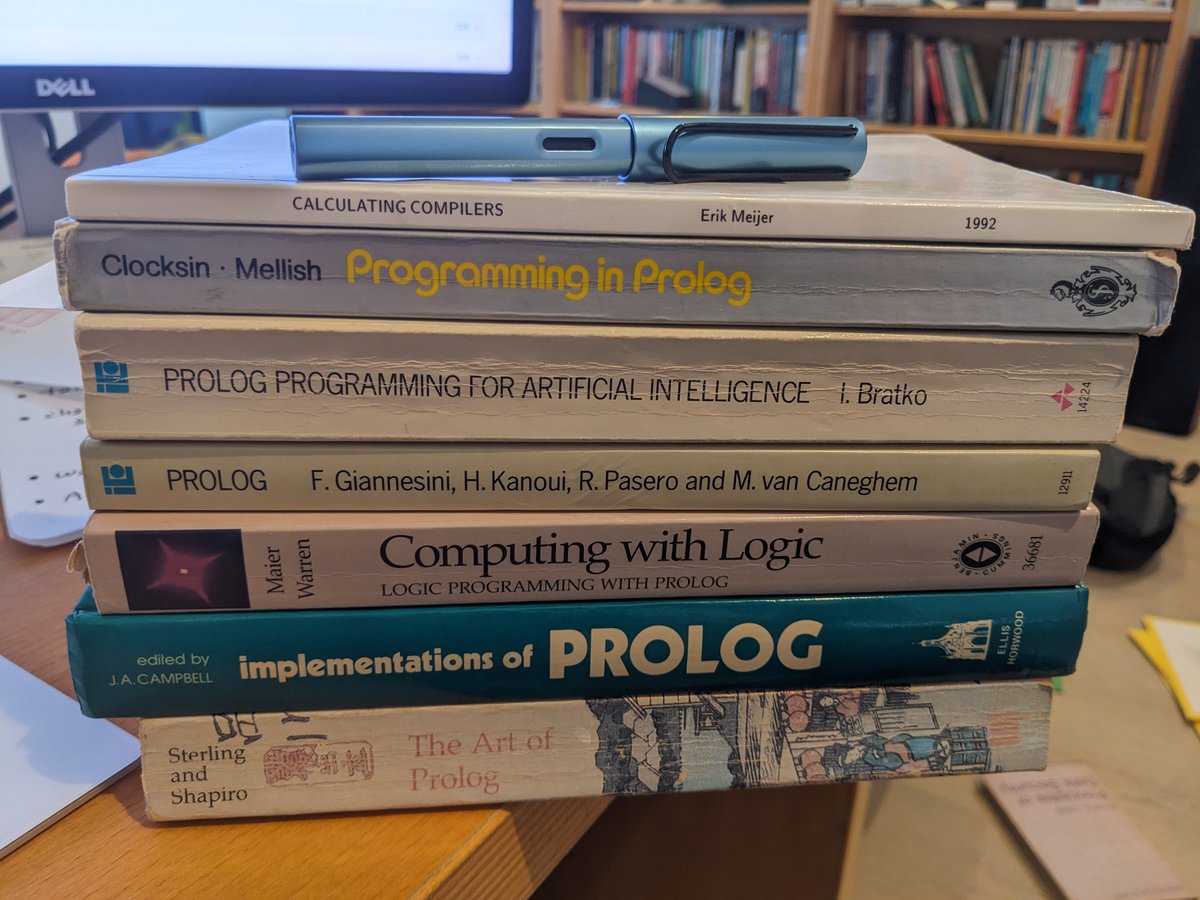
@nathanmarz The more expressive a language is (runnable programs per volume of code) the more easily it is to accidentally create incorrect runnable programs. DSLs give you expressivity where you need it while simultaneously enforcing correct semantics for the domain.
Sorry guys - I'll stop getting upset about people misinterpreting it. I think whoever matters understood the message. It is on me to be clear and truthful. It is not on me how people who couldn't read past the first paragraph will interpret it. It is just outside of my control
@VictorTaelin As Epictetus says. "Some things are in our control and others not." In your control are the points you laid out. Not in your control is misinterpretation. Don't worry, keep doing your good work. There will be no shortage of smart and industrious people who appreciate it.
@VictorTaelin@alittletyper Look to miniKanren instead. Pure logic, designed to be embedded and extended. Doable in one evening. Would its underlying lazy-stream approach parralelize?
@dhh doesn’t appear to understand the difference between a logical argument and unexamined anecdotes. That’s probably why name-calling is used to sound more convincing.
Gotta love the pivot from "it doesn't scale" to "you can't write real systems without types" as the new ding-dong argument against dynamically-typed languages like Ruby (and vanilla JavaScript and Smalltalk and...). https://t.co/lwxTGan6ZO
"So farewell, TypeScript. May you bring much rigor and satisfaction to your tribe while letting the rest of us enjoy JavaScript in the glorious spirit it was originally designed: Free of strong typing." https://t.co/mCDhyrmEnu
@aaronwhite Given that the “Rule 110 automaton” can be used to run any LLM we have, and given that Rule 110 can be implemented by placing rocks on a large beach, it seems fair to ask if subjective experience lies in the placed rocks, the current rock, or in the action of placing the rock.
Logicians understand "False → False" and "False → True". You can prove lies AND truths starting with lies. A contradiction is a logical lie. Agendaists love contradictions as axioms. They can prove whatever suits them. (But in doing so, they arm opponents with the same tool.)