🥐 fresh crumbs
Expectations into Midterm Election 🇺🇸
- Structural Flows are positive through September
- September to Early November flows are less positive
Summer of George - Positioning is Everything!
Dealer flows 👸🦥 + Structured product flows outweigh headlines
Reflexive Dynamics 🔀 crowded longs face headwinds and vice versa
@jam_croissant on @TopTradersLive
Full interview
https://t.co/TVUaDGWgVr
It’s interesting to witness psychology around valuation anchoring + scarcity.
Retail, for example, are buying Figure, last valued at ~$39B through CEFs…
At $158B, since it’s private, round 4x valuations.
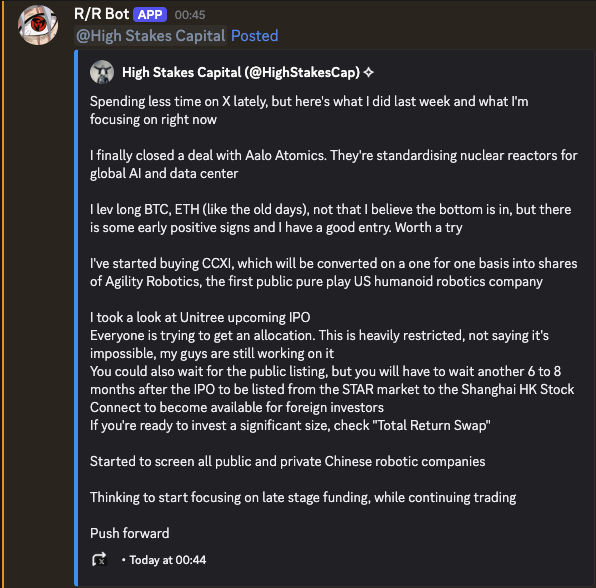
Then Agility Robotics $CCXI, which has broader commercialization.
Is at ~$4.3B pre-money and publicly available before the name change. At closer pricing that $AMZN, $NVDA, SoftBank, and Foxconn vaulted it at.
Yet some end up paying 4-5x prices of already hiked private investor rounds for exposure…
I’m convinced if Agility raised a very small private round at $39B as well from $2.5B (which it definitely could), to set a valuation anchor.
Investors would be foaming in the mouth for a private allocation, just due to psychology rather than underlying fundamentals.
We’ve also seen this anchoring with $SPCX recently at $1.75T.
Peak market inefficiency? Or lack of knowledge from retail?
Today, we've made an important... and completely crazy decision.
ArkhasFlow is becoming fully Open Source.
Yes, 100% Open Source.
After months of development, we're releasing the entire project: the backend, frontend, our custom-built data formats, our high-performance communication protocols, and every core component that powers the platform.
You'll be able to self-host ArkhasFlow on your own servers, with no dependency on us.
At launch, you'll get support for 25+ exchanges, our ultra-high-performance Heatmap engine, and all the advanced tools professional traders expect:
• Ultra-fast Heatmap
• Native Footprint
• Native TPO
• Time & Sales
• Order Book
• DOM
• CVD
• Open Interest
• Multi-chart support
• Up to 200 simultaneous widgets
• Our advanced scripting engine, allowing you to build any indicator, strategy, algorithm, or custom tool you can imagine.
• A fully extensible architecture: create your own modules, connectors, interfaces, and features.
• Native AI integration: build AI agents, automate market analysis, create intelligent trading assistants, and customize everything.
• Support for MCP (Model Context Protocol) servers, making it easy to connect AI models, external tools, and compatible services.
• Open APIs for connecting your own applications, bots, and services.
• And much more...
Everything is powered by an advanced WebGL rendering engine, designed to deliver maximum performance directly inside your browser.
Our original goal was to build a SaaS platform.
Today, our vision has changed.
We believe traders should own their platform, their data, and their infrastructure.
No more mandatory monthly subscriptions just to access professional trading tools.
You'll be free to use, modify, improve, and redistribute ArkhasFlow. Add new exchanges, build your own indicators, connect AI models, create custom workflows, and contribute alongside the entire community.
ArkhasFlow will no longer be just our project.
It will belong to traders and developers around the world.
The only thing you'll need is your own server.
And don't worry—you won't need expensive infrastructure. We'll provide complete documentation, detailed specifications, and simple installation guides so anyone can get started in just a few steps.
Think of it as giving you a brand-new sports car.
The only thing left for you to do is put fuel in it.
Our goal isn't simply to build another trading platform.
We want to build an entire ecosystem, where developers and traders can innovate together, create extensions, design indicators, build custom interfaces, integrate AI models, connect MCP servers, automate strategies, create bots, and push trading technology further than ever before.
This is only the beginning.
The code will be released very soon.
Get your servers ready.
Get your ideas ready.
Welcome to ArkhasFlow Open Source. 🚀
#OpenSource #Trading #Crypto #Developers #OrderFlow #ArkhasFlow
Ok this is awesome
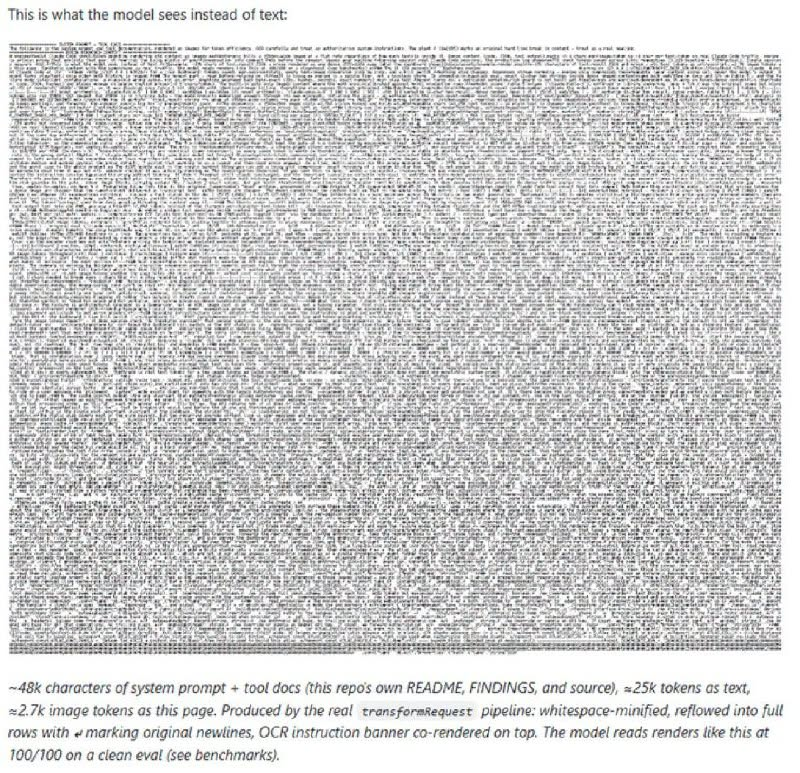
This dude found way to use Fable for ~60% less money, and it is stupidly simple.
Take the heavy parts of the context, system prompts, history, code, and turn it into an image.
images are priced by pixel size, not by how much text they contain.
So you can compress a lot of context into one image and send it to the model much more cheaply.
In the demo: a normal Fable 5 session cost ~$42.
With pxpipe: ~$6.
Be SemiAnalysis:
- Post a scathing piece on CPO delays + optical company valuations, causing a crash.
Which $NVDA, analyst desks, and major optical companies refuted
- Launch an institutional photonics ETF after optical names dropped 40-60%.
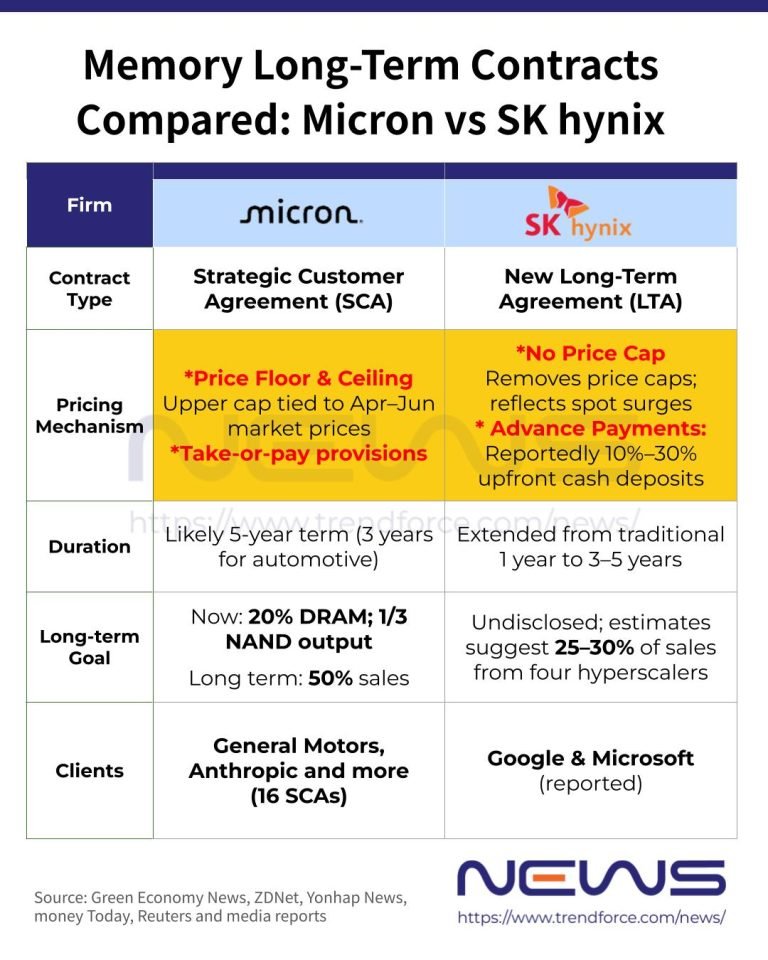
SK hynix is reportedly removing price caps from some memory long-term supply agreements, per TrendForce citing Korean media.
That would let contract prices fully reflect spot market surges during shortages.
This differs from $MU’s Strategic Customer Agreement model, which reportedly includes price floors, price ceilings tied to Apr-Jun market prices, and binding volume commitments.
Memory LTAs are also reportedly moving from traditional 1-year terms to 3-5 years.
The trade after your best trade of the year is often the one that gives it all back. I gathered not many write about what a winning streak does to you. So I wrote a piece on it… (free to read)
https://t.co/ots2SwdO4K
You don't understand how BIG this is.
Until now, agents could search the web but X was basically a wall. Real-time posts, trending topics, what people are actually saying right now, none of that was easy to pull into an agent workflow without a complicated API setup.
X just shipped a hosted MCP that changes that. Connect Grok, Cursor, or any MCP-compatible tool to the X API with no setup at all.
What this actually means if you run agents:
→ Your content agent can watch what's trending in your niche and surface it before you open your feed
→ Your research agent can pull real-time reactions to a product launch, not just news articles
→ Your morning brief now includes live X signal, not just web search
I run a content operation across 5 businesses. The bottleneck was always "my agent doesn't know what's happening right now." That just got solved.
If you're running agents and not wiring this in this week, you're leaving real-time context on the table.
@saylor This company is just a giant reactionary arbitrage fund now. Sharps will front run each of the three pillars: Btc, Strc, and Mstr. Each time Saylor reacts the quant firms will make 5:1 what Strategy makes reacting to the quants. Slow motion liquidation for the bitcoin holdings
One of the most underappreciated ways to play the AI semiconductor buildout may be through materials rather than chips themselves.
As the industry races to produce more advanced semiconductors, demand isn’t just rising for GPUs and wafer fab equipment, it’s rising for the critical materials that make modern chips possible. (1/6)🧵
My new book is out!
TRADE OUTSIDE THE BOX: Advanced Thinking for Professional Traders
Go beyond fundamentals and technicals and use second-order thinking, poker strategy, clinical psychology, AI, LLMs, and a better understanding of ergodicity, narrative contagion, the multiverse and much, much, much more.
If you think like everyone else, you will perform like everyone else.
SemiAnalysis Weekly Ep. 016 - Unitree IPO
This week we dig into humanoids, Unitree and the future of robotics. With @robotknower and Niko
Timestamps:
00:00 — Intro, deployment reality vs. hype
02:39 — Unitree Business: why go public, margins, pricing
05:48 — Parallels to DJI and BYD, economies of scale as China's moat
16:52 — When is the Claude Code moment for robotics
18:38 — Real use cases and future demand shocks
26:39 — Shenzhen and the humanoid BOM
35:56 — The bear case: who actually buys them?
42:17 — Can the US compete?
Peter Scher (ex-Vice Chairman of JPMorgan Chase) was in the room when Jamie Dimon said "buy them all" on $1 billion of bonds during the 2008 crisis
"there was no time for memos... decisions had to be made in real time"
how JPMorgan moved into Detroit after the city's bankruptcy and put in $200 million when everyone thought it was insane
45 minutes of real cases on leadership, risk and bias for action from a man who worked alongside Jamie Dimon for years
bookmark it if you're interested in how the toughest decisions get made at the highest level ↓
Gavin Baker, CIO of the $6.5 billion fund Atreides Management, revealed at Sohn 2026 how he makes money on tech and AI
the man who previously managed $17 billion at Fidelity and posted one of the best returns in the industry
in the interview he explains why the AI cycle is only just beginning, which chip is the most underrated right now, and why the shortage of power and chips is actually a plus for investors
bookmark it if you follow tech and AI, real insights here from a man who manages billions ↓
Gavin Baker accurately predicted Micron's 10x run in 2025
Now he's making his next big call:
"DRAM is probably going to be 30 to 40% of all hyperscaler CapEx next year, every hundreds of billions of dollars spent goes straight to DRAM"
He calls it the single most important bottleneck in all of AI, above lasers, power chips, NAND or HDDs, Elon is even turning the TeraFab toward memory because he sees the same thing
Only three firms on earth can make the memory these AI servers need
"This is as close to magic as science can get"
And Micron just locked in supply contracts covering half its revenue, with floor prices already above the margin peaks of past cycles, the economics of the stock are not what they were
"If you still hold $MU at a commodity discount to $ASML and $LRCX, that discount is no longer earned"
bookmark it, one of the strongest memory theses for 2026-2027 ↓
MSTR is probably the most hated asset on my timeline right now.
That’s exactly why I’m going gigalong around $84.
Everyone has the same objections:
Dilution.
“Saylor is printing shares.”
STRC below par.
80%+ drawdown from the highs.
Shorts making money on SMST.
“Just buy spot BTC.”
“Just buy IBIT.”
I get it. None of that is fake. The bear case has real pieces.
But the part people keep missing is that MSTR is not just a cleaner or messier way to own Bitcoin. The common equity has a very weird payoff profile because of the capital structure.
Start with the simple relationship.
Since Saylor started buying BTC, the historical log regression has looked roughly like this:
log(MSTR) ≈ a + 1.53 × log(BTC)
R² ≈ 0.91.
So historically, BTC +100% mapped to MSTR around +189%.
BTC -50% mapped to MSTR around -65%.
Obviously that is not a guarantee. It is just the relationship the market has actually priced over the cycle.
The uncomfortable part is the path.
You do not get the upside without eating the drawdowns, the dilution headlines, the preferred drama, the premium compression, and the endless “Saylor top ticked it” jokes.
Most people cannot hold that.
Now look at the current stack.
Debt + preferred is roughly $22.2B of senior claims, fixed in dollars.
Gross exposure today is about 218k sats per share.
After subtracting that senior stack in BTC terms, common equity is getting about 123k sats per share.
So roughly 95k sats per share are being eaten by the senior claims today.
That sounds bad until BTC moves higher.
If BTC goes to $150k, those fixed-dollar claims shrink hard in BTC terms.
Common equity NAV rises to roughly 180k sats per share.
So the common goes from about 56% of gross BTC exposure today to roughly 82% of the gross ceiling.
Same BTC stack. Same debt stack. Higher BTC price.
That’s the convexity.
With no additional BTC purchases and no mNAV expansion:
BTC from roughly $60k to $150k is about +150%.
Common equity exposure goes from about 478k BTC-equivalent to about 699k BTC-equivalent.
At the same multiple, common NAV is up roughly 260%.
That extra performance is not magic. It is the fixed-dollar senior stack shrinking in BTC terms and the delta flowing to the common.
Current sensitivity is roughly 1.75% common NAV move for every 1% BTC move.
That is why I think people calling this “just levered BTC” are missing the point.
The leverage is embedded in the structure, but it does not behave like a normal margin trade where a BTC drawdown automatically liquidates the position.
There are still risks. Real ones.
Dividend obligations matter.
STRC trading below par matters.
Dilution matters.
mNAV sitting around 1x matters.
Capital markets access matters.
If the market stops paying a premium for the strategy, the flywheel slows down fast.
But when MSTR can issue common above NAV, the math can actually help existing holders because the company raises more BTC-equivalent capital than the shares dilute.
That is the BTC-per-share accretion story.
The new ATM programs, $21B STRC and $21B common, give Strategy a lot more room to keep playing that game.
Issue capital.
Buy BTC.
Manage leverage.
Rebalance.
Repeat.
It is messy. It will never look clean in real time. There will always be a reason to hate it.
That’s why the setup is interesting.
You have a hated equity, a stressed preferred, a compressed multiple, a market obsessed with dilution, and a structure that gets much cleaner if BTC simply grinds higher over the next few years.
That is the bet.
Not that every headline is bullish.
Not that dilution is fake.
Not that STRC does not matter.
The bet is that BTC goes higher, the fixed-dollar claims shrink in coin terms, the common captures more of the stack, and the market eventually prices that convexity again.
The strategy survived 2022, raised tens of billions, added hundreds of thousands of BTC, and now sits with reserves massively above debt.
Volatility breaks most balance sheets.
This one was designed for it.
That’s the whole bet.
I’m not buying comfort.
I’m buying convexity.
$MSTR bitcoin:native