@metapredict Finally, in my opinion, the most comprehensive meta-analysis on the topic in these outcomes seems to paint a picture that the confounding sources of variation are something to take seriously:
https://t.co/xGNR0bXrLj
The primary intervention study of my PhD investigating inter-individual response variation to resistance training is now finally available as a preprint!
https://t.co/LVCFR1DuY7
1/3
@metapredict That said, I am absolutely open to the idea that with more sensitive means we could identify individual differences and predictors thereof. However, the challenge of separating the variation of interest from confounding sources of within-participant variation remains
3/3
Finally, a massive thank you to my committee, labmates, and participants - this project was a team effort that would not have been possible without all the the people involved
Feel free to shoot me a message with feedback or questions!
The paper is long and relatively dense with jargon that may be unfamiliar for some readers, so I created a simple web-app that hopefully helps to walk through the key concepts visually:
https://t.co/NVHv6FUj5z
@stephenjwild@tjmahr@ajordannafa@IsabellaGhement Interesting! My current working mental conception is that the (apparent) heterogeneity of the ATE is essentially "explaining" away variance in the error term, hence the improved precision for the ATE. With allow_new_levels = TRUE, seems like a "counterfactual" approach kinda?
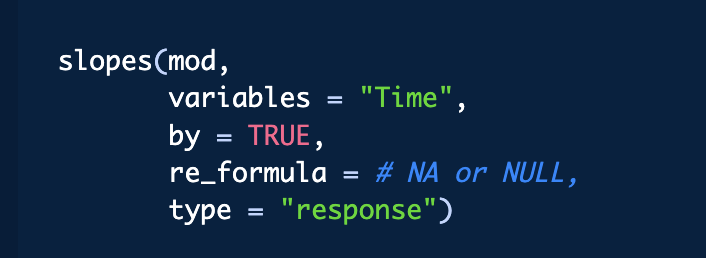
When extracting an average treatment effect (ATE) from a mixed-effect model, what is the fundamental question one should ask themselves when determining how to handle the random effects (i.e., re_formula = NA vs. NULL)? /1
#rstats
@stephenjwild@tjmahr@ajordannafa@IsabellaGhement My brain is in a pretzel (clearly). The latter seems like what we'd want for the estimand for typical RCT ATE, do you agree? Any thoughts on the fact that this (seems to) improve precision substantially?
@stephenjwild@tjmahr@ajordannafa@IsabellaGhement Okay great, pardon my ignorance (just making sure I 100% understand) - the former would refer to the ATE with re_formula = NULL, and the latter = NA?
@magelssen_chr@VincentAB@strengejacke@SolomonKurz@IsabellaGhement What a table! The thing I'm still unclear on is how "predictions" and ATE's may differ here. It's clear that NULL includes cluster specific offsets for the predictions, but is the improved precision of the ATE a "feature" or a "bug". Example with ChickWeight below:
@ajordannafa@tjmahr Interesting - in playing around with a few datasets I’ve found that the ATE’s are similar (as you suggest) but the uncertainty intervals are narrower when re_formula = NULL. Just trying to wrap my head around when that is appropriate to capitalize on
@stephenjwild@tjmahr@ajordannafa This table is awesome! (@IsabellaGhement thank you!)
@stephenjwild I know this is annoying, but if you had to boil down the the consideration of the research q / estimand into a question to ask myself to make this determination in any applied scenario - what would you ask?
@tjmahr@ajordannafa okay yep I think im following. I guess the case I’m comparing is an ATE from NA (random effects set to zero) versus one from NULL (eg state specific estimates) but then averaged across states. So maybe one step further than just the conditional predictions per cluster?
@jgeller_phd @andrewheiss @jgeller_phd thank you! @andrewheiss 's blog is awesome and one I've consulted many times throughout trying to figure this out. Helped a ton with the "what" but I feel I'm still struggling with the "why" in the case of any given research question