These and many other simulations are covered in the paper. Example notebooks for each simulation are provided in the code base, and on Google Colab (see https://t.co/mL4iIbVNpX). We hope the community will find this useful and contribute their own examples using this package.
MINFLUX works well in theory, but system and sample imperfections can lead to suboptimal resolution. To address this, @JonasRies and I developed SimuFLUX: https://t.co/z0YRKTrB8c, a realistic simulator to optimize MINFLUX experiments before samples go on the microscope.
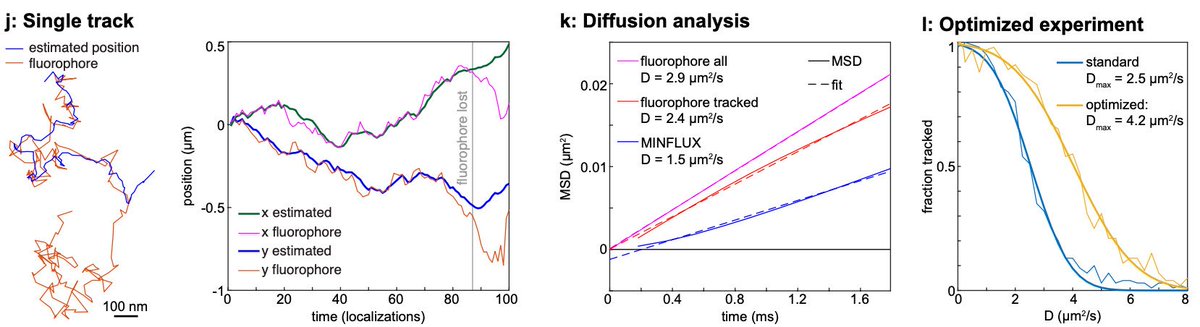
For single molecule tracking, we optimized laser power, pattern size, photon limit and pattern dwell time to increase the measurable diffusion coefficient by 70% over that captured by the standard Abberior tracking sequence.
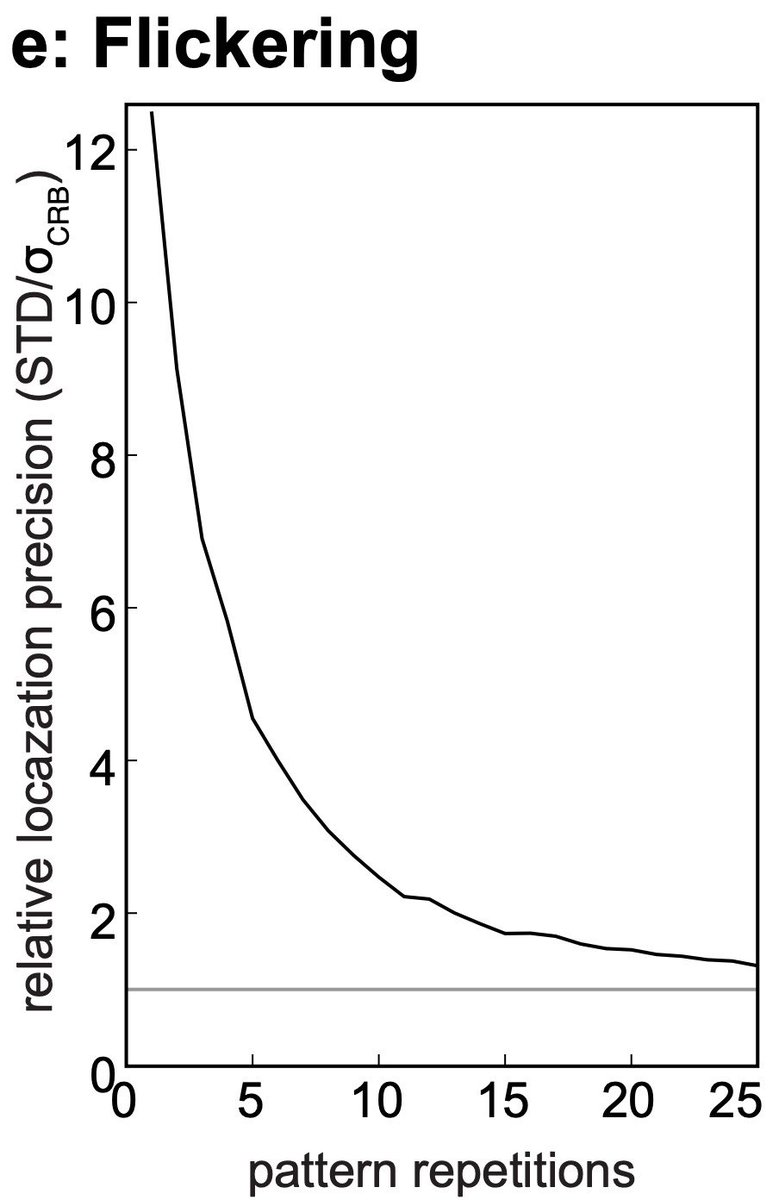
Fluorophore flickering can create up to a tenfold increase in localization precision. We showed this can be mitigated by repeated scanning of a fluorophore.
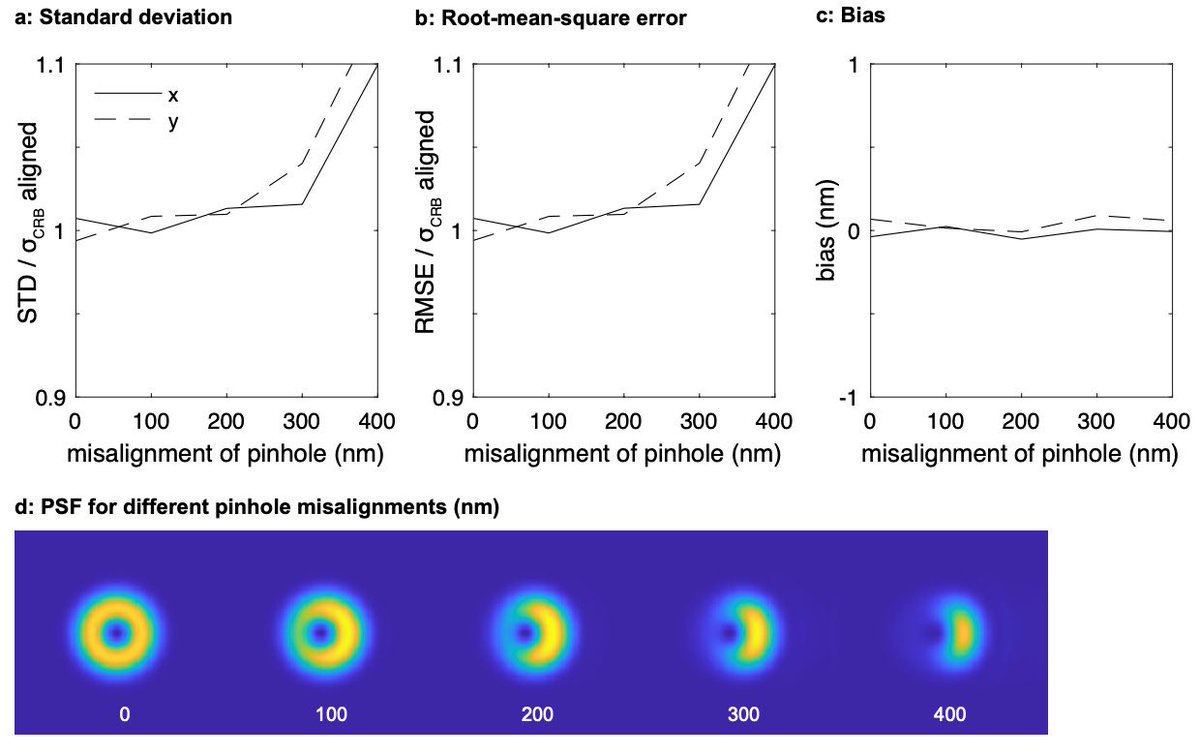
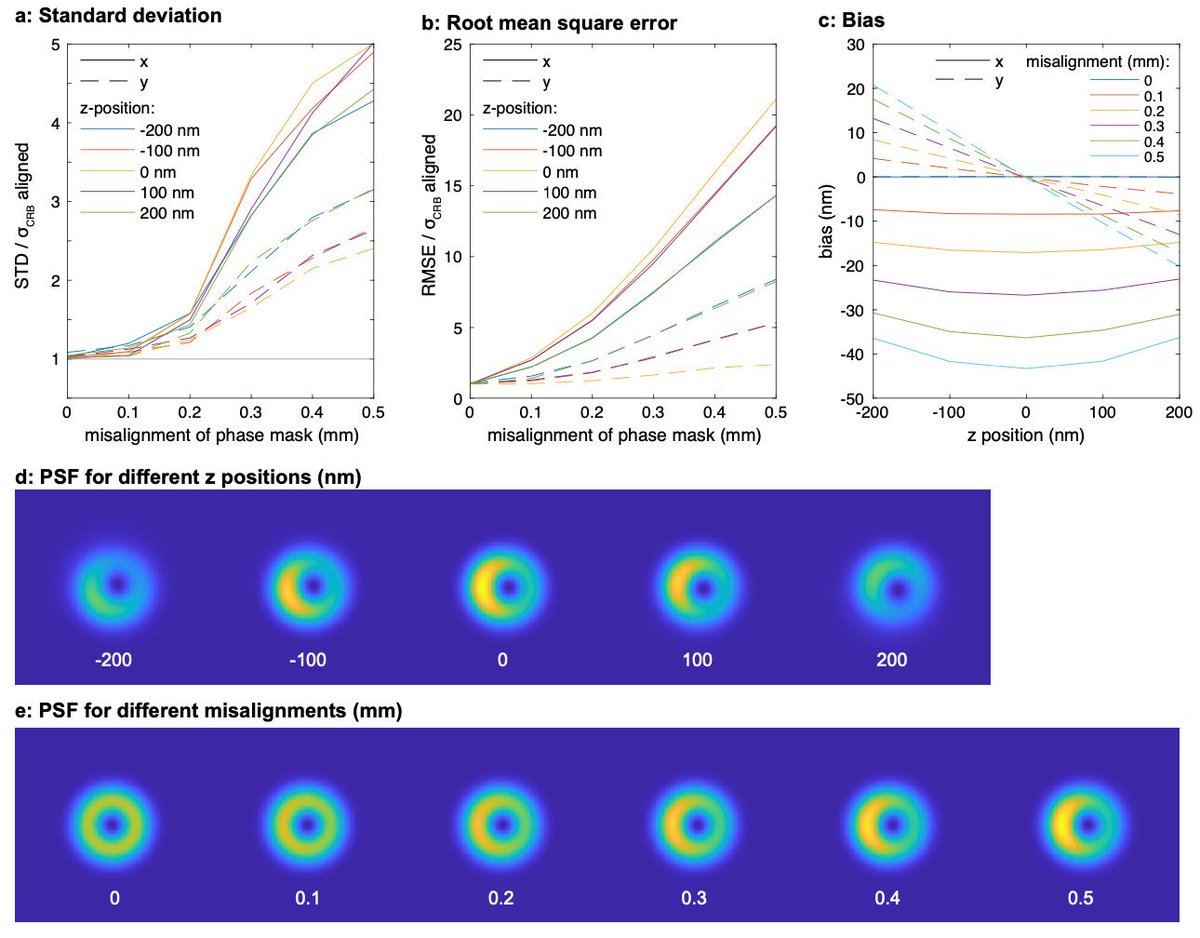
Starting off simple: misalignment of the phase pattern that generates a donut degrades performance, while misalignment of the pinhole has little effect.
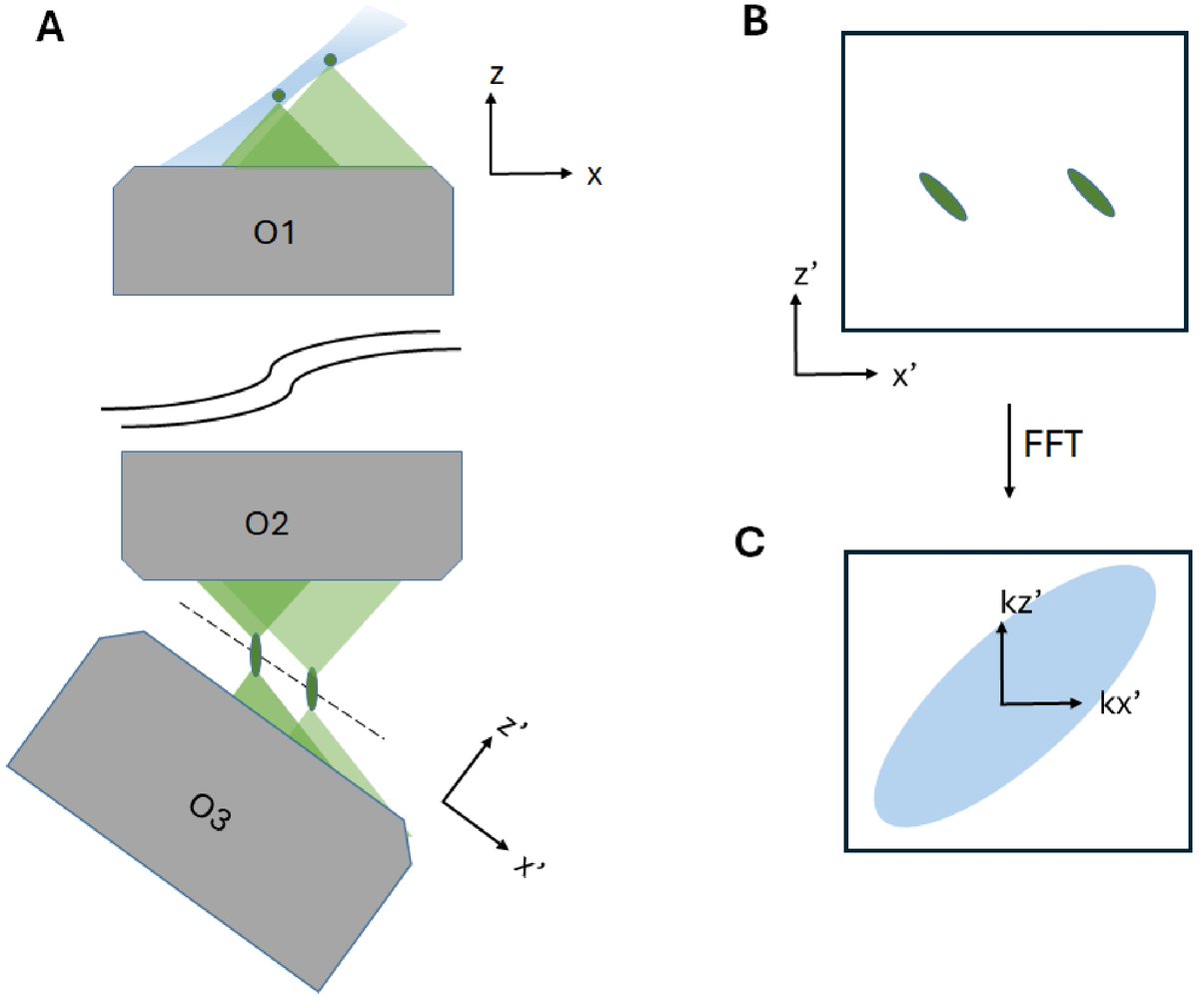
Our manuscript on accelerating OPM / SCAPE acquisition rate via aliasing is online now:
https://t.co/dS69As6Saf
Our work addresses the issue that an OPM PSF is tilted, and as such it leaves a lot of "empty space" in Fourier space (FFT of experimental data on the right)... 1/n
4Pi-SMS and pan-ExM reveal, in a close collaboration with the Rothman lab, a surprising tetraplex organization and self-assembly of rim golgins, which we believe can explain stack formation of the Golgi apparatus:
https://t.co/lxWaoCSN8T
I am happy to share our 5-year's work of manual mapping of all the native proteins in the golgin family, providing the highest resolution atlas of the Golgi apparatus to date! Yes, we can distinguish proteins at different cisternae.
I’m excited to share our latest research from @musser_lab , published today in @Nature. Using two-color 3D MINFLUX, we directly visualized nuclear import and export events through transport-active nuclear pores.
https://t.co/Qq5VtEgUVI
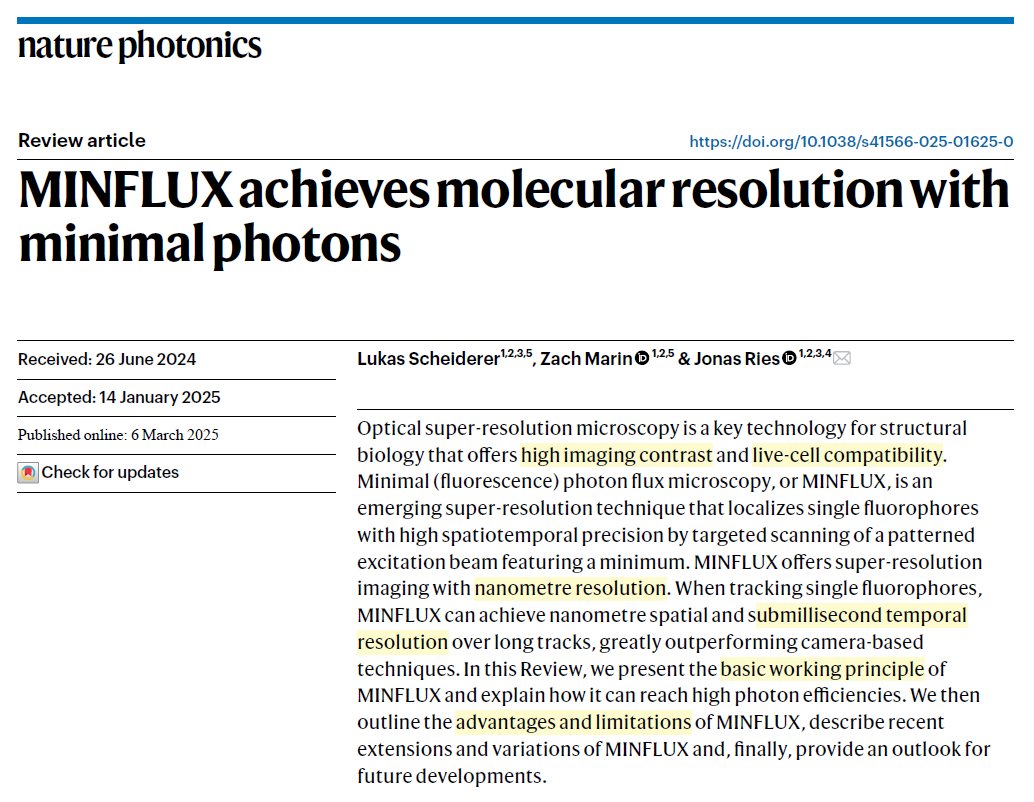
🎉Just out in @NaturePhotonics : https://t.co/24tnEIJs0Y
Our Review describing the revolutionary principle behind #MINFLUX🔬, summarizing major imaging and tracking breakthroughs and giving an outlook on future advancements.
Big thanks to @JonasRies & @zacsimile. @MaxPerutzLabs
Excited to share LUNAR (Localization Using Neural-physics Adaptive Reconstruction) —a self-supervised, blind localization method that combines neural networks & physics to estimate aberrations from overlapped blinking molecules for large DOF imaging. Great work @judefffff !