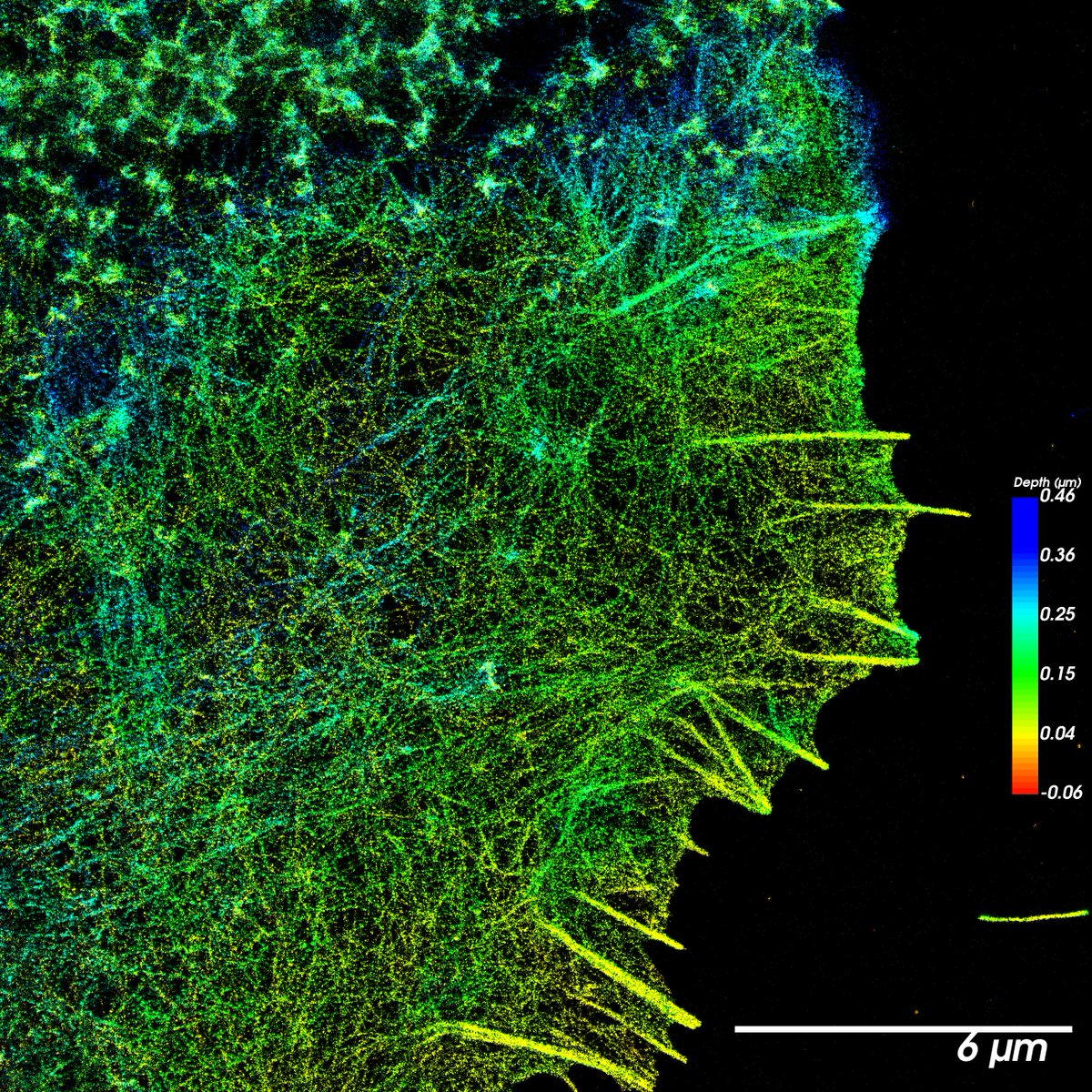
We introduce mirror-enhanced 4Pi-SMLM (me4Pi-SMLM), a streamlined single-objective configuration that leverages mirror-based retroreflection of the illumination beam to achieve near-isotropic localization precision of 2–3 nm, resolving diverse ultrastructural features.
Rubisco is (arguably) the most abundant protein on Earth. (LPP surely comes close, right?) It’s an enzyme that fixes CO₂ into sugars during photosynthesis.
Unfortunately, as most people learn in school, Rubisco is inefficient. Sometimes it confuses O₂ for CO₂ and wastes energy. Plants make up for this in raw concentration; up to half the soluble protein in a leaf is Rubisco.
People have been trying to engineer better Rubiscos for many decades, but it's not easy because the proteins are big, do not fold easily (they need chaperone proteins to help out), are made from 16 subunits in land plants.
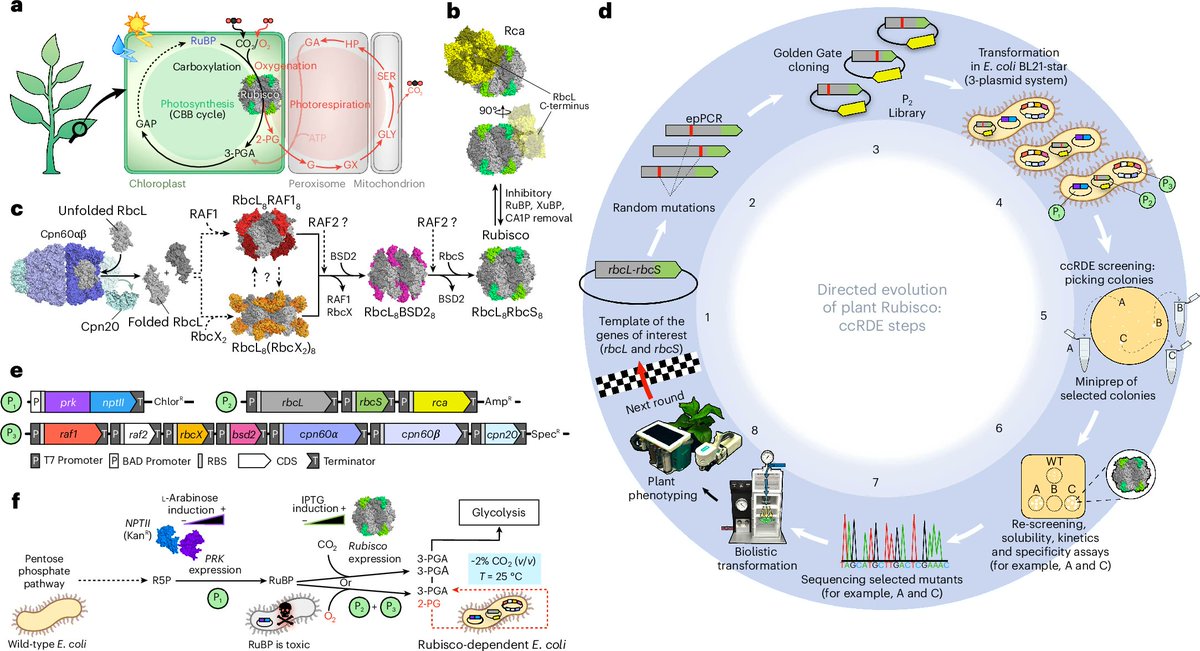
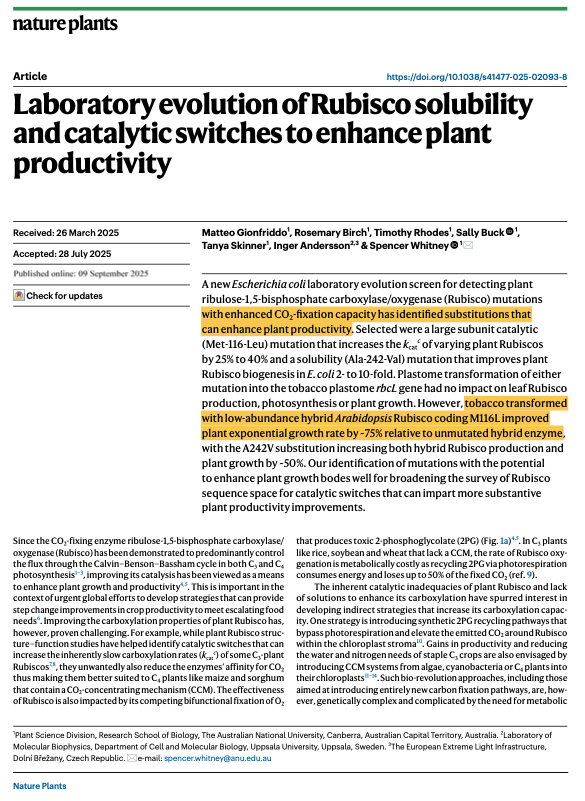
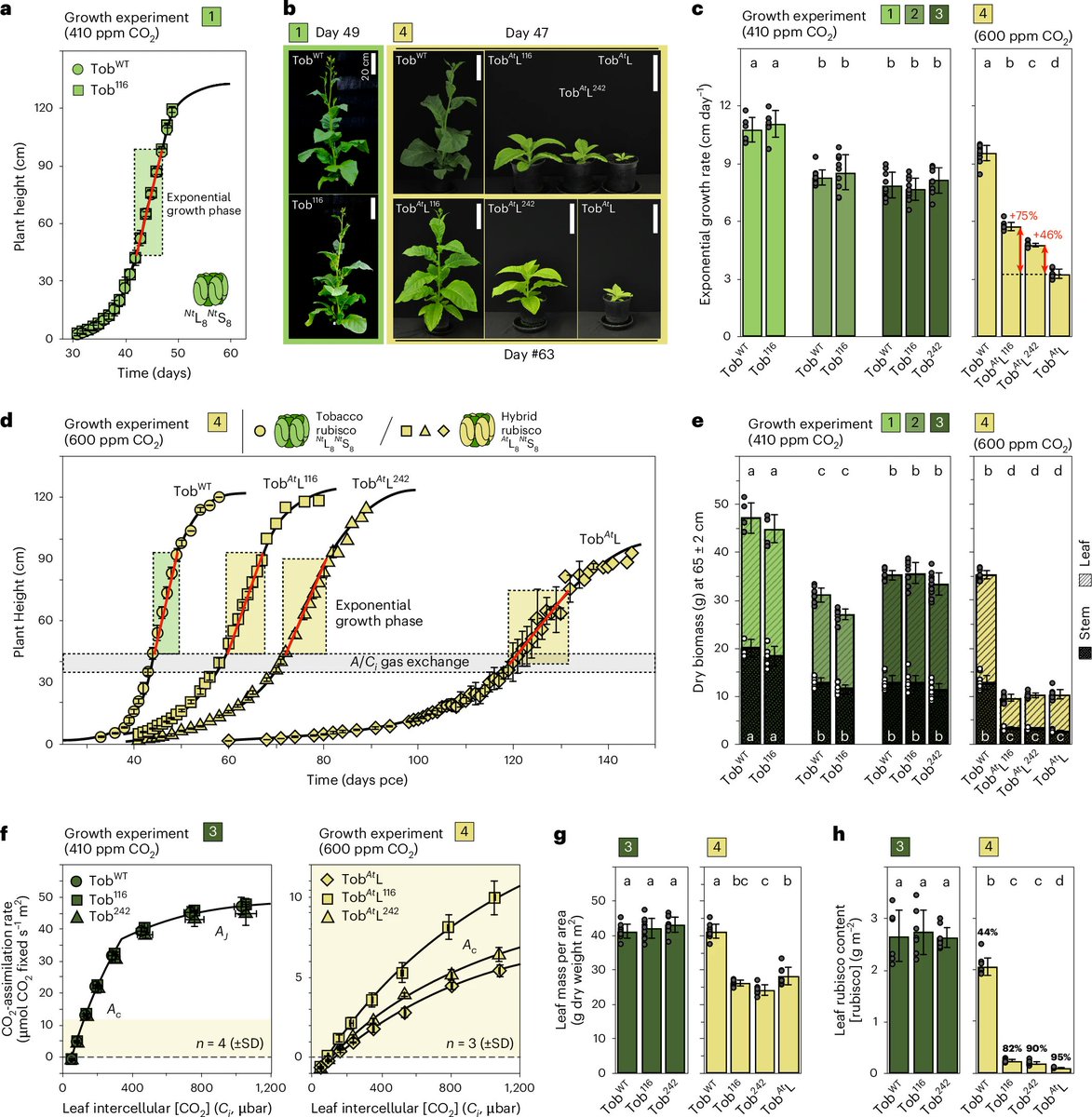
But there's a new paper in Nature Plants that looks really interesting. The TL;DR is that a group in Australia figured out how to express plant Rubiscos (and all SEVEN of their folding chaperones) using a set of 3 plasmids inside of E. coli cells. This enabled them to do "directed evolution" of Rubisco in bacterial cells, and quickly find Rubisco mutants that have higher enzymatic efficiency or that fold better.
In addition to the 3 plasmids, the researchers also coaxed E. coli to make ribulose-1,5-biphosphate, or RuBP, which is the 5-carbon sugar that Rubisco smashes into carbon dioxide to make molecules of 3-PGA for central metabolism.
Now, the clever bit is that you RANDOMLY MUTATE the three plasmids encoding the Rubisco to make millions of variants. Then, you transform those mutated plasmids into E. coli. If the E. coli do NOT make a functional Rubisco, RuBP levels build up and kill the cell; the molecule becomes toxic. But if the E. coli DO make a functional Rubisco, then they keep the RuBP levels in check and live just fine.
Using this "screening assay," the researchers found 46 fast-growing colonies of E. coli. Two of those colonies encoded really useful mutations. One mutation (M116L) makes Rubisco about 25–40% faster. The other (A242V) makes it fold and assemble much more efficiently.
They put this mutation into a "hybrid Arabidopsis–tobacco Rubisco," put that into tobacco plants, and measured growth. The plants with M116L grew 75% faster than wildtype.
No guarantees this will scale to more useful crops, like wheat and corn and soybeans etc. But it seems like a nice in vitro assay for faster prototyping!
Pan-ASLM: a high-resolution and large field-of-view light sheet microscope for Expansion Microscopy
from @bewersdorflab
https://t.co/PB2ctYUuQx
Given that they built an ASLM, I have no more excuses left for not building a 4Pi microscope...
We introduce a new tool to study F-actin remodeling, ADPact, a peptide sensor of ADP-actin. Unlike Lifeact and Phalloidin, which bind both ATP- and ADP-actin, ADPact only detects ADP-actin. It neither overlaps with cofilin nor affects treadmilling 🙌🤗. https://t.co/py31d9v5CX
Majority of data never get the opportunity to be published. This is F-actin clearly organized in two modes, clusters or meshes, possibly mediated by formins and Arp2/3.
There are so many weird Biology quirks that I somehow missed before and am only just finding now...
Apparently translation can and *does* initiate from EVERY codon
With the caveat that any codon other than the canonical AUG / GUG / UUG options induce transcription at such wildly inefficient rates that they are nearly undetectable
But they DO happen 🤯
I wonder what weird and rare products might be floating around in our bodies, some of which might even be really important
Excited to share our pre-print on the molecular architecture of heterochromatin in human cells🧬🔬
w/ @jpkreysing, Johannes Betz,Turoňová lab, @MarinaLusic, Hummer lab, @Beck_Laboratory, @MPIbp
🔗 Preprint here: https://t.co/0tTxZcu0Vz
MINFLUX works well in theory, but system and sample imperfections can lead to suboptimal resolution. To address this, @JonasRies and I developed SimuFLUX: https://t.co/z0YRKTrB8c, a realistic simulator to optimize MINFLUX experiments before samples go on the microscope.