The EU deeply regrets the decision by the United States to impose sanctions against International Criminal Court (ICC) President Judge Tomoko Akane and Senior Trial Lawyer Abdoulaye Seye.
Read the full statement by HR/VP @kajakallas here: https://t.co/dpxxWLxTs3
President @vonderleyen and I stand firmly with the @IntlCrimCourt, President Tomoko Akane and the officials who uphold its mission.
The ICC helps deliver justice to the victims of some of the world’s most horrific crimes.
To carry out this essential work, its judges and officials must be able to act independently and without external pressure.
European Commission President Ursula von der Leyen and European Council President António Costa threw their weight behind the International Criminal Court today, after Washington sanctioned its president and another senior court official.
https://t.co/dgslLnVE4t
Avec l’AI Act, l’Europe est la seule au monde à savoir à la fois protéger et innover.
L’un ne se fait pas au détriment de l’autre.
Cette souveraineté ne se négocie pas, elle s’exerce 🇪🇺
Ma tribune dans @Grand_Continent 👇
https://t.co/VTa9d1rDAr
Brexit has been a disaster for our city and country.
I welcome steps to strengthen our relationship with the EU that help businesses grow and create jobs.
From architects and engineers to tech firms and creatives, London thrives when talent can work across borders.
Derrière Ceuta, la leçon de sang-froid de Pedro @sanchezcastejon, qui n’a pas cédé à la démagogie face à une attaque hybride inédite.
En creux, le silence assourdissant de l’Europe devenue désunie… par calcul politicien.
Mon analyse @Grand_Continent👇
https://t.co/9LcSU5yC9k
On aurait pu s'attendre à ce qu'un tel article paraisse dans Libé, Mediapart, Libération... mais certainement pas dans le FT, tant son ton dénonce brutalement le capitalisme américain comtemporain, allant jusqu'à avancer que "contrairement aux barons voleurs du passé, qui étaient souvent charitables et donnaient généreusement aux institutions publiques, les milliardaires de la tech actuels affichent une indifférence totale envers toute forme de contrat social et envers la nécessité de « compenser les personnes pour les perturbations qu'ils ont apportées dans leur vie". Et il est exact, Carnegie, Rockefeller, Pierpont Morgan... étaient célébrés pour leur philanthropie. En témoignent les nombreuses universités, hôpitaux bibliothèques au travers de tout le pays. Leurs équivalents de la technologie non seulement n'ont pas réellement pratiqué la philanthropie (à part de notables exceptions comme l'ex-femme de Jeff Bezos, Bill Gates ou encore Mark Benioff), mais ils ont cherché autant que possible à limiter les dépenses sociales de l'Etat. En favorisant la fin de "l'Obamacare" (ACA) ou en créant le DoGE, l'agence dirigée un temps par Musk et chargé de démanteler l'administration sociale et d'Etat autant que possible, ils ont clairement affirmé leur souhait d'un capitalisme exclusif et par ailleurs oligarchique.
La dénonciation d'ailleurs ne vise pas que le mandat de Trump. Elle vise une lente dérive qui a vu les 0,0002% des américains posséder de 3% de la richesse du pays, il y a quarante ans, à plus de 20% aujourd'hui. Parmi les éléments clés se trouvent les superPAC : la possibilité de donner sans limite pour une cause politique. SuperPacs qui seront autorisées par la cour suprême dès 2010, permettant ainsi aux 100 milliardaires les plus riches de sponsoriser à hauteur de 2,4Mds de dollars les candidats à l'élection de 2024. l'influence de ces acteurs - dont les plus emblématiques viennent désormais du monde de la technologie et de l'IA. Le cabinet de Trump lui même est essentiellement composé de milliardaires, ce qu'il revendique comme une vertu, mais que les chercheurs, d'UCLA et d'ailleurs, dénoncent comme une source de corruption majeure.
On peut, comme c'est parfois fait, me faire observer que "je me gauchise". La réalité est que c'est plutôt le contexte qui a changé. Une newsletter que je reçois (celle de Guy Hervet "une semaine aux Etats-Unis" NDRL) observe que cette "économie américaine est structurée par une concentration de marché extrêmement forte, secteur après secteur. L’indicateur le plus utilisé par les économistes industriels, le CR4 - la part de marché cumulée des quatre plus grandes entreprises d’un secteur - dessine un paysage saisissant : dans la recherche en ligne, les réseaux sociaux, les systèmes d’exploitation, les paiements électroniques, les télécommunications ou les processeurs pour l’intelligence artificielle, on est dans le quasi-monopole pur : plus de 90 % du marché tenu par quatre acteurs, adossés à des effets de réseau et des rachats de startups et de concurrents à tour de bras, qui verrouillent durablement la position des leaders." Il me semble que c'est tout le contraire du capitalisme réel, qui limite les trusts et les abus de pouvoirs. Nous sommes face à une ploutocratie dans sa forme aboutie et c'est particulièrement inquiétant alors que se profile d'importantes créations de richesse avec l'IA. Le risque étant évidemment que cette valeur aille de façon disproportionnée vers le capital concentrée plutôt que le capital déconcentré et le travailleur. https://t.co/IzwLwefm9X
What did Europe learn - if anything - from Ceuta?
With another Ceuta crisis possible as soon as 15 August, last week’s events exposed Europe’s vulnerability to migration pressure amplified online.
Here’s 10 lessons Europe must learn before the next Ceuta.:
1. The EU Commision must do its job, by enforcing the Schengen code (vs Italy) thus preempting retaliatory border controls (vs Spain) @vonderleyen
2. Solidarity first towards a Member State facing pressure at an EU external border despite disagreemwnt on its migration policies @GiorgiaMeloni
3. Internal Schengen border checks must remain a last resort and be evidence-based @magnusbrunner
4. Tackle migration, online smuggling and hybrid threats together while protecting fundamental rights @HennaVirkkunen
5. Regularisation of migrants is not uniquely Spanish. Most EU governments do, without saying @GiorgiaMeloni@Antonio_Tajani
6 EU migration ‘partnerships’ with third countries create Europe’a dependencies on those countries that can be weaponised any time @dubravkasuica
& many more
Read my latest @Substack
https://t.co/hv0oMOy7WZ
Europeans are getting a taste of what the EU could look like if the hard right runs it:
No free movement. A race to the bottom on standards. And a lawless space where Europe’s worst enemies can divide and conquer.
The Ceuta–Italy spat was largely provoked by an EPP-led Commission that has not only failed to act against Italy’s unlawful checks, but has fuelled the tit-for-tat by siding with the 22-member-state letter blaming Spain.
Yet despite this unprecedented politicisation of EU law enforcement, no mainstream party - not the S&D not the liberals (having mostly joined that letter) or the Greens - is holding the Commission to account.
That’s the real danger for Europe: not just the hard right’s agenda, but its mainstream parties failing to defend European integration and, in doing so, helping dismantle it themselves while strengthening Europe’s worst enemies.
Le minacce per l’Europa non arrivano dai migranti di #Ceuta, rimpatriati in 48 ore, ma da chi li ha usati per alimentare sfiducia e paura: dall’esterno, il mondo Maga e i troll di Mosca, pronti ad attaccare la Spagna e a diffondere l’idea dell’”invasione”; e dall’interno, da parte di chi - Italia in testa - ha strumentalizzato i fatti per piccole rendite elettorali, in spregio ad ogni solidarietà.
Non si rendono conto di fare il gioco di chi vuole un’Europa divisa e più debole. O forse sì, ed è questo il loro intento.
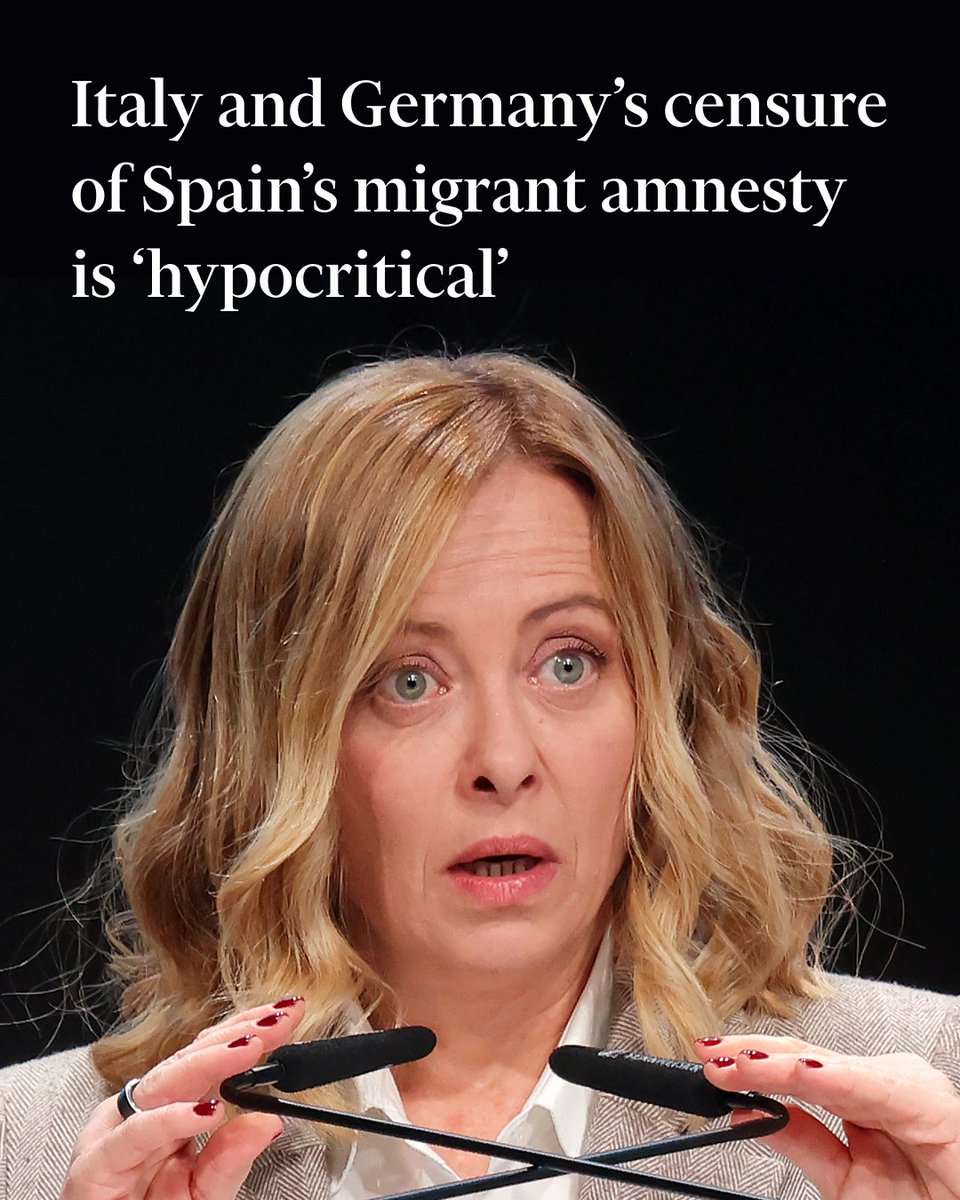
Italy, Germany and other countries that accused Spain of attracting migrants with its amnesty scheme have also quietly legalised the status of people who arrived irregularly in their own territory. https://t.co/qyXCOjNgWL
French interior Minister on Ceuta after meeting with EU counterparts
"The problem isn't Schengen. Schengen is the solution. Schengen didn't let a single person from Ceuta onto the Spanish mainland. The problem is "outside interference" whipping up divisions within Europe"
EU home affairs ministers addressed current developments in Ceuta in a video conference.
They expressed strong solidarity with Spain, commended its authorities' swift reaction and discussed further coordination to protect EU’s external borders.
See → https://t.co/fSE5HjhK9T
Mi evito il tweet e ripropongo questo che dice la verita'.
@GiorgiaMeloni e @Antonio_Tajani (mani flaccide nemmeno lo considero): ancora una volta avete danneggiato l'immagine dell'Italia nel mondo per i vostri, miserabili, interessi elettorali.
Esattamente come accadde con #Trump, il quale vi ha poi ripagato con la moneta che vi meritate.
I paesi dell'UE, alla fine, vi hanno di nuovo dato una lezione, di stile oltre che di senso dello stato.
Ora, almeno, togliete quegli offensivi e dannosi controlli verso i cittadini spagnoli negli aeroporti italiani!
Ci avete fatto vergognare gia' abbastanza.
Like many Europeans, I felt deep unease, not only at the deaths in Ceuta, but at Europe’s dehumanised response.
EU leaders fell into the trap of treating the crisis as an invasion, despite signs that it had been fuelled by a third-country-led social-media campaign intended to provoke precisely that reaction.
By embracing this dystopian narrative, they turned desperate people into invaders, abandoned European solidarity and helped create the image Europe’s worst enemies want: a frightened, divided continent betraying its own values under pressure.
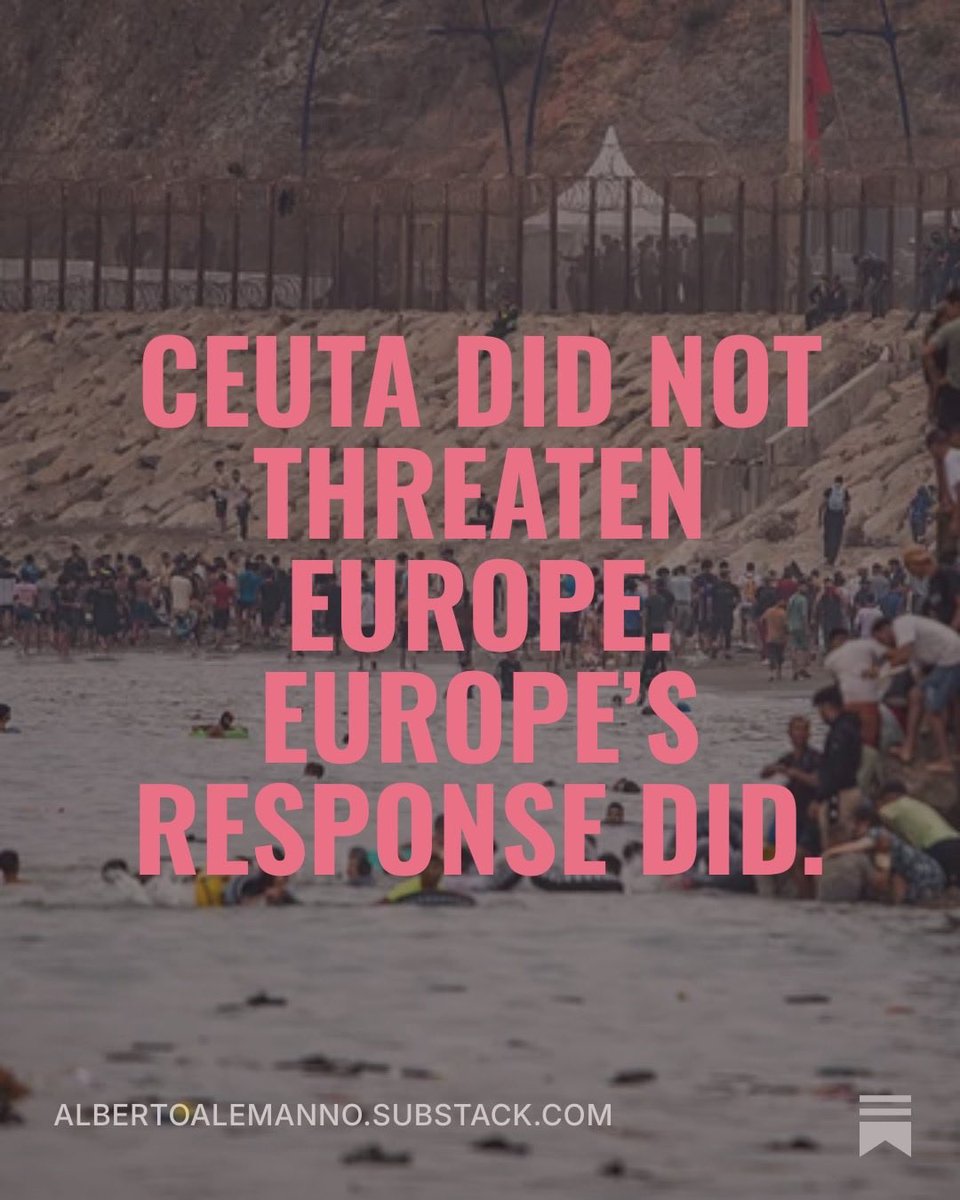
Ceuta did not threaten Europe. Europe’s response did.
As EU Interior Ministers meet today #EUCO, READ my latest https://t.co/ebuofYbso2
La crisi di Ceuta appare come una crisi migratoria, ma dietro la schermata iniziale c’è la storia di un’Europa minacciata tanto esternamente – da Mosca e Washington – quanto internamente dal nazionalismo e dall’estremismo, e il suo intrinseco anti-patriottismo. Oggi su La Stampa
⚠️ We have fined Google €890 million for breaching the Digital Markets Act, by promoting their own services and restricting customer access to alternatives on Google Search and Google Play.
https://t.co/zFChIQxKua
The digital euro is here to protect Europeans’ freedom to choose how they pay. In an interview with Ouest-France, Executive Board member Piero Cipollone explains how it will protect privacy, strengthen Europe’s autonomy in payments and support innovation https://t.co/kZgXXXbUvW
I signed this manifesto.https://t.co/tRNHodQATa AI is clearly a technology with extremely dangerous left tails.
Dystopian scenarios clearly have positive probability. Controlling its diffusion until the risks are better understood and potentially contained is clearly worth it.
But I have the same questions as everybody else, including the builders of the technology who signed. What does it mean to control, to contain? And can it be done?
Why did I sign this statement?
First, I had a hand in revising it, after the organizers reached out to me. I did not feel like I could sign the initial version, but I felt that finding a statement that would reflect the overlapping views of a number of AI researchers, economists, and social scientists was important.
Second, I agree with much of the revised text. Indeed, there is a possibility (or perhaps more than a possibility) that AI may become more powerful over the next 10 years. I’m still not convinced that we are going to see the very large productivity gains that industry insiders are predicting. But more powerful AI may (again no certainty, just may) lead to significant job displacement. This is a big economic and social risk.
It could also have myriad consequences on human cognition, starting with K-12 and all the way to advanced science. Some of these consequences are good, some of them are dangerous.
Third, while I do not like the comparison to the Industrial Revolution that much (feels like comparing apples to oranges to me), it is true that AI will have complex effects on the economy.
Finally and most importantly, I wholeheartedly agree with the ending: “to build the incentives, guardrails, and institutions needed to steer AI in a direction that complements humans and benefits society.”
This is what I have been arguing for over a decade now. Good AI needs to complement humans, and this requires a redirection, because the current focus on AGI is, in all but name, an agenda for displacing humans from meaningful work. That’s why steering AI must be a first priority.
I’m happy that many thought leaders have agreed.