SAM BANKMAN FRIED PICKED EVERY WINNER OF THE 2020s AND HIS LAWYERS SOLD THEM ALL AT THE BOTTOM.
If the FTX estate hadn't panic-sold its assets during bankruptcy, SBF would be sitting on a $114 billion empire today. Instead, he is watching the greatest trades of the decade from a prison cell.
The data is almost impossible to believe:
- Anthropic: $82.3 billion (165x) SBF bought an 8% stake for $500M. The estate sold it for $1.3B in 2024. Today, that stake would be worth over $80B.
- SpaceX:$15 billion (75x) A massive stake liquidated early to pay creditors.
- Solana: $5.1 billion (27x) SBF was an early backer at $8. The estate offloaded a massive chunk at $64.
- Robinhood: $4.9 billion (8x)
- Genesis Digital: $3.5 billion (3x)
The Latest "Missed" Fortune: CURSOR
In 2022, Alameda Research wrote a tiny $200,000 check for a 5% stake in the AI startup Cursor. In April 2023, the bankruptcy estate sold that entire stake back for exactly what they paid: $200,000.
Yesterday, SpaceX announced a deal to buy Cursor for $60 billion.
That "worthless" 5% stake would be worth $3 billion today. That is a 15,000x return that vanished because the lawyers wanted a quick exit.
SBF was a genius at picking generational winners and a criminal at managing their money.
The lawyers recovered $18 billion for users. If they had just held, they would be sitting on $114 billion and the most valuable venture portfolio in history.
BREAKING: The SEC has reportedly eliminated the Pattern Day Trader rule, replacing it with a new intraday margin system.
The requirement to maintain a $25,000 balance to engage in day trading is being scrapped.
🚨 THE FED IS NOW PRIVATELY PREPARING FOR A POSSIBLE $2 TRILLION CREDIT MARKET COLLAPSE.
For the first time in over a decade, the Fed has started directly asking U.S. banks to hand over their exposure numbers to the private credit market.
This is the exact move regulators make when they stop trusting public numbers and start preparing for real stress.
Bloomberg reported on April 11 that the Fed has formally reached out to major U.S. banks for detailed information on how much risk they're carrying from private credit firms, and whether stress inside that sector could spread into the wider financial system.
Here's why this is happening now.
Over the past few weeks, three of the largest private credit funds in the market have limited investor withdrawals:
- Blue Owl Capital restricted redemptions on its $14B fund
- BlackRock capped withdrawals on its $26B HPS Corporate Lending Fund after investors requested $1.2B in redemptions
- Cliffwater capped withdrawals on its $33B fund after investors tried to pull 14% and only 7% was allowed to exit
Three of the biggest names in the industry, all hitting redemption limits within a short period. That's not random. That's investors trying to get out faster than the funds can return their money.
At the same time, Apollo executive John Zito publicly said private equity marks are wrong across the board. He said he "literally thinks all the marks are wrong."
His estimate: loans to a typical mid size software company bought between 2018 and 2022 could recover only 20 to 40 cents on the dollar in a slowdown. That implies losses of 60 to 80 percent.
So the pattern:
- Investors trying to withdraw from private credit funds
- Funds blocking those withdrawals
- A senior Apollo executive saying valuations across the industry aren't real
- The Treasury calling a meeting with insurance regulators this month to discuss the $2T private credit market
- The Fed directly asking banks for their exposure numbers
Now here's why this matters far beyond the U.S.
Private credit has grown to around $2T over the past decade, but it's not isolated. It sits in the middle of the global financial system. Pension funds, insurance companies, sovereign wealth funds, and foreign banks all have money parked in these funds because they were marketed as higher yielding and more stable than public bonds.
If valuations are revised down the way Apollo's own executive is suggesting, the losses don't stay with a handful of U.S. firms. They flow directly into:
- Public and private pension funds across Europe, Canada, Japan, and the Gulf that allocated heavily to private credit for yield
- Insurance companies, some of the largest buyers of private credit whose solvency ratios are tied to these valuations
- Banks in the U.S., Europe, and Asia that lend to the private credit firms themselves, which is exactly what the Fed is now trying to measure
Most people miss this part. A private credit fund limiting withdrawals isn't just a problem for that fund. The banks lend to the funds. The funds lend to private equity. Private equity owns thousands of mid sized companies. Those companies employ millions.
When valuations at the top are wrong, the entire chain underneath is mispriced.
The exposure also ties directly into the AI infrastructure buildout. Blue Owl alone is behind some of the largest AI infrastructure deals in the world:
- $27B joint venture with Meta in Louisiana
- $15B deal with Crusoe in Texas
- $5B backing CoreWeave
Oracle now carries over $100B in debt, much tied to AI infrastructure that will take years to generate returns. Companies like CoreWeave, Crusoe, and others are funding their buildouts through private credit rather than public bond markets.
The structure works as long as AI revenue grows fast enough to service the debt.
If it slows, the stress doesn't stay in tech stocks. It moves straight into the credit side of the system, which is the exact part the Fed is now trying to get a clearer picture of.
Globally, this is also colliding with:
- Japan dealing with the weakest yen in decades and rising bond yields
- Europe trying to manage weak growth and stretched sovereign balance sheets
- China still working through its own property and local government debt problems
- A U.S. consumer already showing signs of strain at the lower end
The world financial system has been running on elevated debt and loose valuations for years. Private credit is one of the largest and least transparent parts of that system.
If the valuations are wrong, if redemptions keep accelerating, and if AI revenue assumptions disappoint, losses could cascade through pensions, insurers, and banks across multiple countries at the same time.
Fed Chair Jerome Powell said last month he doesn't currently see private credit issues infecting the wider financial system. St. Louis Fed President Alberto Musalem said stress is "largely limited" to the sector.
But the fact the Fed is now pulling exposure numbers directly from banks suggests the central bank wants to verify that for itself rather than take those statements at face value.
And this happens when regulators are no longer comfortable being surprised by what they find later. If stress inside this $2T market turns into actual losses, it won't stay inside the U.S., and it won't stay inside one sector.
It will move through pensions, insurers, banks, and AI infrastructure debt across the global system at the same time.
BREAKING: Anthropic's new model, Claude Mythos, is so powerful that it is not releasing it to the public, per NYT,
Instead, it is starting a 40-company coalition, Project Glasswing, to allow cybersecurity defenders a head start in locking down critical software.
🚨 EVERY COUNTRY'S STOCK MARKET IS CRASHING.
$12 TRILLION GONE IN ONE MONTH.
THE 2008 COLLAPSE HAS BEGUN.
Here's what's happened to EVERY major stock market since war started:
🇺🇸 S&P 500 — DOWN 7% (down 8.5% from all-time high)
🇺🇸 Nasdaq — DOWN 12.4% — OFFICIALLY IN CORRECTION TERRITORY
🇯🇵 Nikkei 225 — DOWN 14.1% — biggest crash since 2022
🇭🇰 Hang Seng — DOWN 12.9%
🇰🇷 KOSPI (Korea) — DOWN 7.6%
🇮🇳 Sensex (India) — DOWN 10% IN MARCH ALONE — worst month in 6 YEARS
🇮🇳 Nifty 50 (India) — DOWN 10.5% in March
🇩🇪 DAX (Germany) — DOWN 2.8%
🇫🇷 CAC 40 (France) — DOWN 3.5%
🇪🇸 IBEX 35 (Spain) — DOWN 5%
🇨🇳 Shanghai Composite — DOWN 1.7%
🇧🇷 Bovespa (Brazil) — DOWN 4%
🇦🇺 ASX 200 (Australia) — ON TRACK FOR BIGGEST MONTHLY DROP IN 4 YEARS
⚠️ $12 TRILLION in global market value — GONE. In 30 days.
⚠️ That's more than Germany + Japan + UK's ENTIRE annual economic output. Combined.
⚠️ ANOTHER $2.5 trillion wiped from global bond markets in March.
⚠️ Brent crude oil: UP 57% since the war started. $115 a barrel.
Read that again.
Every stock market on Earth is falling.
The bond market is falling.
Oil is surging.
When stocks AND bonds fall together, there is NO safe haven.
That's not a correction. That's a crash.
⚠️ Now compare to 2008:
⚠️ In 2008, S&P 500 took 4 MONTHS to lose 10% from peak
⚠️ In this war crash, 10% is gone in ONE MONTH
⚠️ The 2008 crash took 17 months total to bottom at -57%
⚠️ At this pace, a 2008-scale crash arrives in under a YEAR
Goldman Sachs: 30% recession probability.
JPMorgan: 35% recession probability.
Moody's AI model: 48.6% recession probability.
Nearly HALF the smart money thinks we're heading into a recession.
This is wealth destruction on a scale the world has not seen since 2008.
And the real crash hasn't even started yet.
*ISLAMIC REVOLUTIONARY GUARD CORPS: ANY ARAB OR EUROPEAN COUNTRY THAT EXPELS THE AMBASSADORS OF ISRAEL AND THE UNITED STATES FROM ITS TERRITORY WILL, STARTING TOMORROW, HAVE FULL AUTHORITY AND FREEDOM TO PASS THROUGH THE STRAIT OF HORMUZ
BREAKING: The G7 countries are considering a joint release of oil from reserves, potentially as much as 400 million barrels, as oil prices skyrocket, per FT.
Details include:
1. The release would be potentially coordinated by the International Energy Agency
2. Three G7 countries, including the US, have so far expressed support for the idea
3. US officials believe a joint release in the range of 300m-400m barrels is appropriate
4. G7 countries currently hold 1.2 billion barrels of oil in the reserve
Oil prices are back below $108/barrel on the news.
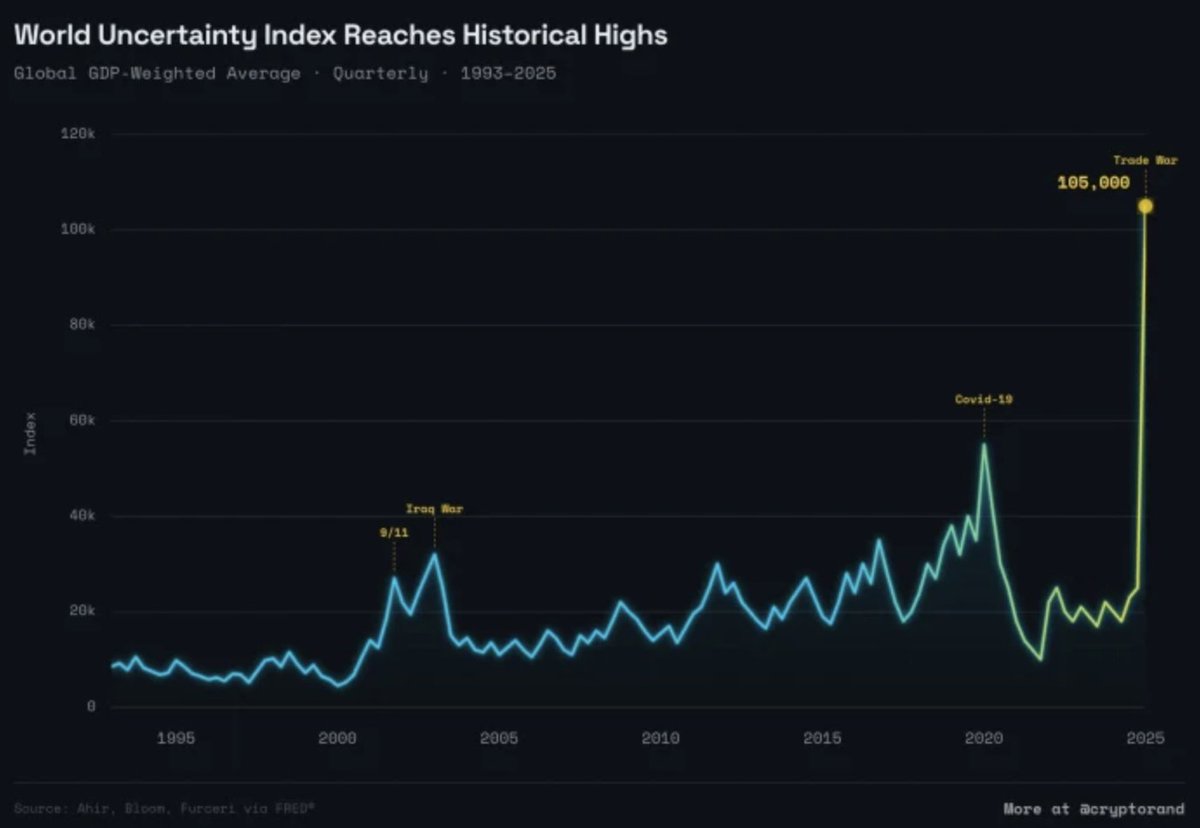
BREAKING 🚨: The World
The World reaches highest level of uncertainty in history, surpassing Covid, the Global Financial Crisis, and the Dot Com Bubble 👻🤯👀
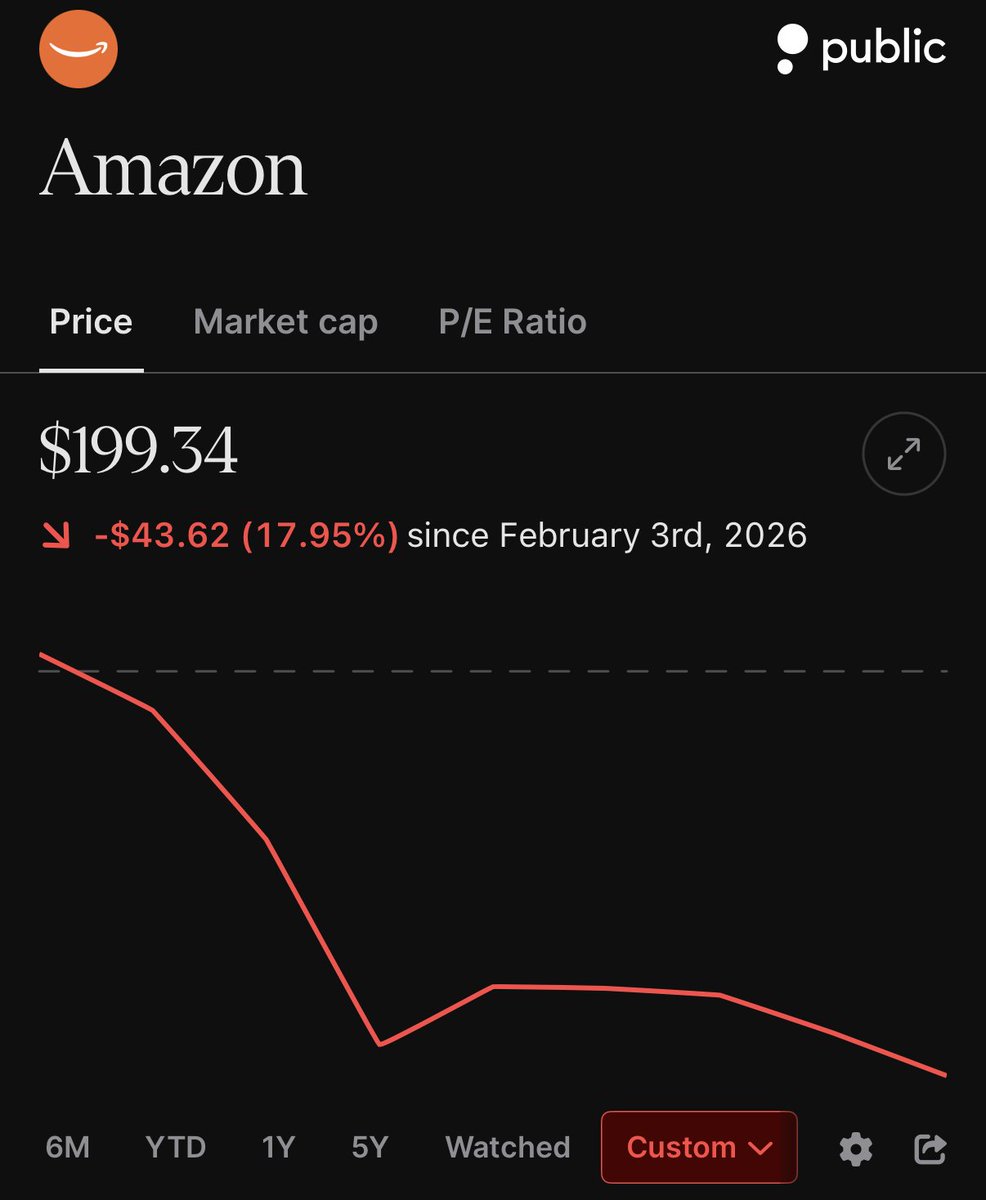
Amazon $AMZN is on pace for its longest losing streak in 20 years.
The stock has lost 18%, erasing $470 billion in value, as investors fret over $200 billion in planned 2026 spending on data centers, chips, and AI.
Time to buy the dip?
We are now currently in the last quarter that Warren Buffett will be the CEO of Berkshire Hathaway $BRK.B
Buffett will remain as the Chairman of Berkshire Hathaway's board of directors going forward
Eli Lilly $LLY just announced plans to build a new $6.5 billion manufacturing facility in Houston, Texas
"This planned next-generation synthetic medicine active pharmaceutical product (API) facility, the second of four new U.S. sites Lilly will announce this year, will focus on manufacturing the company's pipeline of small molecule medicines across therapeutic areas, including cardiometabolic health, oncology, immunology and neuroscience. It is expected to be operational within five years."