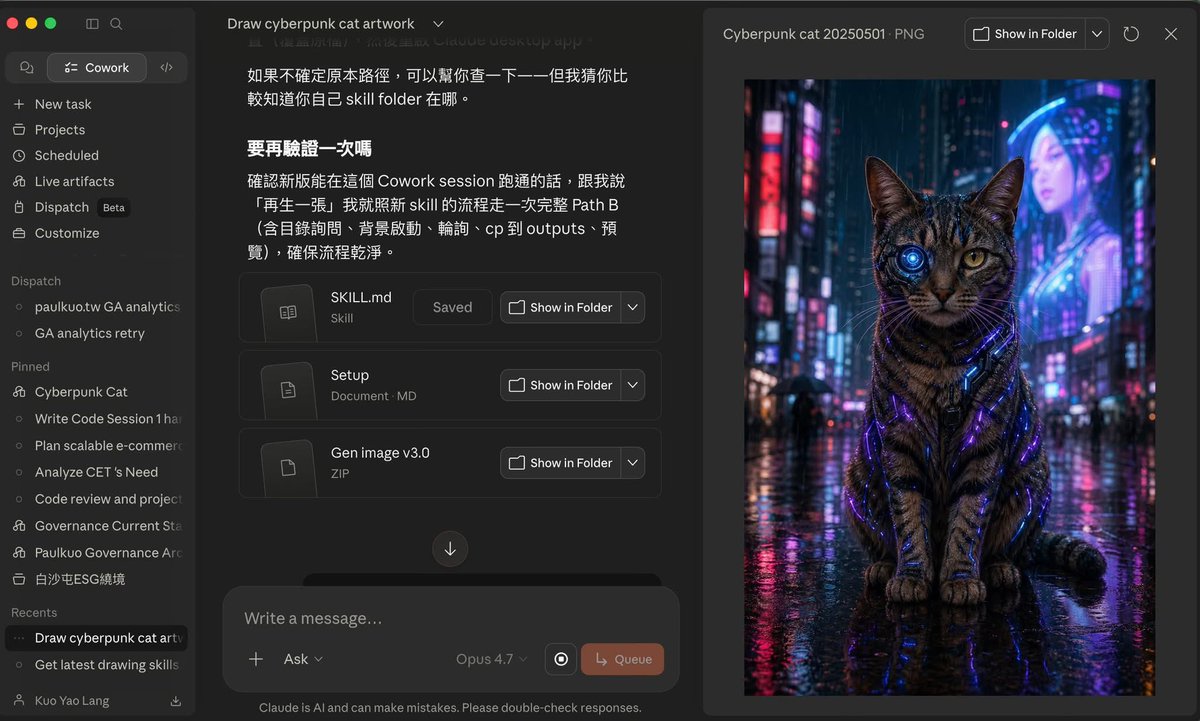
This is a new paradigm for interacting with Claude that is significantly more "inline" with all the other human activity org-wide. Once you do all of the under the hood engineering work to make this "just work" (e.g. across tools, integrations, compute environments, memory, security, etc.), Claude basically joins the team in a seamless way - you can talk to it as you would talk to a person and it can help with a very large variety of workloads.
Imo this is the 3rd major redesign of LLM UIUX. The first paradigm was that the LLM is a website you go to, the second was that it is an app you download to your computer. This third one is that it is a self-contained, persistent, asynchronous entity with org-wide tools and context, working alongside teams of humans. It really takes a while to wrap your head around it, but it works and it is awesome.
Andrej Karpathy spent 70 minutes breaking down how top AI users actually work with LLMs.
The reality is simpler than people expect. You tell the model what you want in plain language and let it run.
No 40-line system prompts. No secret tricks.
By 2026 the engineer who writes off LLMs loses to the junior who just set one up properly.
70 minutes. Free. A rare straight look from an OpenAI co-founder.
Bookmark it and watch.
Andrej Karpathy: "90% of Claude's mistakes come from missing context, not a weak model."
41% mistake rate without a CLAUDE.md. 11% with the 4-rule baseline. 3% with the 12-rule version below
here are the 12 rules senior engineers settled on:
1. think before coding: state assumptions, don't guess. the model can't read your mind, stop hoping it will
2. simplicity first: minimum code, no speculative abstractions. the moment you let Claude add "for future flexibility," you've added 200 lines you'll delete next quarter
3. surgical changes: touch only what you must. don't let it improve adjacent code, that's how PRs blow up
4. goal-driven execution: define success criteria upfront, loop until verified. without them Claude either loops forever or stops too early
5. use the model only for judgment calls: classification, drafting, summarization, extraction. NOT routing, retries, status-code handling, deterministic transforms. if code can answer, code answers
6. token budgets are not advisory: per-task 4000, per-session 30000. by message 40 of a long debug, Claude is re-suggesting fixes you rejected at message 5
7. surface conflicts, don't average them: two patterns in the codebase? pick one. Claude blending them is how errors get swallowed twice
8. read before you write: read exports, callers, shared utilities. Claude will happily add a duplicate function next to an identical one it never read
9. tests verify intent, not just behavior: a test that can't fail when business logic changes is wrong. all 12 of Claude's tests can pass while the function returns a constant
10. checkpoint every significant step: Claude finished steps 5 and 6 on top of a broken state from step 4. nobody noticed for an hour
11. match the codebase conventions: class components? don't fork to hooks silently. testing patterns assumed componentDidMount, hooks broke them without surfacing
12. fail loud: "completed successfully" with 14% of records silently skipped is the worst class of bug. surface uncertainty, don't hide it
what actually compounds instead of the next framework:
- the CLAUDE.md file as institutional memory across sessions
- eval-driven changes, not vibe-driven
- checkpoints over speed
- explicit conflicts over silent blending
- discipline over framework, every time
- one repo, one rules file, no exceptions
you don't need a better AI
you need better context engineering
complete playbook below ↓
Boris Cherny,Claude Code 的創始人和負責人,剛剛轉發了 Claude 官方的消息。
Claude 官方宣布,接下來一個月會把 Claude Cowork 的使用額度加倍,也就是提高到原本的 2 倍。這次放寬特別適用於原本每 5 小時的使用限制。換句話說,在未來一個月內,使用者可以在同樣的時間區間裡,把更大、更複雜的任務交給 Claude 處理,不會那麼快碰到使用上限。
Claude 官方的說法是:「Delegate bigger, more complex tasks to Claude。」也就是鼓勵使用者把更大、更複雜的任務交給 Claude。如果你手上一直有那種大型、複雜、甚至有點混亂的專案,現在就是很適合拿出來交給 Claude 測試的時候。
鼓勵大家把複雜的工作流、程式專案、文件整理、研究任務,交給 AI 來協作完成。換句話說,AI 工具正在加速從「聊天助理」往「任務型工作夥伴」前進,成為每個人的數位助理。
從另一個角度看,面對 Codex、Antigravity 等其他 AI 工具與開發環境的挑戰,各家都在加速奔馳。這則訊息不只是一次單純的使用量放寬,也是清楚的產業訊號:AI 工具之間正在進入一種共同演化的階段。
大家一邊競爭,一邊推動彼此往更高強度、更長時間、更複雜任務的協作能力前進(需要燒更多Token, 有更多晶片的需求)。
最後一句是重點。
https://t.co/Z0aShi9zZ4
Our internal data shows Claude is accelerating AI development—a possible path to recursive self-improvement, or AI autonomously building a more capable successor.
It’s happening faster than we thought, and the implications deserve greater attention. https://t.co/OVVPJO7VQx
Anthropic co-founder Chris Olah was invited to speak at today's presentation of Pope Leo XIV's encyclical "Magnifica humanitas."
Read the full text of his remarks: https://t.co/CoBfkVOVcy
have been excited for realtime voice-to-voice translation as an AI application since we started OpenAI. extremely cool to see it now available in the API for anyone to build with:
New Anthropic research: Project Deal.
We created a marketplace for employees in our San Francisco office, with one big twist. We tasked Claude with buying, selling and negotiating on our colleagues’ behalf.
Introducing Claude Managed Agents: everything you need to build and deploy agents at scale.
It pairs an agent harness tuned for performance with production infrastructure, so you can go from prototype to launch in days.
Now in public beta on the Claude Platform.