econ of aging (topics: work and retirement, tech/A.I., pension, immigration) | Assistant Prof @LKYSch @NUSingapore | PhD @USCPrice MS @Cornell BA @DukeU
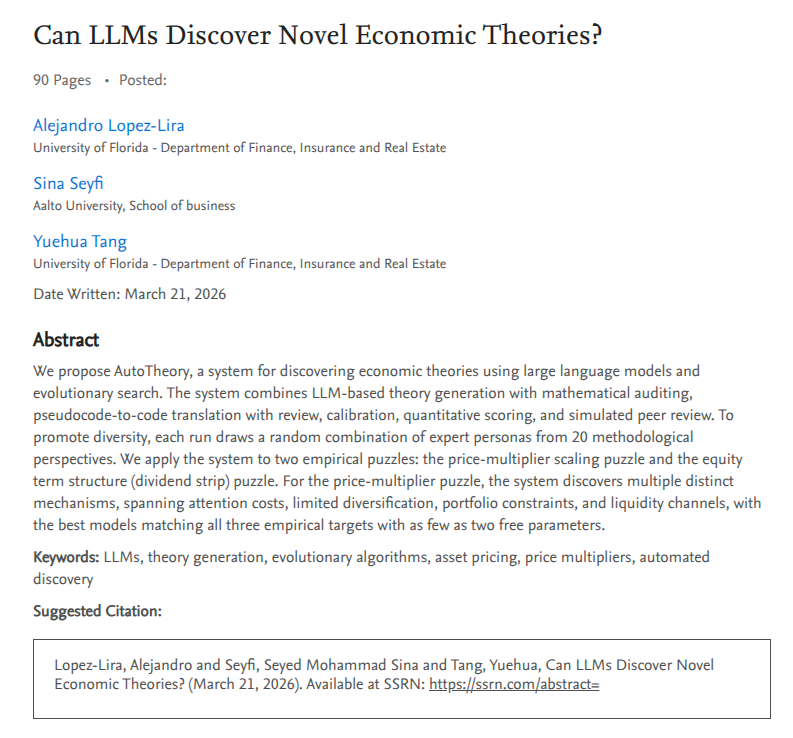
We are one step closer to replacing researchers with autonomous LLM systems. New paper: "Can LLMs Discover Novel Economic Theories?" with Sina Seyfi and Yuehua Tang. https://t.co/lnwoQ0TP9F
AutoTheory uses LLMs and evolutionary search to automate the creative stage of theoretical research: the part where a researcher stares at a puzzle, draws on intuition, and iterates until a mechanism clicks. That process is powerful but slow, sequential, and bottlenecked by human bandwidth.
Give it an empirical puzzle with quantitative targets a baseline model can't match, and the system proposes, codes, calibrates, and evaluates candidate theories at scale. No hand-holding. It runs end-to-end from puzzle specification to scored, refereed candidate mechanisms. The system generates hundreds of candidate theories using evolutionary strategies (random generation, mutation, crossover), filters them through mathematical auditing, automated coding, optimization, and simulated peer review. A numerical anchor (does the model actually match the data?) keeps evaluation grounded regardless of how persuasive the LLM's prose is.
The broader goal is to automate the production function of theoretical research. Instead of one researcher pursuing one mechanism for one puzzle over months, a system explores hundreds of mechanisms overnight. The human role (for now) shifts from generation to curation: selecting the most promising theories, probing their implications, and refining them with domain expertise.
We applied it to two asset pricing puzzles:
Price multiplier scaling (Li & Lin 2025): Why is the ratio of style-level to idiosyncratic price multipliers ~3.6 in the data, when the standard CARA-normal model predicts ~14.5? Across 1,000 pipeline runs (458 completing all stages), the system discovered multiple distinct mechanisms (attention costs, limited diversification, portfolio constraints, Bayesian learning with breadth costs), with the best models matching all three empirical targets using just 2-5 free parameters.
One mechanism the system found (limited investor participation, ~28% active liquidity providers) was independently proposed by the original authors in a later revision, after the LLM's training cutoff. The system arrived at the same explanation without access to it.
Dividend strips (van Binsbergen et al. 2012): A harder puzzle with 10 moment conditions. 2,153 runs, 257 scored theories, best score 58/100. Harder puzzles need more runs and richer models, but the system still generates useful candidate mechanisms.
The approach is puzzle-agnostic: any empirical puzzle with well-defined quantitative targets can be plugged in. As LLMs improve and evaluation pipelines mature, automated theory search can expand the set of candidate explanations that receive serious scrutiny.
BREAKING: Apple just proved AI "reasoning" models like Claude, DeepSeek-R1, and o3-mini don't actually reason at all.
They just memorize patterns really well.
Here's what Apple discovered:
(hint: we're not as close to AGI as the hype suggests)
1/ What to expect: tomorrow at 11AM, S. Korea's Constitutional Court will deliver its verdict on President Yoon Suk Yeol's impeachment.
The 8 justices, led by acting chief of the court Moon Hyung-bae, will determine if Yoon returns to office or is removed.
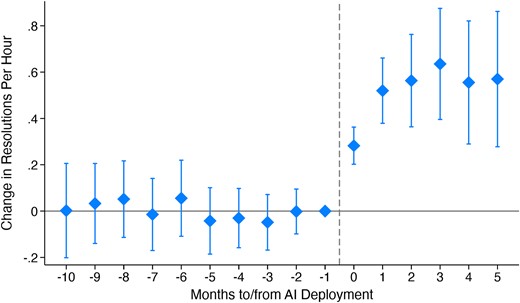
Great to see "Generative AI at Work", my paper with @LindseyRRaymond and @Danielle__Li, published in the @QJEHarvard.
We find that the AI makes customer support agents 14% more productive, improves customer satisfaction and reduces employee turnover.
🚨BREAKING. From a program officer at the National Science Foundation, a list of keywords that can cause a grant to be pulled. I will be sharing screenshots of these keywords along with a decision tree. Please share widely. This is a crisis for academic freedom & science.
1/ Breaking: South Korea's prime minister Han Duck-soo and ruling party leader Han Dong-hoon announce President Yoon will cease involvement in state affairs, call for his "orderly early resignation" following failed martial law attempt. https://t.co/HGv4hXrYwA
I'm a South Korean journalist based in New York City. This is a thread about what's happening in South Korea right now after the president declared emergency martial law.
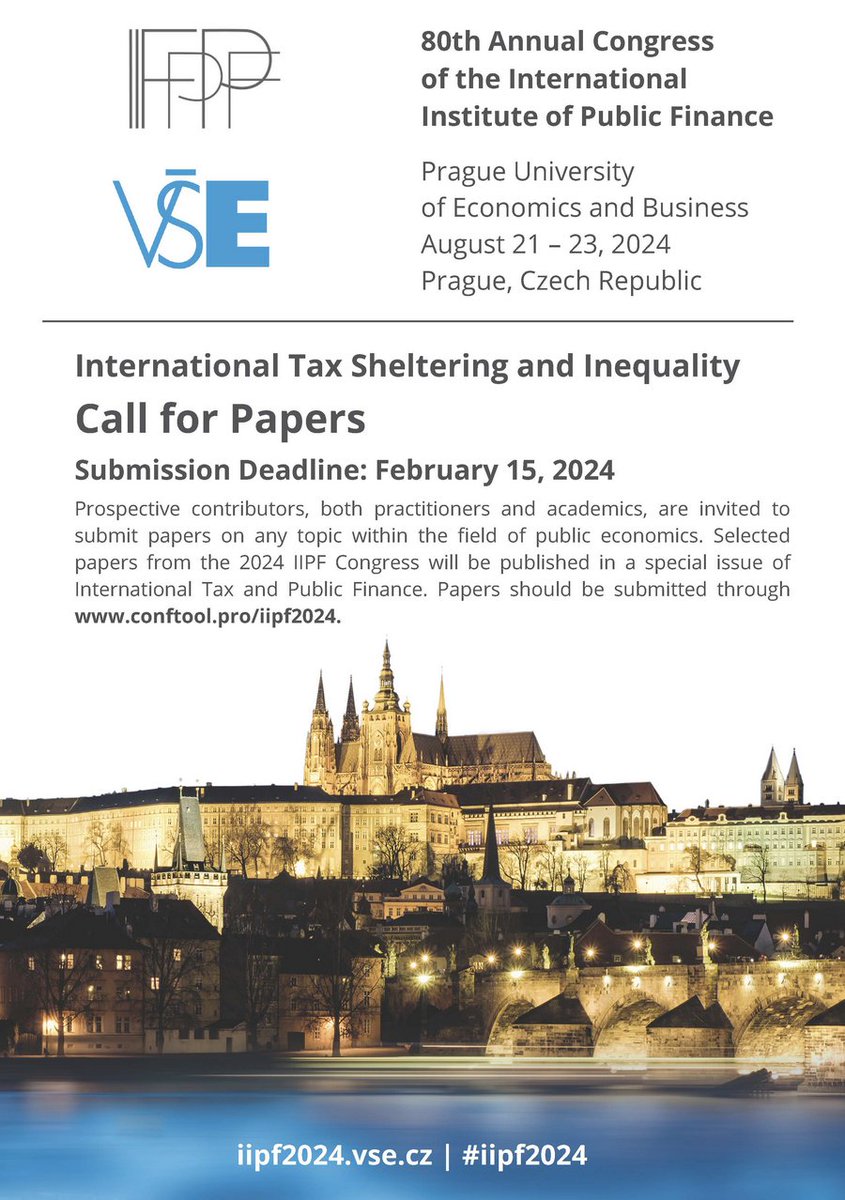
Call for Papers: the next @IIPF_org conference will be in Prague (Aug 21-23).
Travel grants for authors from low- or middle-income countries are available!
Papers on any topic in public economics welcome. Application deadline is Feb 15th.
Apply here: https://t.co/12KE30kwMu
CALL FOR PAPERS—Conference & Special Issue of the ILR Review Artificial Intelligence & the Future of Work
ILR School, Cornell University September 12–13, 2024
Deadline for submission (~1,000 word abstract) is March 15, 2024.
https://t.co/8TrctGgb1r
An amazing opportunity for junior researchers to get constructive feedback on their work in the topics of economics of the household, gender economics, labour economic, public economics, demography, and health economics👇 @ifo_Institut@RoyalEconSoc
https://t.co/GzEopoYYrx
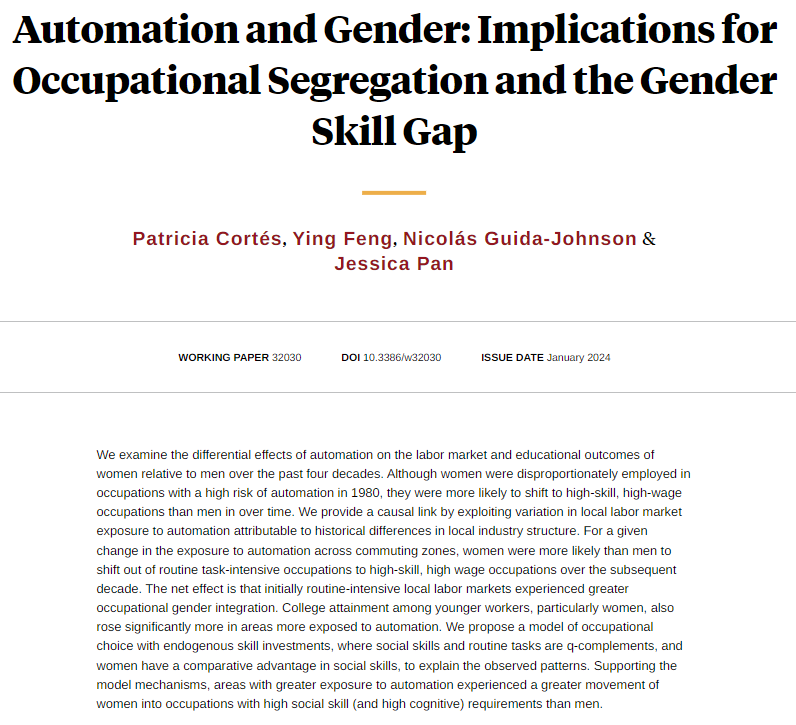
Automation led to occupational integration and increased women’s relative college rates. A model in which women have greater social skills and lower college costs fits the findings, from @cortespatico, @YingFeng_Econ, Nicolás Guida-Johnson, and Jessica Pan https://t.co/PfpJQUWehC