O noso Dr. do Dépor, bórdao! 🩺🥼
👉 Súmate a este agradecemento que están facendo os nosos compañeiros de ABANCA Seguros e regálalle unha bata cunha mensaxe personalizada ao teu médico ou médica.
ℹ️ Infórmate en https://t.co/e4RSCsmC4t
#ABANCASeguros#Salud #ABANCASegurosLoborda
🆕“Readiness to RTP needs to be assessed with a more significant number & higher specificity of tests during the rehab of an intramuscular tendon than a myotendinous junction hamstring injury ⚽️”
👉@paolop_physio@MarcoBeato1 et al. 2026 🇮🇹
📂Open Access: https://t.co/3KrIXm1fsJ
Stop underloading your hamstrings in the gym, the Romanian Deadlift (RDL) crushes sprint-level demands.
New BJSM study (2026) used MRI + EMG + 3D motion capture + musculoskeletal modelling to measure actual muscle force & stretch in the hamstrings (BFlh, semimembranosus, semitendinosus) during common exercises vs. walking → jogging → running → max sprinting.
Key findings:
Bilateral RDL produced the highest peak force in biceps femoris long head (1.6 BW) and semimembranosus (1.9 BW) — significantly more than any other exercise or even max sprinting (p<0.001). It also created the greatest stretch.
Unilateral hamstring bridge came close behind for high force + stretch.
NHE (Nordic) and eccentric sliders: solid force (~0.9 BW in BFlh, similar to sprint) but much lower stretch.
Hip thrust: lower force & stretch than walking — great for early rehab.
"The RDL and unilateral hamstring bridge produced significantly greater peak stretch than any other task across all three hamstring muscles.
The Nordic, often considered the eccentric gold standard, generated lower stretch demands than most other exercises. The eccentric slider was similarly modest."
https://t.co/cHF5bfq22h
Practical takeaway for coaches/athletes: RDL is a beast for building resilience against high-load, high-stretch scenarios (like late swing in sprinting). Use it in later rehab or prevention phases. Match exercise to running speed demands: low-stretch options early, progress to RDL for full specificity.
Link: https://t.co/pHbPgj7zOk
Injury mitigation cannot be owned by rehabilitation specialists alone, and it cannot be owned by medical doctors alone.
That is not a critique of either discipline. It is a recognition that injuries do not emerge from one isolated variable, and they are not solved by one isolated profession.
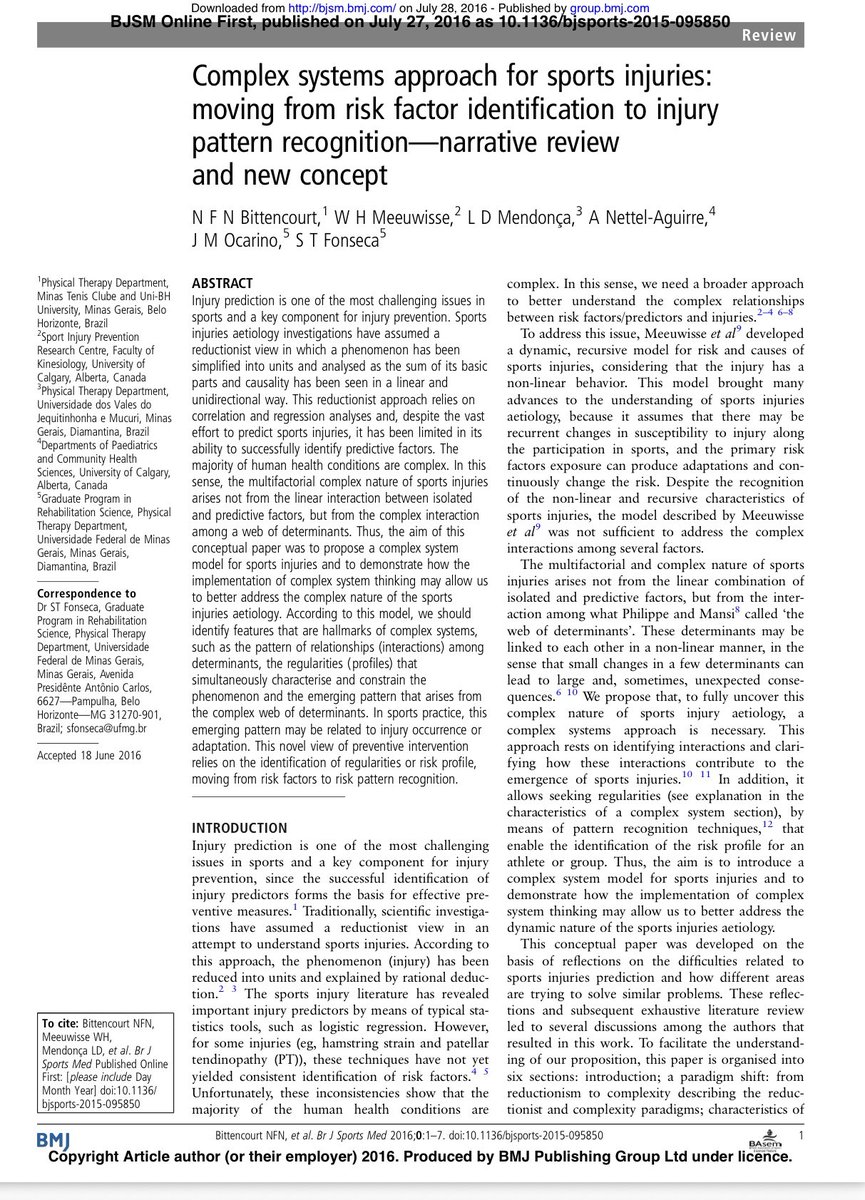
Bittencourt et al. describe sports injuries as complex emergent phenomena that arise from interactions across a web of determinants, including biomechanical, physiological, psychological, behavioral, training, and contextual factors.
That matters for Human Performance.
If injury risk emerges from an interacting system, then injury mitigation requires an integrated team. Rehab matters. Medicine matters. Strength and conditioning matters. Nutrition matters. Psychology matters. Coaching matters. Preparation matters.
The vulnerability comes when organizations assign injury mitigation only to the people who manage the injury after it occurs, while failing to integrate the disciplines that influence the conditions that made the injury more likely.
Bittencourt et al. argue that prevention must move from isolated risk factor identification toward risk profile and injury pattern recognition. In other words, the question is not only, “What is injured?” The better question is, “What pattern allowed this risk to emerge?”
That is where readiness lives.
Readiness is not just the absence of pain, pathology, or injury. It is the ability to prepare, tolerate, recover, adapt, and perform under demand.
That is the difference between treating injuries and protecting readiness.
Here, advanced footwear technology combining polyether block amide (PEBA) foam with a carbon-fiber plate improved running economy in recreational runners without increasing biomechanical variables that have been previously associated with running-related injuries.