Stanford + Together AI just made text generation 31× faster than the best diffusion LMs.
every frontier model today writes the same way: next token, left to right, one at a time. accurate, but serial and slow.
diffusion LMs tried to fix it by generating everything at once and denoising over and over. but quality falls apart when you cut steps, every step touches the full sequence, and training needs many passes over the data.
Next-Concept Modeling (NCM) takes a third path: coarse to fine.
a multiscale residual VQ-VAE encodes text into a hierarchy of discrete codes. early levels are short, a few codes holding the rough "concept" of the sequence. later levels add detail.
a transformer then generates one level at a time, predicting every code in that level in parallel. one forward pass per level, and the early levels are tiny, so they're nearly free.
the results (wall-clock on a single H100):
• LM1B: better gen perplexity than the strongest DLM, 21× faster
• OpenWebText: competitive, 10× faster
• XSum: matches the best DLM's ROUGE-L, 31× faster
• Sudoku: beats both autoregressive and diffusion baselines at every difficulty, with fewer function evals
• ~4–5× fewer training tokens than diffusion baselines
it sketches the whole thought first, then fills in the words.
papers:
- https://t.co/0egEdC1u5F
- https://t.co/sPeV2841io
- https://t.co/9gUhNC0UCd
how X ranks your posts (breakdown of the new algo update)
the X algo predicts how each person will react to your post, and that then decides if and where it shows up in their feed
here's how much each reaction counts, compared with a like:
> someone copies the link: 30x
> someone you follow back replies: 30x
> a reply, a quote or a DM share: 7.6x
> a follow from the post: 6x
> a repost: 1.5x
> a like: 1x
> a bookmark: 0
the negative actions weigh far more, a report is -355x a like, a mute -89x, "not interested" -79x and a block -47x
if X predicts someone is likely to mute or report your post, it ranks lower in their feed
reports get a big weight because they are rare, a report is over 1,000x less likely than a like
these rules decide how far a post can reach:
> if you have 50,000 followers or fewer, X can boost a new original post up to about 16th place in someone's feed
> the boost only works in the post's first 2 hours, and stops once the post has 200 views in the Home feed
> X boosts one post each time a feed loads, and it prefers posts that got the most likes per view from their first viewers
> after 48 hours, X stops putting your post in people's feeds
> your replies and reposts only show up in the feeds of people who follow you
> original posts can also reach people who don't follow you, X scores them 25% lower for those people
> when several of your posts compete for one person's feed, the 2nd keeps 62.5% of its score and the 3rd keeps 43.75%
> replies, quotes, DM shares and copied links only count when people find your post in their feed, so engagement from a group chat link adds nothing
> if X labels your post low quality, it shows a notice on it and people can't like, reply, repost, bookmark or share it, misinformation labels can limit it too
what I'd do with it (my read of the weights):
> post when you can reply in the first 2 hours
> write posts people want to quote, reply to or send in a DM
> reply back to accounts that follow you
> post originals when you want to reach new people
With the growing and imminent thread of AI and cyber security concerns i see only a future where users are forced to utilise encrypted forms of compute and WEB4 utilisation.
PHP//NULL is the start of this ear and a small look into what the near future could become.
1/ PHP//NULL ($PHP) ; The authentic reconstruction of PHP execution.
With the recent PHP vulnerabilities coming to light, I've developed my own experimental solution to address the underlying architectural weaknesses.
[ SYSTEM // 0x618 ]
Following the disclosure of CVE-2026-109618 and CVE-2026-109619, I began researching how memory-management failures within PHP's execution environment could potentially be addressed at a more fundamental level.
Rather than simply patching individual vulnerabilities, I wanted to explore whether PHP applications could run without depending on the original PHP execution engine.
This led me to develop the concept behind PROTOCOL 0x618.
I've published the project, its architecture, and the research behind it below.
Website: https://t.co/BPtRdq91Og
Compute costs on this project run high so i have tokenised the project and encrypted the wallet to operate off fees to generate compute.
CA: 7BZqbAWt4mSfm9xDeZ3VaRkbhzD7g17mSfBbz87hpump
A breakdown of how it works ↓
6/ WHAT'S NEXT
My goal with PHP//NULL is to explore whether legacy execution environments can be reconstructed around stronger security guarantees rather than continually inheriting the same architectural risks.
There's still a significant amount of engineering and validation required.
But I believe it's an interesting direction for future research.
PHP//NULL — PROTOCOL 0x618
ISOLATE THE WEB. NOT THE USER.
https://t.co/KHbYsGjxOV
5/ THE RESEARCH
I've documented the proposed PHP//NULL architecture on the website.
This includes:
→ Runtime reconstruction
→ Memory-isolation models
→ State-transition equations
→ Code examples and execution pipelines
→ Compatibility challenges and verification methods
The underlying architecture is still experimental. Full PHP compatibility and security guarantees would require implementation, testing and independent verification.
I wanted to make the research accessible so others could examine the ideas and follow the development.
https://t.co/Ub931c4zeB
this is genuinely one of the cleanest splat demos I've seen... insane work
curious how you're handling the scene swaps. are both splat sets resident in GPU memory during the portal, or are you streaming + LOD-culling the next world? and is the depth sort a full GPU radix sort per frame or something incremental?
Introducing SKY-001, the first Engineering World Model.
On CAD and BIM tasks, it beats GPT-6 Astra and every frontier model we tested:
-> 51-125x faster
- > 150-210x cheaper
-> Higher IOU than all frontier models
SKY-001 lets you dream a physical object before you build it.
18 months of work. Built by the team out of Maluuba's deep learning lab (acq. by @MSRResearch).
The first ‘AI General Engineer’ will be the backbone for Autonomous Manufacturing.
This is awesome... curious what the generation stack looked like. I've been experimenting with the Gemini 4 Model abit myself.
was this a single long-context prompt, or a shot-level pipeline with reference frames / character sheets for identity lock?
also did you condition on brand assets (type, UI mock, product stills) via image refs, or was the iMessage UI pure text-to-video with no controlnet / IP-adapter style anchors?
yeah the compute threshold is real. but the bottleneck for most labs isn't "can we afford a 1T MoE run", it's that the training stack for agentic RL at that scale doesn't exist in a form they can even try
prime-rl + verifiers + 365k tasks is the missing layer. once the stack is open, the people who can rent the GPUs stop reinventing harnesses and start competing on algorithms
reproducibility at the infra layer is what unlocks the next wave of papers. the FLOPs stay expensive either way
I don't think people understand what Prime Intellect is building and once you actually look into it... its quite amazing
they're shipping the full open stack for agentic RL, piece by piece:
→ prime-rl: RL at 1T-param MoE scale on agentic coding tasks, 131k context, <5 min step time
→ verifiers v1: RL environments split into taskset × harness × runtime, so every piece is swappable
→ 365k+ agentic RL tasks
→ Prime Agent: an open, self-modifying harness
and then they point it at itself. 2,000+ agents, 10k+ sandboxes, 200B+ tokens rewrote Prime Agent in Rust. ~13× faster to usable input, 83% less startup memory
environments → RL → harness → agents improving the harness. that loop is the whole game, and it's being built in the open
the frontier labs have this internally. Prime is giving it to everyone
Over two weeks, Prime Agent orchestrated a swarm of over 2,000 agents to rewrite itself in Rust.
With 10,000+ sandboxes, 200B+ GLM-5.3 tokens, and 16,000 agent-to-agent messages, this was our largest test yet of Prime Agent’s multi-agent capabilities and our infrastructure powering these agent swarms.
Prime Agent now reaches usable input ~13× faster and uses 83% less startup memory than before.
Prime Agent is a general-purpose coding harness
On ARC-AGI-3, it scores 95.5%, surpassing the human-expert baseline, but the gain is not benchmark-specific.
We see major improvements across models when compared to their proprietary harnesses:
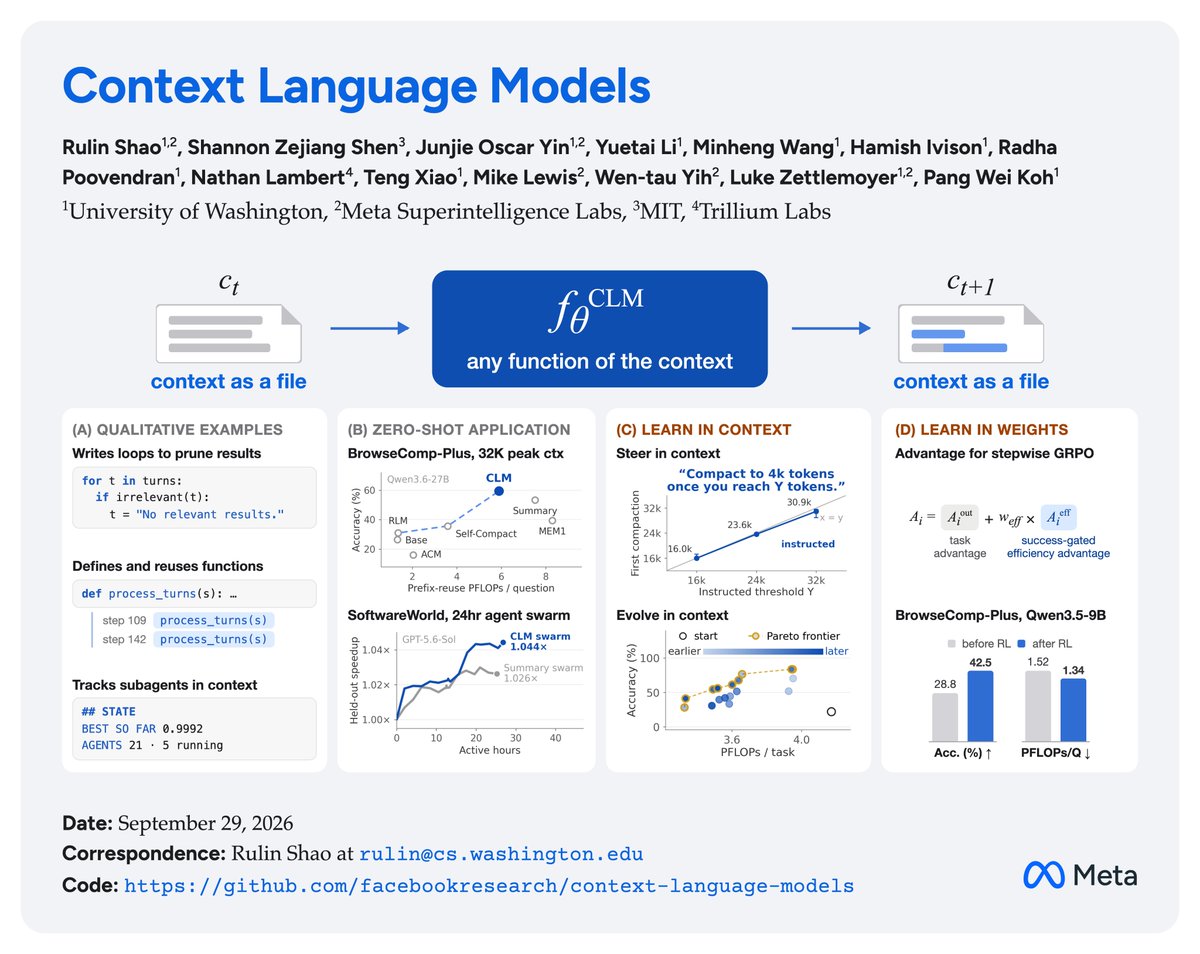
few thoughts on CLMs (context as a file + the model gets write access):
formally c_{t+1} = f_θ(c_t) instead of c_{t+1} = c_t ⊕ f_θ(c_t). append-only is one point in function space, and it isn't the best one the real cost is KV.
editing the prefix kills cache hits, so the Suffix Cache Reuse co-design (-35% server compute vs SGLang at matched perf) matters as much as the accuracy numbers.
this is the same primitive autonomous onchain agents need: long horizons, bounded context, state they can't afford to drop
https://t.co/AZYHzGyxDG
‼️The Bitter Lesson for context management: Giving LMs unrestricted control over their context beats human-designed SOTA!
Introducing 🩵Context Language Models (CLMs)🩵
- Natively manage their own context
- Treat context as a file
- Learn policies in CLM weights, no harness