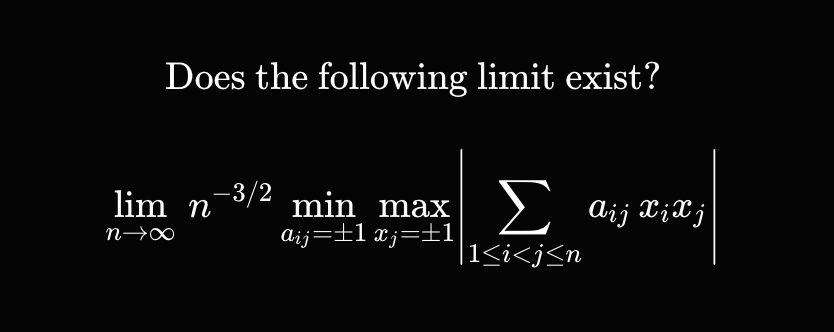
Okay, here is a problem for testing AI. You do not need to know any abstract mathematics to understand the statement, only how to add and multiply 1’s and -1’s.
I am offering a monetary prize for a correct solution, paid via X Money on X. I will also check the proof myself and retweet it. If the solution truly impresses me, I am happy to increase the prize.
The question arose almost accidentally while I was working on something else. I remember spending around five hours thinking about it without finding a solution. It is also one of my least-upvoted questions on:
https://t.co/HNy06Awdbk
It appeared before AI became good at mathematics, so this is a fair challenge: can AI beat roughly five hours of human work?
The rule is simple: the solution (share the full AI transcript) must be purely AI-generated, with no substantial mathematical hints from a human.
Usually I have a very vague idea of what Fields Medallists worked on. But this time, out of the four, I (sort of) understand the work of two out of four, namely: the Kakeya conjecture, and o-minimal systems. 1/n
AI 2040 has been released! What a day.
AI 2027 was probably the most forward-looking blog about the future, and much of it has come to pass with remarkably accurate timing.
Alongside Aschenbrenner’s “Situational Awareness,” it is probably the most important blog for theoretically preparing ourselves for the future. That makes me all the more excited about AI 2040! I’m going to read it immediately, and I can only recommend that you do the same.
🚨 We just used AI to solve a 35-year-old open math problem!
In queuing theory, BAR is the "master equation" for finding networks reach a equilibrium. However, a core uniqueness conjecture about BAR remain open
Here is how human + AI cracked the case👇1/7 https://t.co/YPf3hghyT7
@aravind Your spiritual argument is ridiculous.
If everything is conscious, nothing is conscious.
If everything can be made conscious, nothing can be made conscious.
False unification.
@aravind To add, AI would never in it's most distant future understand or author the Vedas from itself. It WILL NEVER write any shlokas. If it does, it will be defined conscious because it now has a way to attain Moksha from Maya.
@aravind Consciousness cannot exist beyond Human body. This is a loud declaration of scriptures.
And, consciousness is meant only to attain God. Your views are materialistic for the same. AI isn't meant to attain moksha by nature. Closed.
There is another way of using LLMs for pushing math boundaries. Instead of asking them to solve open problems, we can ask them to solve known problems by techniques from other fields or by totally elementary means.
changing your mind in the middle of voice prompting gives the model so much more context
like 70% of my prompts i say "actually ignore everything before this" but it gives so much information when i imagined one thing but then decided on something else
aim for MAX tokens
STOP HOLDING BACK WHEN PROMPTING you can literally one shot whatever feature in one prompt just yap for longer. aim to describe every thing you can possibly imagine in ONE prompt
and obviously use voice. i often talk for 15minutes straight
Final version of my book (with a new title)
Online Learning: A Modern Introduction Using
Convex Optimization
Especially proud of the Foreword by @NicoloCB!
It'll be printed by Cambridge University Press.
The end of 7 years of updates :)
https://t.co/NeqTSih2ra
I solved an open problem in optimization with ChatGPT Pro.
Consider min-max problems, where we have to minimize with respect to some variable and maximize with respect to other variables to find a saddle-point.
One of my open math problems apparently got resolved by ChatGPT 5.5 Pro (Ryan O'Donnell prompted it better than I did!), though the proof was so hard for me to read that it seemed easier to just prove it myself. More thoughts on implications for math here: https://t.co/8NGs5sVzzn